Pure C++ AI Voice Assistant Built from Scratch: Offline, Sub-Second Launch, No Python Required

A 19-year-old Indian developer built an offline voice assistant in pure C++, challenging Python solutions with performance advantages.
A 19-year-old Indian developer wrote FRIDAY STARK OS, a 15,000+ line voice assistant in pure C++17/20, with sub-second startup, reportedly 10x less memory than Python alternatives, and fully offline operation with local STT/TTS. It supports voice interaction, text chat, and PC automation on Windows, uses a $50 one-time license, and highlights both the performance edge of system-level languages for AI assistants and the practical challenges of model integration and iteration speed.
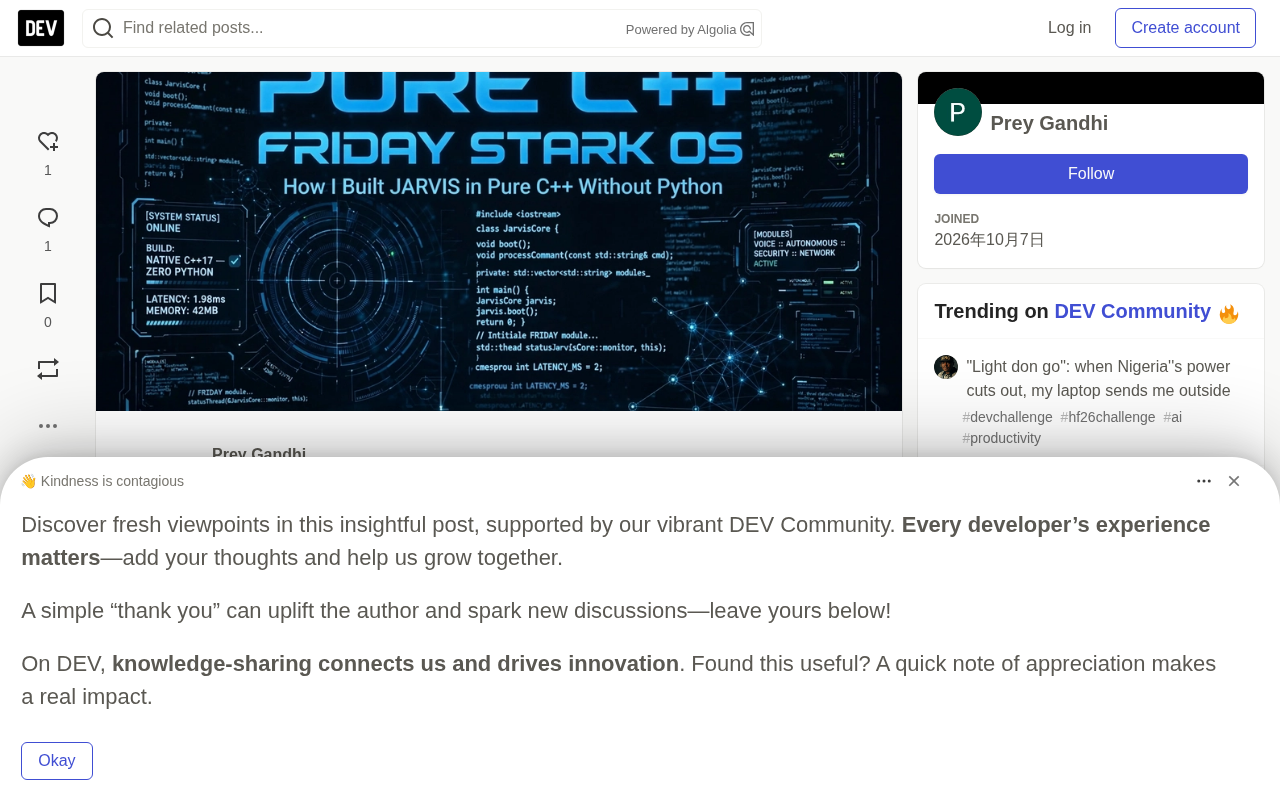
While most AI assistant developers default to Python as their tech stack, a 19-year-old developer from India went the opposite direction, building a voice assistant system called FRIDAY STARK OS entirely in pure C++. The project doesn't just stand in stark contrast to Python solutions on performance metrics — it also takes a fully offline architectural approach.
Why Not Python? The Performance Gap Is the Core Driver
Python's dominance in AI is undeniable — from PyTorch to LangChain, the mainstream toolchain is almost entirely built around Python. But this developer points out an often-overlooked problem: when an AI assistant needs to run as a resident desktop application, Python's runtime overhead and startup latency directly impact the user experience.
According to the project author, FRIDAY STARK OS launches in under 1 second, while comparable Python solutions typically take 5 to 6 seconds. On memory usage, the C++ version reportedly uses 10x less RAM than Python alternatives. The practical significance of these numbers: they allow the AI assistant to run on older laptops, rather than requiring users to have high-spec hardware.
From a technical standpoint, Python's startup latency mainly comes from interpreter initialization, dependency imports (especially heavy libraries like numpy and torch), and virtual environment loading. A compiled C++ binary, by contrast, maps directly into memory for execution, with cold start time essentially limited to loading dynamic link libraries.
Python's startup latency isn't caused by a single factor — it's the accumulation of multiple stages. First is the interpreter's own initialization: CPython needs to set up the bytecode execution environment, load built-in modules, and configure path search rules at startup. Second is dependency imports — libraries like numpy and torch execute massive C extension initialization, memory allocation, and symbol binding during the import phase, and some frameworks even preload operator libraries or check hardware backends at import time, with a single import potentially consuming hundreds of milliseconds to several seconds. Virtual environments isolate dependencies but also add path resolution and site-packages scanning overhead. In contrast, once a C++ program is compiled to machine code, the OS simply maps libraries via the dynamic linker and jumps to the entry point for execution, with no interpreter layer or runtime reflection overhead. Cold start time typically depends only on binary size and the number of dynamic libraries, making sub-second startup an engineering-expected result.
Fully Offline Architecture: Data Never Leaves the Machine
Another core selling point of FRIDAY STARK OS is 100% offline operation. The project integrates local speech recognition (STT) and speech synthesis (TTS) engines, requiring no calls to OpenAI or other cloud APIs after installation.
This design choice carries two implications. For users, privacy is fundamentally guaranteed — voice commands, conversation logs, and PC automation operation logs all stay local. For developers, it means solving model deployment themselves, including embedding speech recognition models, integrating inference engines, and performance optimization.
The author explicitly states "this is not a wrapper," but a complete system built from over 15,000 lines of pure C++ code. Features cover voice interaction, text chat, and PC automation operations, positioned close to the JARVIS experience from Iron Man.
It's worth noting that the original material doesn't provide detailed data on the specific offline STT/TTS implementation approach or recognition accuracy.
Offline speech recognition (STT) and speech synthesis (TTS) typically rely on two categories of local models: one is traditional signal processing and statistical models, such as small acoustic models based on HMM or CTC paired with n-gram language models — small in size, low in latency, but limited in accuracy; the other is end-to-end neural network models like the Whisper series, Vosk, Coqui TTS, etc., which offer higher recognition quality but require embedding model weights and inference engines into the application. In a pure C++ environment, common practice is integrating inference backends like ONNX Runtime, whisper.cpp, or TensorFlow Lite, converting models to ONNX or GGUF formats for loading — this avoids depending on the Python runtime, but at the cost of handling tensor memory management, thread scheduling, and audio front-end processing (denoising, framing, VAD) yourself. The actual accuracy of offline solutions depends heavily on model size and microphone quality; recognition rates in far-field or noisy environments are typically lower than cloud-based large models — a trade-off that must be accepted when choosing the offline route.
Tech Stack and Commercialization Attempt
The project's tech stack includes C++17/20 standards, native Windows development, and no dependency on OpenAI services after installation. The author claims it runs smoothly even on old laptops, indicating low hardware requirements.
On the commercialization side, the author adopted a one-time purchase model at $50 for a lifetime license, rather than a subscription. He mentions he initially developed it for himself, then 20 friends wanted to use it, so he decided to open up licensing. The source code is hosted on GitHub, with transactions completed through Dodo Payments via a Sponsor button.
The developer says he's 19 years old, from Surat, India, self-taught in programming, and spent 6 months in Navsari completing FRIDAY STARK OS v14.9.
Real-World Challenges of Building an AI Assistant in Pure C++
Building an AI assistant in C++ isn't without costs. The rich ecosystem of pre-trained models, inference frameworks, and rapid prototyping capabilities in Python requires extensive manual integration work in C++. Developers need to handle model format conversion, inference engine bindings (like ONNX Runtime, llama.cpp, etc.), and cross-platform compatibility themselves.
Moreover, pure C++ solutions are inherently slower to iterate than Python. When you need to swap speech models or adjust the NLP pipeline, the compile-test cycle is more costly.
The original material doesn't disclose the specific STT/TTS engine choices, whether a large language model is integrated, or how PC automation is implemented. These missing technical details make it difficult for outside developers to assess the project's reusability.
Integrating inference engines in C++ — the core difficulty isn't in calling APIs, but in connecting models with the runtime. Taking ONNX Runtime as an example, developers first need to use Python toolchains to export PyTorch or TensorFlow models to ONNX format, handling operator compatibility and dynamic dimension issues, then configure execution providers (like CPU, DirectML, CUDA) via Session Options on the C++ side, manually managing the memory layout and lifecycle of input/output tensors. If using llama.cpp, it involves choosing GGUF quantization formats, configuring context windows, and managing KV Cache. On cross-platform: native Windows development can call Win32 APIs and COM components, but migrating to Linux or macOS requires rewriting audio capture, window management, and hotkey listening modules. Additionally, C++ lacks Python's interactive debugging experience — when model behavior goes wrong, the troubleshooting chain is longer, and the compile-test cycle is typically measured in minutes, significantly slowing iteration pace.
Lessons for Small Teams and Independent Developers
The FRIDAY STARK OS case shows that at the AI application layer, performance-sensitive scenarios still have room for rewriting in system-level languages. Especially for desktop resident assistants, embedded AI, edge devices, and other scenarios sensitive to startup speed and memory usage, C++ or Rust solutions have competitive advantages that shouldn't be ignored.
Another signal worth noting is the commercialization potential of offline AI. As users become increasingly sensitive to data privacy, "data never leaves the machine" is becoming a differentiating selling point that some users are willing to pay for. The $50 one-time purchase pricing strategy also caters to those who dislike subscriptions.
The project's ultimate value still depends on community feedback and subsequent iterations. The author actively asks at the end of the post "what feature would make you willing to buy," indicating the product is still in the early stages of finding product-market fit.
Desktop resident assistants, embedded AI, and edge devices are resource-sensitive because hardware budgets and power budgets in these scenarios are often strictly limited. Desktop assistants need to stay in the background long-term, and memory usage directly affects how many other applications users can run simultaneously; embedded devices typically have only a few hundred MB to a few GB of memory, with limited CPU compute, unable to bear the overhead of Python interpreters and large dependency libraries; edge devices often require offline operation to meet latency and privacy requirements. In these scenarios, rewriting the inference pipeline in C++ or Rust can minimize runtime dependencies while leveraging compile-time optimization and manual memory management for more stable latency performance. However, this path suits developers with clear quantitative performance goals and system-level programming capabilities — otherwise, the lack of ecosystem tools and debugging costs may offset the performance gains.
One-line Summary
A 19-year-old Indian developer built an offline voice assistant in pure C++, challenging Python solutions with performance advantages.
Paragraph Summary
A 19-year-old Indian developer wrote FRIDAY STARK OS, a 15,000+ line voice assistant in pure C++17/20, with sub-second startup, reportedly 10x less memory usage than Python alternatives, and fully offline operation integrating local STT/TTS without calling OpenAI or other cloud APIs. The system supports voice interaction, text chat, and PC automation, runs natively on Windows, works smoothly on old laptops, and uses a $50 one-time purchase license. The article analyzes why Python's runtime overhead causes startup latency, points out the practical challenges of C++ solutions in model integration, iteration speed, and ecosystem tools, and argues there's commercial space for rewriting performance-sensitive desktop assistants and privacy-sensitive offline AI in system-level languages.
Related articles

Penguin Moves Up Publication of 'Smarter Than Us': An AI Risk Guide for General Readers
Penguin moves up publication of 'Smarter Than Us,' an AI guide co-written with Patchen Barss that explains how AI works and lays out its many risks for non-technical readers.

From Photons to Production: An Open-Source Computer Vision Engineering Reading Path
Reddit user open-sources a computer vision engineering reading path with 16 chapters from image formation to production deployment, emphasizing primary sources, dependency order, and reproducible benchmarks to help engineers understand why models fail and build reliable vision systems.

Prompt Failures? The Truth About Why AI Agents Struggle in Production—and How to Fix It
A Reddit developer built Agents with Copilot and Gemini but faced unstable behavior. This article analyzes three gaps in prompt engineering for Agent scenarios and offers three practical paths to reliable Agent deployment, including structured prompts, workflow-first approaches, and building an evaluation loop.