PyAgent's Minimalist Design Philosophy: The Scalable Path for AI Coding Agents

PyAgent carves out differentiated competitiveness in the AI coding agent arena through a minimalist core plus on-demand extension Harness approach.
PyAgent is an open-source AI coding agent project that, unlike tools like Codex, Claude Code, and Cursor that chase feature completeness, compresses its core to the extreme—keeping only the agent loop as the main line—and implements everything else through plugins and external extensions. Its GitHub Stars show multi-phase sustained growth rather than a single viral spike, indicating it hits the real developer need for a lightweight agent. Minimalism doesn't mean weakness; complex capabilities move from the core to extensible layers, with developers retaining autonomy over tools, plugins, event flows, and safety approval rules.
The AI coding agent arena is getting crowded, with tools like Codex, Claude Code, and Cursor each showing off their own strengths. But an open-source project called PyAgent has taken a completely different path—instead of chasing feature completeness, it strips its core down to the absolute minimum and hands extensibility over to developers. This "going against the grain" approach deserves serious scrutiny from anyone following AI agents.
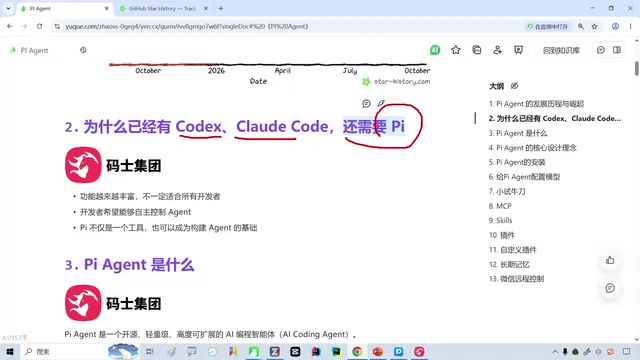
Why does fewer features mean more attention?
According to an analysis by a Bilibili creator, looking at the historical GitHub Star trends, PyAgent's growth wasn't a single viral spike but rather multiple phases from early accumulation to sustained climb, and it's still in an accelerating range recently. This sustained growth shows it has hit on a real developer need.
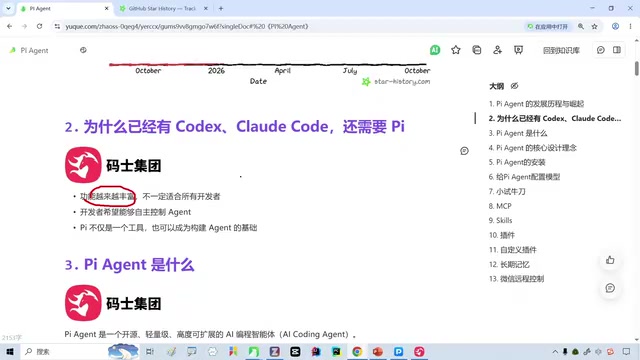
An interesting comparison: mature AI coding tools like Codex and Claude Code have very high feature integration, with tool calling, MCP, Skills, task planning, context management, sandboxing, and more all present. Feature richness is of course useful, but the accompanying problems are ever-growing context, slower request speeds, and an increasingly heavy interaction chain.
For many developers, what they really need is just a lightweight agent—one that can call large models, read files, modify code, and execute commands. That's enough. PyAgent's judgment is: do the foundational capabilities everyone needs well, and extend everything else on demand. This is exactly the embodiment of the Harness philosophy—the core is simple, stable, and reliable enough, while complex capabilities are layered on through external mechanisms.
The Harness philosophy originates from the "test harness" concept in software engineering: it refers to a thin, stable layer of runtime infrastructure that drives core logic and provides pluggable hooks, without hardcoding business details inside. In the AI agent space, a Harness typically handles shared responsibilities like model invocation, tool routing, loop scheduling, and state recording, and developers only need to register tools or middleware externally to extend capabilities. Its value lies in: the core layer keeps interfaces stable, making it easy to test and swap models; the extension layer enables rapid experimentation without polluting the trunk. PyAgent treats the "agent loop" as the main axis of its Harness, which is a typical application of this idea—the core only drives, complex logic is attached externally, achieving a balance between feature bloat and controllability.
A minimalist core doesn't mean weak functionality
PyAgent's core capabilities are compressed into a very small set of basic tools, but the creator specifically emphasizes one point: minimalism doesn't mean weak functionality—it means moving complex things out of the core into external extensible capabilities.
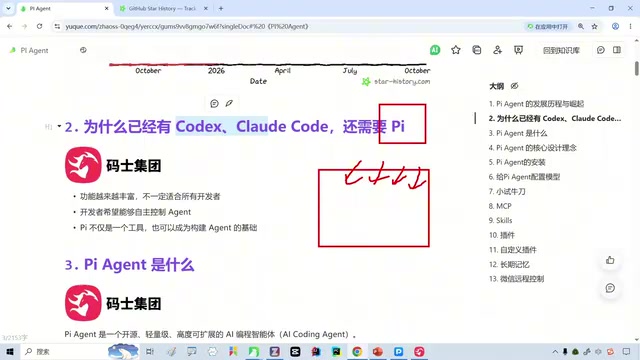
How to understand this? If you want the agent to query a database, extend it with database-related tools; if you want it to call enterprise APIs, extend it with API-calling capabilities. The core keeps only the agent loop as the main line: user gives a task → large model reasons → decides whether to call a tool → tool executes and returns results → model continues reasoning. Get this loop right, and everything else can be attached externally.
Judging from the sustained growth in Star trends, this design approach has won developer recognition. It proves one thing: in an era where AI tool competitors are piling on features, subtraction is also a competitive advantage.
Agent loop is the minimal closed loop for agent operation: receive user task → construct prompt and call large model → parse tool-calling intent from model output → execute tool and feed results back → call model again, until the model gives a final answer or a termination condition is reached. Its key design points include: loop termination conditions (max rounds, task completion signals), message format for tool results, error retry and timeout handling, and context trimming strategies. PyAgent treats this loop as an irreplaceable core, meaning all extended tools only need to follow a unified calling convention to be scheduled by the loop; while strategies like context management and approval can be attached to loop hooks without modifying the loop itself. Understanding this makes it clear why a "small core" actually makes behavior easier to predict.
Developer autonomy: returning rule-making power to you
PyAgent's second design focus is developer control over the agent. When using mature tools like Codex, you must follow its preset extension methods and interaction rules; PyAgent emphasizes that you can write your own plugins, customize tools, and even customize commands to handle events and workflows, without relying on product-preset capabilities.
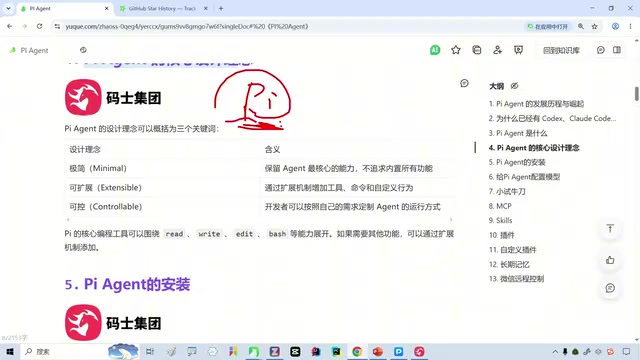
This autonomy is also reflected in behavioral constraints. For example, you can require the agent to get user confirmation before modifying important configuration files, or add extra checks before executing dangerous operations like deletion. According to the creator, these approval and safety rules are not in PyAgent's minimalist core and need to be implemented by developers through extension mechanisms—which exactly echoes the overall philosophy of "extend on demand, stay in control."
MCP (Model Context Protocol) is an open protocol for letting AI applications connect to external data sources and tool services in a standardized way. It decouples "tool/resource providers" from "model hosts": providers implement an MCP Server that declares available tools, resources, and prompt templates; hosts (like coding agents) discover and invoke these capabilities through an MCP Client, without needing to write integration code for each tool separately. For a minimalist core like PyAgent, MCP is a natural extension channel—the core only needs to implement an MCP client, and capabilities like databases, enterprise APIs, and file systems can all be connected through independent Servers. Understanding MCP helps grasp the boundary division of "stable core, attached capabilities": the protocol handles discovery and invocation, while security approvals and business rules are still implemented by developers on the host side.
Implications for developers
PyAgent's rise offers a unique perspective on the evolution of AI agents. While mainstream products engage in an arms race on feature lists, PyAgent chooses to provide a sufficiently simple core, clear extension boundaries, and complete control. It doesn't chase feature quantity but positions itself as a lightweight, customizable DIY agent foundation.
For developers, this means lower learning costs and greater customization space. You can build agents on top of it that fit your own workflow, without having to accommodate some product's preset rules. Of course, this also requires developers to have a clear judgment of their own needs—extensibility is freedom, but it also means responsibility.
The creator's tutorial lays out a complete path from installation and configuration, MCP protocol, Skill encapsulation, to long-term memory, and finally WeChat remote control. Interested readers can follow this thread into hands-on practice and personally verify how the "minimalist core + on-demand extension" approach works in practice.
Related articles
 Tech Frontiers
Google Omni 1.2 Flash: 15-Second AI Video at Just $0.07 per Second
Google DeepMind releases Gemini Omni 1.2 Flash: 15-second video, 720p at $0.07/sec (30% cheaper), multi-turn editing without regeneration, draft upscaling to 4K.
 Tech Frontiers
No AI Ghostwriting: Writer's Quarter Reinvents Novel Writing with a Visual Workbench
The Writer's Quarter is an AI-free novel writing and planning tool that unifies character building, story planning, and manuscript writing in one visual workbench. This article analyzes its positioning, target users, and differentiated value amid the rise of AI writing tools.
 Tech Frontiers
Fleeep: A Unified Inspiration Collection Notes App for Creatives
Fleeep is a notes app for creatives that unifies screenshots, bookmarks, saved posts, and inspiration into one calm, cross-device, offline-capable space. This article analyzes its positioning, differentiation, and target users.