Python + AI Reverse Engineering from Zero: A Full Breakdown of Bilibili's 300-Episode Course

Bilibili's 300-episode Python + AI course integrates scraping and JS reverse engineering; practice-oriented but requires compliance and persistence.
This Bilibili course markets itself as "Python + AI from zero," linking Python syntax, scraping principles, JS encryption reverse engineering, AI-assisted unpacking, and LLM reverse engineering implementation into a progressive path. The article breaks down its structure and a hands-on case of locating a `sign` encryption parameter, noting the method is basic but hits the core of JS reverse engineering. It rationally assesses AI's auxiliary role, stresses that fundamentals remain irreplaceable, and reminds learners about legal compliance and the self-discipline needed for 300 episodes.
Why Is This Course Worth Paying Attention To?
On Bilibili, a Python + AI beginner course billed as a "full 300 episodes" has attracted widespread attention. Unlike the usual pure-syntax teaching, this course strings together Python fundamentals, core scraping principles, JS encryption reverse engineering, AI-assisted unpacking, and LLM reverse engineering implementation, attempting to give beginners a complete path from zero to hands-on practice.
The course opens by emphasizing "beginner-friendly throughout, pure practical content" and promises coverage from setting up basic AI reverse engineering tools to web reverse engineering projects and cracking encryption logic. For learners who want to enter the scraping and reverse engineering field but are frustrated by scattered resources, this kind of systematic content organization is genuinely appealing.
Course Structure: A Progressive Design from Syntax to Reverse Engineering
According to the course introduction, the entire content follows a "from shallow to deep, layer by layer" logic. The starting phase solidifies Python basic syntax, then moves into core scraping principles, and gradually transitions to JS encryption reverse engineering logic and common encryption algorithm cracking. The advanced section introduces AI-assisted unpacking, LLM reverse engineering implementation, batch reverse engineering automation, and avoiding pitfalls in multi-scenario reverse engineering practice.
This design attempts to solve a typical pain point in self-study: online resources are severely fragmented, and beginners easily stumble repeatedly on environment configuration, tool selection, and debugging methods. The course claims to help students "avoid 99% of self-study detours." Although this phrasing has a promotional flavor, its one-stop approach covering both fundamentals and advanced topics is indeed more efficient than scattered tutorial searches.

Hands-On Case Study: How to Locate JS Encryption Parameters
The course demonstrates a typical JS reverse engineering entry scenario: locating where the encryption parameter sign is generated in the developer tools. The specific steps are clear and easy to understand—open the developer tools panel, refresh the page, select the target data packet in the network request list, and check the sign field in the payload information. Faced with a long string of seemingly meaningless numbers, beginners often feel confused.
The course's method is very direct: copy the parameter name, click the three dots in the upper right corner of the developer tools to open the search panel, and search for the keyword sign. The search results list all script locations containing that keyword, and by checking them one by one you can find the specific line of code that generates or assigns the parameter. In the example, the search results show that the sign value is being copied, thereby pinpointing the key code location.
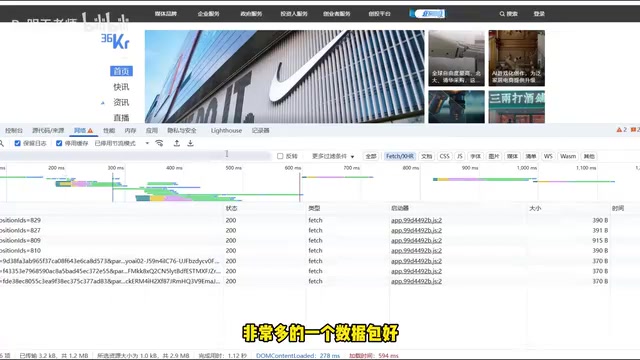
Although this method is basic, it is a common technique for locating encryption logic in JS reverse engineering. The course builds beginners' confidence through hands-on operation and avoids empty theoretical discussion.
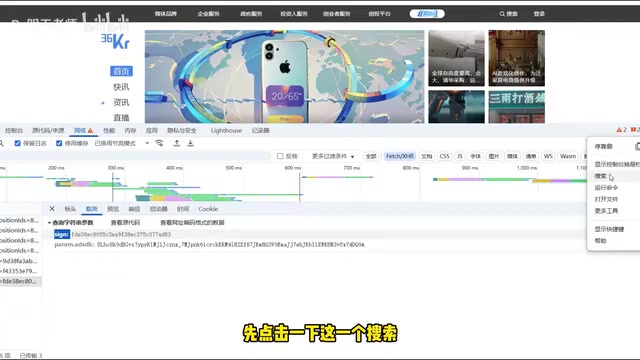
JS encryption parameters usually refer to the result of front-end JavaScript code performing hashing, symmetric/asymmetric encryption, or encoding on certain fields (such as sign, token, timestamp) before sending a network request, in order to prevent requests from being tampered with or scraped in bulk. Common algorithms include MD5, the SHA series, AES, RSA, and custom obfuscation logic. The key to locating such parameters is finding the assignment point, and the developer tools' global search (Ctrl+Shift+F) can quickly list all script files that reference the variable name. In advanced scenarios, the encryption logic may be split across multiple functions or loaded dynamically, in which case you need to combine the Call Stack and XHR breakpoints to trace back step by step. Understanding the browser event loop and script loading order also helps determine when the code executes.
The Role of AI in Reverse Engineering
The "AI" in the course title is not a gimmick. According to the introduction, the content covers directions such as AI-assisted unpacking and LLM reverse engineering implementation. In traditional reverse engineering, steps like unpacking and obfuscated code analysis rely heavily on experience, while AI tools can assist in code understanding, pattern recognition, and automated script generation. The course attempts to embed AI capabilities into the reverse engineering workflow to help learners improve efficiency.
However, it is important to view this rationally: AI-assisted tools cannot replace understanding of underlying principles. Encryption algorithm logic, browser debugging techniques, and network protocol analysis remain the core competitiveness of reverse engineers. The course positions AI as an auxiliary means to "improve reverse engineering efficiency," which is a relatively restrained statement that aligns with current technical reality.
Unpacking originally refers to removing software packer protection (such as UPX, VMProtect). In the context of web reverse engineering, it often extends to stripping the obfuscation and compression layers from JavaScript code, such as restoring scripts packed by eval, converted into string arrays, or processed with control flow flattening. Traditional unpacking relies on AST (Abstract Syntax Tree) parsing and manual rules, while AI-assisted tools can use large models to make semantic guesses about obfuscated code, suggest variable renaming, or automatically generate restoration scripts. However, the output of such tools still requires human verification, because the model may produce seemingly reasonable but logically incorrect inferences. For beginners, it is recommended to first master Chrome DevTools' Pretty Print, breakpoint debugging, and AST fundamentals before using AI to improve efficiency on repetitive work.
Who Is It For? What Should You Watch Out For?
This course is clearly aimed at zero-foundation students, especially those interested in web data scraping, Python scraping, and AI reverse engineering who want to master practical skills. The course emphasizes "fully practical, no empty theory," and for learners tired of pure conceptual explanations, the practice-oriented content arrangement is more appealing.
It should be noted that reverse engineering involves legal and ethical boundaries. Related techniques should be learned for legally authorized scenarios, such as security testing, academic research, or personal data management. The course itself does not expand on legal risk warnings in its introduction, so learners need to ensure compliance on their own when practicing.
In addition, the 300-episode volume means a long learning cycle, and completing it requires strong self-discipline. It is recommended to follow the progressive order designed by the course and reproduce each practical project hands-on, avoiding watching without practicing.
Conclusion
The value of this Bilibili course lies in integrating Python fundamentals, scraping, JS reverse engineering, and AI-assisted tools into a coherent learning path, reducing the time cost for beginners in filtering resources. The encryption parameter locating method it demonstrates is simple but directly addresses the core pain point of JS reverse engineering. For learners who want a systematic introduction to this field, this is a learning resource worth considering.
One-line Summary
Bilibili's 300-episode Python + AI course integrates scraping and JS reverse engineering, practice-oriented but requiring attention to compliance and persistence.
Paragraph Summary
This Bilibili course is marketed as "Python + AI from zero" and links Python syntax, scraping principles, JS encryption reverse engineering, AI-assisted unpacking, and LLM reverse engineering implementation into a progressive learning path. The article breaks down its course structure and a hands-on case of locating a sign encryption parameter, noting that the method is basic but directly addresses the core of JS reverse engineering. It also rationally evaluates AI's auxiliary role in reverse engineering, emphasizing that underlying principles are irreplaceable. The article also reminds learners to pay attention to legal compliance boundaries and the self-discipline challenge posed by the 300-episode volume, concluding that the course has reference value for learners seeking a systematic introduction.
Related articles

9 AI Subscription Plans Compared: The Real Cost Per 100M Tokens Revealed
Bilibili creator tests 9 AI subscription plans from Volcano, Alibaba, Tencent, Baidu, Zhipu, Xiaomi, MiniMax and more, converting them all to real cost per 100M tokens, breaking down fixed-quota vs. three-tier coefficient billing and how caching, time-of-day discounts, and window limits affect actual quota.

Vibe Coding for Beginners: Expressing Intent Instead of Handwriting Code
What is Vibe Coding? A 137-episode Bilibili course defines it: the core is expressing intent, not writing code. This article analyzes Vibe Coding's productivity logic, target audience, and entry expectations to help beginners decide if it's worth learning.

LangChain Beginner's Guide: An Agent Development Roadmap from LangGraph to Deep Agents
Clarify the encapsulation relationship among LangChain, LangGraph, and Deep Agents, and master the learning path and selection logic for agent development frameworks—suitable for beginners in large model development.