Python Flaky Test Diagnosis Tools: A Systematic Approach to Curing Unstable Tests

A systematic guide to diagnosing and eliminating Python Flaky Tests using automated tooling and proven strategies.
This article explores the root causes of Python Flaky Tests—hidden test dependencies, timing issues, race conditions, and external dependencies—and examines how automated diagnosis tools systematically identify them through test reordering, repeated execution, and isolation verification, helping teams move from reactive retries to permanent fixes.
Introduction: Why Flaky Tests Drive Developers Crazy
In modern software development, automated testing is the cornerstone of code quality assurance. Yet almost every Python developer has encountered a maddening class of problems—Flaky Tests. These tests share a defining characteristic: with identical code and no changes whatsoever, they sometimes pass and sometimes fail. They haunt CI/CD pipelines like ghosts—neither fully trustworthy nor easily eliminated.
CI/CD (Continuous Integration/Continuous Delivery) is a core practice in modern software engineering, where the CI phase automatically runs the test suite after every code commit to ensure new code doesn't break existing functionality. In this workflow, test results serve as a "gate"—only when all tests pass is code allowed to merge or deploy. Flaky Tests fundamentally undermine this gate's reliability: if teams set up automatic retry strategies to handle sporadic failures, the gate's strictness is weakened; if they don't retry, legitimate code changes may be innocently blocked. This makes Flaky Tests one of the most destructive anti-patterns in CI/CD practice.
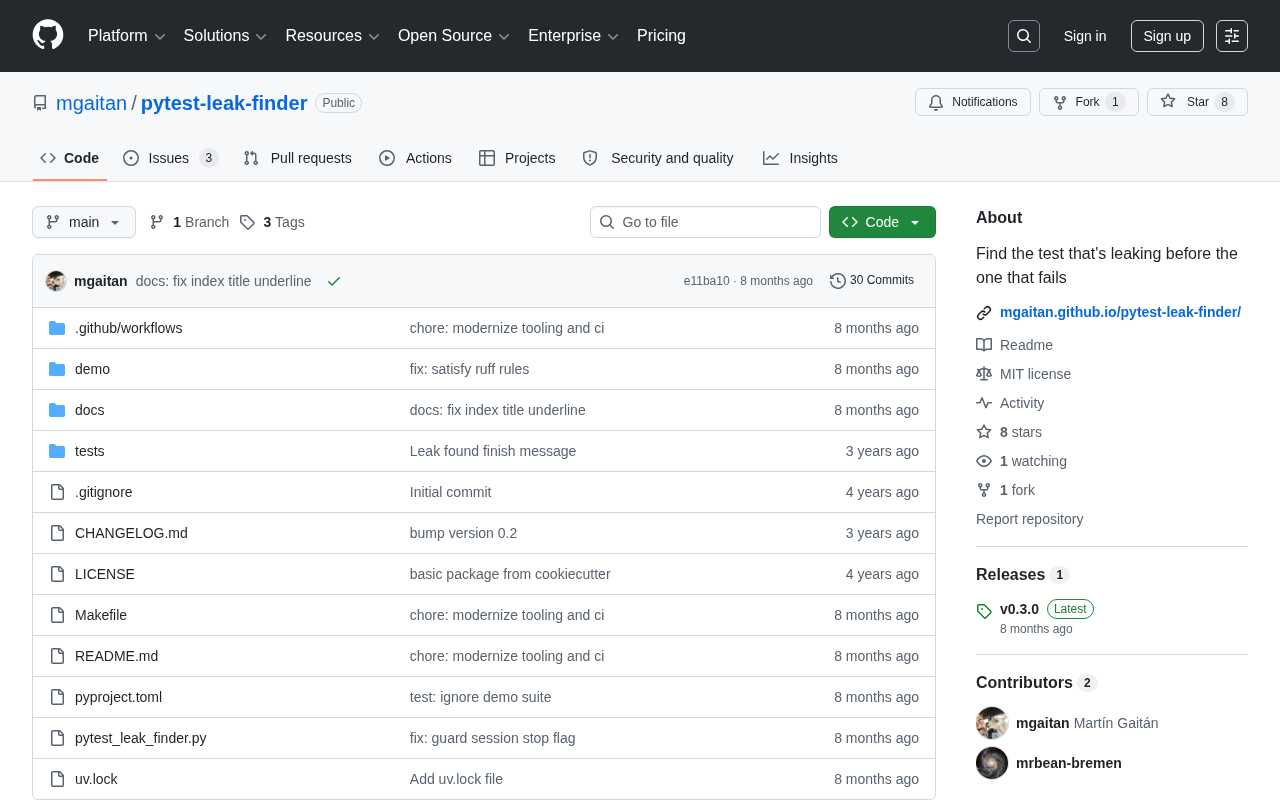
Recently, a tool specifically designed to pinpoint the root causes of unstable Python tests appeared on Hacker News, drawing community attention. While the discussion is still in its early stages, the topic touches on a long-standing pain point in engineering practice that deserves in-depth analysis.
What Are Flaky Tests: Definition and Impact
Definition and Typical Manifestations
A Flaky Test is a test case that produces non-deterministic results even when both the test input and the code under test remain unchanged. It might pass on one run and fail on the next, or behave inconsistently across different machines or concurrency conditions.
The Hidden Costs of Unstable Tests
The damage caused by Flaky Tests goes far beyond the surface. First, they erode team trust in the test suite—when developers get accustomed to "just rerun it if it fails," real bugs may be mistakenly dismissed as sporadic flakiness. Second, they significantly slow down CI pipeline efficiency, with repeated retries consuming computational resources and wait time.
In a 2016 paper titled An Empirical Analysis of Flaky Tests, Google revealed that its internal testing infrastructure runs millions of test cases daily, with approximately 1.5% flagged as Flaky. While the percentage seems small, at the scale of millions of tests, tens of thousands of unreliable test results require engineer judgment every day. Google developed internal tools to automatically flag and isolate Flaky Tests and established dedicated governance processes. Microsoft, Facebook, and other companies have similar research and practices, demonstrating that this is a systemic industry-wide problem rather than an occasional annoyance for individual teams. In large test repositories, while Flaky Tests typically account for a single-digit percentage, the cumulative engineering burden is enormous.
Root Cause Analysis of Unstable Tests
To understand the value of these tools, we first need to understand what causes Flaky Tests. These causes can generally be categorized as follows:
Hidden Dependencies Between Tests
The most common issue is that test cases aren't truly independent. When one test modifies global state, shared caches, or database records without proper cleanup, subsequent test results become dependent on execution order. Change the order tests run in, and results may be completely different.
Test independence is one of the fundamental principles of unit testing, originating from the xUnit test framework design philosophy. In the pytest framework, the fixture mechanism provides a declarative implementation of setup/teardown, with scopes that can be set to function, class, module, or session level. The broader the scope, the wider the fixture is shared, and the higher the risk of introducing hidden dependencies. For example, if a session-scoped database fixture has its data modified in one test without rollback, all subsequent tests may be affected. Good practices include: using transaction rollbacks instead of manual cleanup, providing independent temporary directories for each test, and avoiding mutable global state in fixtures.
Timing and Asynchronous Issues
Tests involving sleep, timeouts, timestamp comparisons, or async callbacks are extremely prone to becoming brittle. When system load fluctuations cause execution time variations, hardcoded wait times may no longer be sufficient, triggering intermittent failures. In Python's asyncio ecosystem, this problem is particularly pronounced—event loop scheduling timing may produce different callback execution orders under different loads, and if tests make implicit assumptions about specific timing, they become fragile. Better approaches include using conditional waiting (polling with timeout) instead of fixed delays, or using libraries like freezegun to freeze and control time.
Concurrency and Resource Contention
Race conditions in multi-threaded and multi-process tests are a major source of Flaky Tests. When the access order of shared resources cannot be guaranteed, test results naturally carry randomness.
Race conditions are one of the most classic defect types in concurrent programming, occurring when two or more execution threads/processes simultaneously access shared resources and the final result depends on their relative execution timing. In Python, although the GIL (Global Interpreter Lock) in the CPython implementation limits true parallel execution, race conditions can still occur in scenarios involving I/O operations, multiprocessing, async programming (asyncio), or C extensions that release the GIL. Race conditions in tests are especially difficult to debug because adding debug code (such as print statements) itself changes execution timing, potentially causing the problem to "disappear"—this is the famous "Heisenbug" phenomenon: the act of observation itself changes the observed behavior.
External Dependencies and Randomness
Tests that depend on network requests, third-party services, random number generators (without fixed seeds), or system clocks inherently introduce uncontrollable variables. In production-grade testing practices, such dependencies are typically isolated through Mock/Stub—for example, using unittest.mock or the responses library to simulate HTTP requests, or using fixed random seeds to ensure reproducibility. However, over-mocking reduces test authenticity, and finding the balance between mock accuracy and test stability is one of the core challenges of test design.
Core Strategies of Flaky Test Diagnosis Tools
Addressing the root causes above, the value of these specialized tools lies in automating and systematizing the investigation process, rather than leaving developers to guess one by one based on intuition and experience.
Detecting Test Dependencies Through Reordering
A common strategy is to shuffle the test execution order and run multiple times. If a test only fails in a specific order, the tool can infer that it has state pollution or hidden dependencies with other tests, precisely identifying the "polluter" and "victim" pairing.
In the Python ecosystem, pytest-randomly and pytest-random-order are two commonly used plugins that expose hidden dependency issues by randomizing test execution order. The theoretical basis for this strategy is: if tests are truly independent (satisfying the test isolation principle), results should be consistent regardless of the order they run in. By recording the random seed, developers can precisely reproduce the specific order that caused the failure, then use binary search to progressively narrow down the "pollution source." More advanced tools automatically perform this binary search process, reducing what might take hours of manual investigation to just minutes.
Repeated Execution to Quantify Flakiness Rate
Tools typically perform many repeated executions of suspicious tests, recording their failure frequency. This not only confirms that a test is indeed unstable but also provides a quantified "flakiness probability" to help teams prioritize fixes. For example, a test with a 50% failure rate obviously deserves higher priority than one with a 0.1% failure rate. Quantitative data also helps teams track governance progress—as fixes are applied, the overall flakiness rate should trend downward.
Isolated Execution to Verify Test Independence
Extracting individual tests from the suite and running them in isolation—if they always pass when isolated but intermittently fail when integrated—strongly points to mutual interference between tests. This comparative experiment approach is essentially an application of the controlled variable method—by changing the variable of "whether running alongside other tests," one can determine whether the failure cause is an intrinsic defect in the test itself or external environment contamination.
Implications for Engineering Practice
Treat Flaky Test Governance as a First-Class Citizen
Many teams adopt a "look the other way" or "just retry" attitude toward Flaky Tests, which is effectively accumulating technical debt. Technical Debt is a metaphor proposed by Ward Cunningham in 1992, comparing suboptimal technical decisions to financial debt—saving time in the short term but generating "interest" (additional maintenance costs) over time. Flaky Tests are a typical form of test debt: tests that may have been stable when initially written in their original environment, but gradually become unreliable as system scale grows, concurrency increases, or dependencies change. Without proactive governance, these unstable tests erode test suite credibility at an accelerating pace, eventually leading teams to completely abandon relying on automated testing as a quality assurance mechanism—this is the "bankruptcy" state of test debt.
Introducing dedicated diagnosis tools means incorporating unstable test governance into formal engineering processes rather than treating it as ad-hoc firefighting.
From "Rerun" to "Root Cure"
Retry mechanisms are merely painkillers that mask symptoms. The truly healthy approach is finding the root cause—whether it's missing cleanup logic, incorrect time assumptions, or concurrency defects. The significance of automated tools lies in reducing the cost of root cause identification, making "root cures" feasible. It's worth noting that while some CI systems (such as GitHub Actions, GitLab CI) provide built-in retry functionality that improves pipeline pass rates in the short term, without accompanying root cause analysis, this essentially trades computational cost for ignoring the problem.
Integrate into CI Workflows for Proactive Defense
Ideally, these tools should run periodically as part of the CI pipeline, proactively discovering newly introduced unstable tests rather than waiting for them to explode at critical release moments. In practice, this can mean running multiple rounds of randomized tests in nightly scheduled builds, or performing additional stability verification on new/modified tests during the Pull Request stage (for example, running them 10 consecutive times to confirm they all pass). This "Shift Left" strategy—finding problems as early as possible—is the core philosophy of modern quality engineering.
Conclusion
Although discussion of this tool on Hacker News is still in its early stages, the problem it addresses has universal significance. Flaky Tests are a challenge that every scaled Python project can hardly avoid, and tooling and automating the investigation process represents one direction in which test engineering is maturing.
For teams currently plagued by unstable tests, rather than continuing the passive approach of "just rerun on failure," it's better to try using systematic tools to uncover the real causes behind these ghost tests. After all, a trustworthy test suite is the true cornerstone of continuous delivery.
Related articles

Apple HomeView Hands-On Review: Is the $300 Smart Home Hub Worth It?
Apple HomeView hands-on: a $300 smart home hub with facial recognition for quick account switching, but no App Store or voice recognition. Is the wall-mounted version worth it? Should you buy the first generation?

Meta Muse Wonder Launch: What It Means for Meta's Return to the Frontier AI Race
Meta releases Muse Wonder and WonderFull, benchmarks reach the frontier, community feedback is polarized. An in-depth look at Meta's return to the frontier AI race, its personal agent strategy, and Zuckerberg's different path.

Apple Home Smart Home Lineup Leaked: LG and Schneider Team Up, UWB Door Lock on Board
Apple Home ecosystem gains new LG and Schneider devices: UWB smart lock with proximity unlock, 2.5K dual-camera doorbell, privacy indoor camera, and AirPods-like seamless pairing.