Qencode MCP: Using Natural Language to Drive AI-Powered Video Transcoding and Processing

Qencode MCP lets AI agents handle video transcoding and processing through natural language via the MCP protocol.
Qencode MCP leverages the Model Context Protocol to connect cloud-based video processing capabilities with AI agents, enabling developers to perform video transcoding, analysis, editing, optimization, and delivery using natural language instructions. By abstracting away complex codec configurations and encoding parameters, it significantly lowers the technical barrier for video processing while following an "AI orchestration + cloud execution" architecture that ensures reliability and scalability.
When Video Processing Meets AI Agents
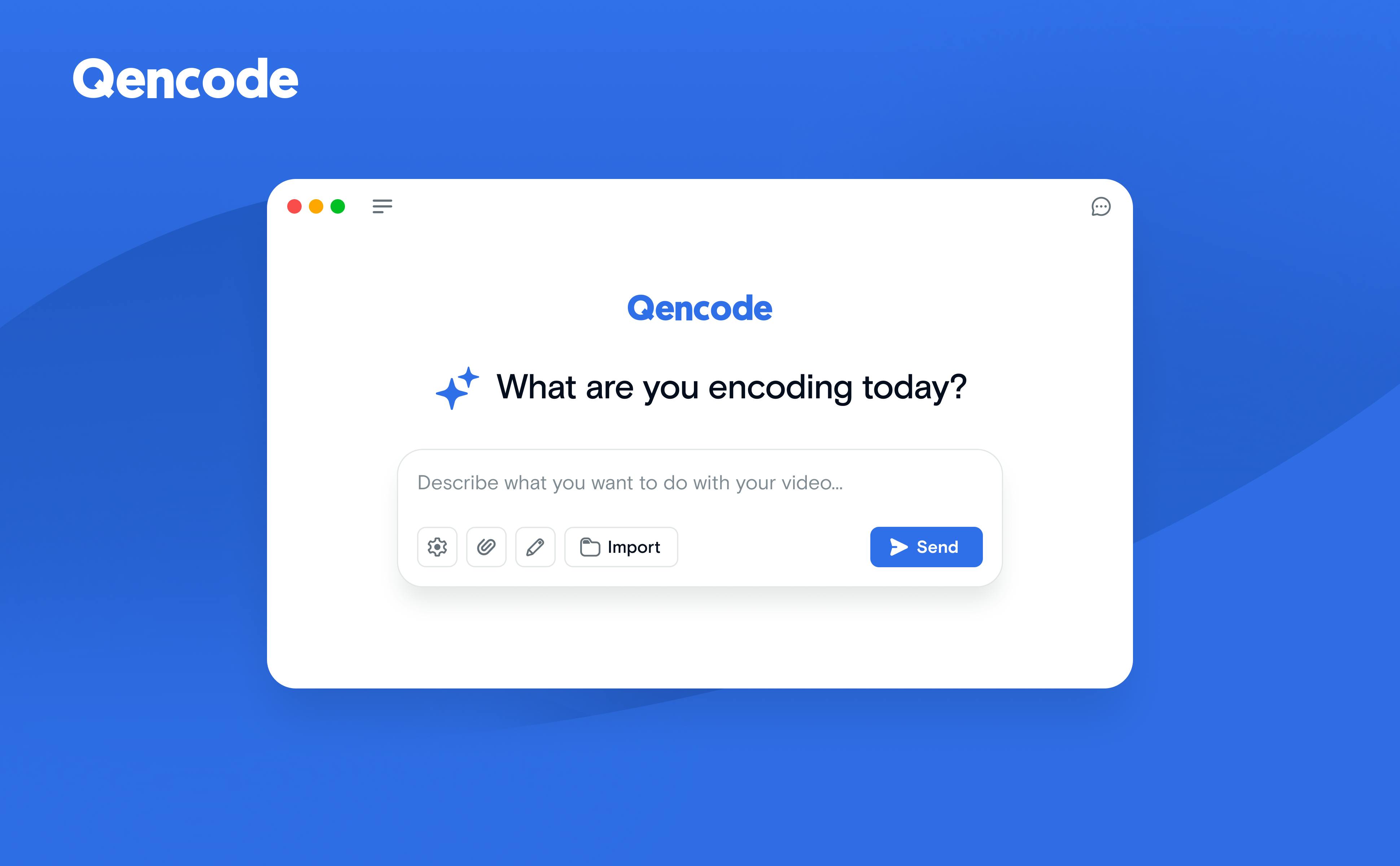
Video transcoding, editing, optimization, and distribution have always been "heavy lifting" in developers' eyes. Whether building a streaming service or integrating video features into an application, engineers must wrestle with complex codecs, bitrate configurations, and format compatibility. Qencode MCP, which recently launched on Product Hunt, aims to change this — it enables AI assistants to handle the entire video workflow, from transcoding, analysis, and editing to optimization and delivery, all through natural language instructions.
The product performed impressively after launch, garnering 90 upvotes and ranking 12th on the daily leaderboard, categorized under Streaming Services, Developer Tools, and Artificial Intelligence.
What Is the MCP Protocol, and Why Does It Matter for AI Video Processing
The Rise and Core Value of MCP
MCP (Model Context Protocol) is a standard that has rapidly gained traction in the AI tooling ecosystem. Formally proposed and open-sourced by Anthropic in late 2024, it was designed to address the lack of a unified communication standard between large language models and external tools. Before MCP, every AI application that needed to call an external service required a custom adapter layer, leading to severe ecosystem fragmentation.
MCP adopts a client-server architecture and defines three core primitives — Tools, Resources, and Prompts — allowing any protocol-compliant service to be seamlessly invoked by any compatible AI client. This is analogous to how the USB standard unified computer peripheral interfaces — with MCP, AI Agents gain a standardized "socket" for connecting to various capabilities. Its core value lies in providing LLMs with a unified "external capability interface" that lets AI Agents securely and structurally call third-party services without relying on scattered API wrappers from different vendors.
Qencode MCP wraps its cloud-based video processing platform as an MCP service. This means AI assistants with MCP integration (such as Claude and various Agent frameworks) can directly invoke "video processing" as a native capability, without developers having to write the invocation logic manually.
From FFmpeg Command Lines to Natural Language
Traditional video processing typically relies on tools like FFmpeg. FFmpeg is an open-source multimedia framework born in 2000 that supports virtually every known audio and video format. Its power stems precisely from its complexity: a typical FFmpeg transcoding command might include dozens of parameters covering input/output format specification, codec selection (e.g., H.264, H.265/HEVC, AV1), bitrate control modes (CBR constant bitrate, VBR variable bitrate, CRF constant rate factor), resolution scaling algorithms, color space conversion, audio resampling, and more. The H.264 encoder x264 alone has over 100 tunable parameters, and understanding the interactions between them (such as the nonlinear relationship between bitrate and visual quality, or the impact of B-frame count on encoding latency) requires substantial domain expertise — enough complexity to deter many non-specialists.
Qencode MCP abstracts all of this into a conversation: you simply tell the AI, "Compress this 4K video to 1080p H.264 suitable for mobile playback," and the platform handles the transcoding parameters, bitrate control, and format selection behind the scenes.
This paradigm shift in interaction essentially transfers "expert knowledge" from humans to the system, dramatically lowering the technical barrier to video processing.
A Deep Dive into Qencode MCP's Core Features
According to official documentation, Qencode MCP covers the complete video processing pipeline:
- Video Transcoding (Transcode): Convert videos between different formats, resolutions, and bitrates to meet multi-platform playback requirements. Video transcoding is essentially the process of decoding a video from one encoding format and re-encoding it into another. It involves not only container format conversion (MP4, WebM, MKV, etc.) but more critically, codec-level processing. Modern video coding standards like H.265 can save approximately 50% bandwidth compared to H.264 at equivalent quality, while the newer AV1 codec further improves compression efficiency at the cost of significantly longer encoding times. Adaptive Bitrate streaming (ABR) also requires generating multiple resolution and bitrate versions of the same video (a transcoding ladder) to accommodate playback environments ranging from 4G mobile networks to fiber broadband.
- Video Analysis (Analyze): Extract technical metadata and content characteristics from videos.
- Video Editing (Edit): Perform basic editing operations such as trimming and concatenation.
- Video Optimization (Optimize): Compress file size and balance quality against bandwidth for different delivery scenarios.
- Video Delivery (Deliver): Handle video distribution and output.
All these capabilities are built on Qencode's existing cloud-based video processing platform. In other words, the AI Agent acts as the "commander," while the real computational heavy lifting is handled by mature cloud infrastructure.
This "AI orchestration + cloud execution" architecture is known in distributed systems design as the "Orchestrator Pattern." The AI Agent serves as the orchestration layer, responsible for understanding user intent, decomposing tasks, and scheduling resources, while the actual compute-intensive work is offloaded to dedicated cloud infrastructure. Video transcoding is a classic compute-intensive task — encoding a 4K video may require dozens of CPU cores or dedicated GPUs (such as NVIDIA's NVENC hardware encoder) running continuously. Separating intent understanding from computational execution leverages the LLM's strengths in natural language understanding while avoiding the impractical scenario of having AI models directly process binary data streams. This separation of concerns also allows each layer to evolve and scale independently, ensuring reliability while maintaining the flexibility of natural language interaction.
Practical Value for Developers
Accelerating Video Feature Integration Cycles
For teams that need to embed video capabilities into their products, the significance of Qencode MCP lies in dramatically shortening development cycles. Work that previously required studying codec details and building transcoding pipelines can now be driven by a few natural language instructions through an AI Agent.
Infrastructure for the AI Agent Era
From a broader perspective, Qencode MCP represents a trend: an increasing number of vertical cloud services are "MCP-ifying" themselves, proactively integrating into the AI Agent ecosystem. Since 2024, AI Agents have rapidly transitioned from proof-of-concept to production-ready engineering. OpenAI's Function Calling, LangChain's Tool mechanism, and Anthropic's MCP protocol are all trying to solve the same problem: enabling AI to not just generate text, but to actually "get things done." By rough estimates, as of early 2025, hundreds of MCP services have been published, covering areas such as database queries (e.g., PostgreSQL MCP), file management, browser automation, and code execution.
This trend is analogous to the early App Store boom in mobile internet — once a platform establishes a standard interface, third-party developers rush to plug their capabilities into the ecosystem to gain new distribution channels and user reach. When AI assistants need to handle images, video, databases, payments, and other tasks, MCP services become their "hands" reaching into the real world.
Video processing, as a compute-intensive and highly specialized domain, is naturally well-suited to this "AI initiates intent, specialized platform executes" model. Qencode's entry can be seen as the streaming infrastructure industry's response to the Agent wave.
A Sober Perspective: Opportunities and Current Limitations
It's worth noting that Qencode MCP is still a newly released product. Its actual processing precision, performance on complex editing tasks, and depth of compatibility with mainstream Agent frameworks all await validation through more real-world scenarios. With only 1 comment so far, community feedback remains insufficient.
Moreover, entrusting video processing to natural language introduces new uncertainties — how does the AI accurately interpret user intent when instructions are ambiguous? Will transcoding results meet expectations? These are reliability issues that MCP-based tools need to continuously refine beyond mere "ease of use." There is an inherent tension between the natural ambiguity of language and the precision required by video encoding parameters: when a user says "high quality," does that mean CRF 18 or CRF 23? When a user requests something "suitable for web playback," should the target bitrate be 2Mbps or 5Mbps? Resolving these ambiguities may require the AI to confirm through multi-turn dialogue, or to establish a reasonable set of default strategies and presets.
Conclusion
Qencode MCP is a quintessential example of the AI Agent ecosystem penetrating into vertical domains. It opens up professional cloud-based video processing capabilities through the MCP protocol for natural language interaction, making "processing video with a single sentence" a reality. For developers, it serves as both an efficiency tool and a harbinger of how software will be built in the future — shifting from writing code to call APIs, to using language to command Agents to complete tasks. Video processing is just the beginning; it's easy to foresee that an increasing number of specialized capabilities will be plugged into AI's "toolbox" via MCP.
Related articles

Why Does the Tesla Roadster Need to Fly? A Deep Dive into Musk's Wild Demo
Tesla's Roadster launch showed wall-climbing, upside-down driving, and flying stunts—but The Vergecast notes the demo car may lack a battery, the Rocket version is invite-only and not street-legal, and the website terms don't guarantee delivery. After nine years of delays, why does this car still need to exist?

AI Is Not a Replacement: Human-AI Collaboration Through the Lens of Factory Root Cause Analysis
Starting from factory root cause analysis, this article explains how AI accelerates evidence chain construction rather than replacing human experts, exploring the pragmatic implementation logic and business value of 'AI supporting people rather than replacing them.'

AI Agent Decision Auditing: Building an Evidence Chain in Regulated Workflows
Starting from a Reddit discussion, this article analyzes three core issues in AI agent decision auditing within regulated workflows: what fields audit records should contain, how to handle feedback latency for erroneous decisions, and how to continuously calibrate LLM judge consistency with human judgment.