Quad9 Announces Exit from France: A New Clash Over DNS Privacy and Net Neutrality

Quad9 exits France under regulatory pressure, reflecting the deep conflict between DNS privacy and content censorship.
Quad9 announced it will terminate operations in France, citing changes in the local regulatory environment. As a nonprofit public DNS resolver known for blocking malicious domains and not logging user IPs, its exit reflects a fundamental conflict between DNS privacy and regional regulatory demands. France requires DNS providers to take on more review responsibilities, contradicting Quad9's privacy-first philosophy. The Hacker News community is actively discussing DNS neutrality and the boundaries of content censorship, and the event may signal broader compliance pressure on public DNS providers across Europe, with French users needing to switch providers while encrypted DNS and decentralized resolution efforts may accelerate.
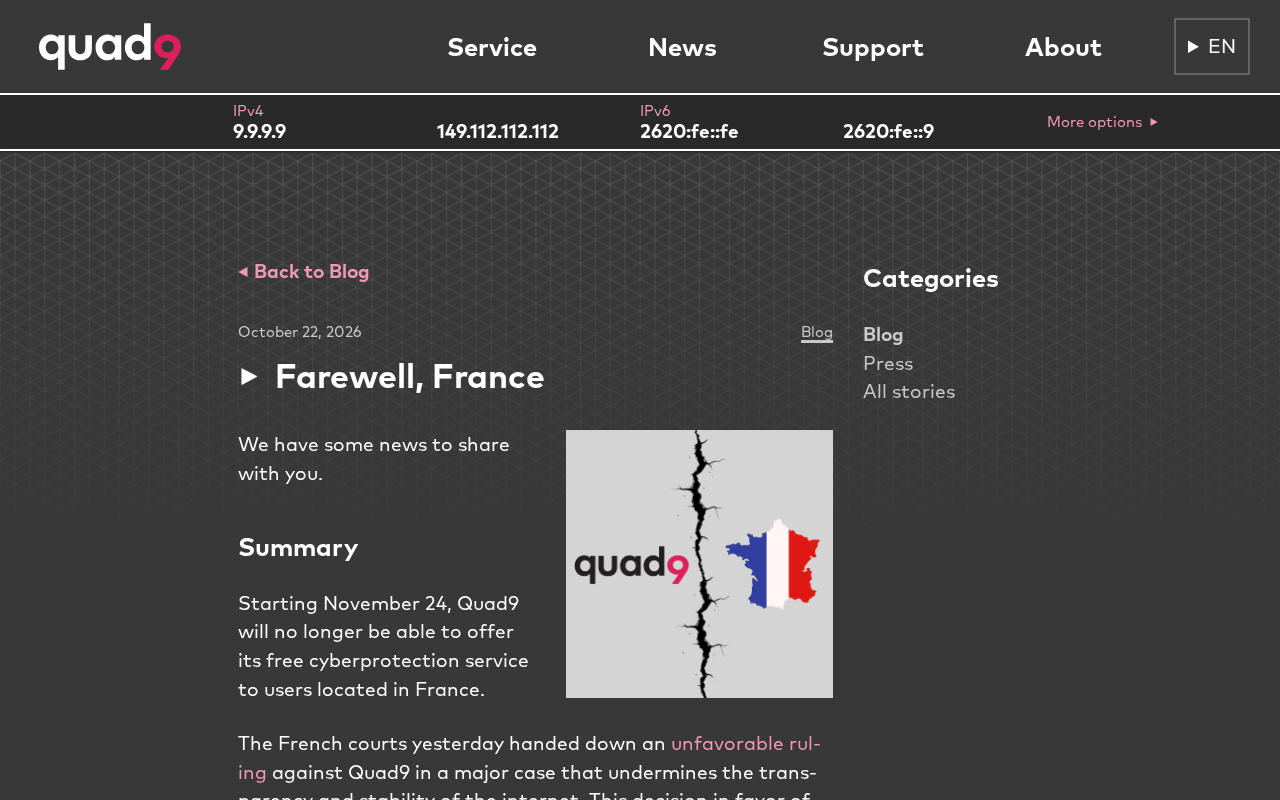
Recently, the well-known public DNS resolver service Quad9 published a blog post titled "Au Revoir France" on its official website, announcing that it will terminate operations in France. This decision has sparked widespread discussion in the tech community, with a related post on Hacker News garnering 302 points and 96 comments. Quad9's exit is not a simple business adjustment—it reflects a deeper conflict between DNS privacy protection, the principle of net neutrality, and regional regulatory requirements.
Background: Why Quad9 Chose to Leave France
Quad9 is a nonprofit public DNS resolver known for providing privacy protection and security safeguards. Its core services include blocking malicious domains, filtering phishing sites, and committing not to log user IP addresses. This model has been welcomed by privacy advocates and security researchers worldwide.
According to Quad9's official blog, the decision to exit France is directly related to changes in the local regulatory environment. Although the original post did not elaborate on specific legal provisions, judging from reactions in the tech community, the controversy likely involves data retention requirements, domain filtering obligations, or the legality of DNS resolution. In recent years, France has continued to tighten cybersecurity and content regulation, requiring DNS providers to assume more review responsibilities—a fundamental conflict with Quad9's privacy-first philosophy.
In the Hacker News comment section, many users expressed support for Quad9's stance, arguing that DNS resolvers should not become tools for content censorship. Other comments noted that this event may foreshadow broader regulatory pressure across Europe, with other public DNS providers potentially facing similar dilemmas.
Public DNS resolvers are a critical part of internet infrastructure. When users enter a domain name in their browser, the device must translate it into an IP address via DNS (Domain Name System) to access the website. Most users default to the DNS provided by their network operator, but public DNS services (such as Quad9, Google Public DNS, and Cloudflare 1.1.1.1) allow users to configure manually for faster resolution, higher security, or stronger privacy protection. Quad9's uniqueness lies in its nonprofit positioning: it blocks malicious domains through threat intelligence and explicitly commits not to log user IP addresses, in stark contrast to the data policies of commercial DNS providers.
The Global Tension Between DNS Privacy and Regulation
Quad9's exit is not an isolated incident. Over the past few years, public DNS services have encountered compliance challenges in multiple jurisdictions. As internet infrastructure, DNS sits at a critical position between users and websites, naturally providing visibility into traffic. Regulators hope to use the DNS layer for security protection and content control, while privacy advocates worry this will lead to mass surveillance and speech filtering.
Quad9's operating model is built on a "no-logs" commitment, meaning it does not store user query records or track user behavior. Once regulations mandate data retention or cooperation with domain blocking, Quad9's technical architecture and operational principles would be difficult to maintain. Choosing to exit rather than compromise demonstrates its commitment to privacy—but it also means French users will lose an important secure DNS option.
This event also touches on the principle of net neutrality. A DNS resolver is essentially a neutral addressing service; if required to treat specific domains differently, it deviates from neutrality. Quad9's departure has sparked discussion about whether "infrastructure should bear content review responsibilities"—an issue that remains unresolved globally.
Encrypted DNS (DoH/DoT) is an important technological evolution addressing DNS privacy risks. Traditional DNS queries are transmitted in plaintext, allowing network intermediaries to easily snoop on or tamper with resolution results. DoH (DNS over HTTPS) encapsulates DNS queries in HTTPS encrypted channels, while DoT (DNS over TLS) uses TLS encryption—both can prevent eavesdropping and interference. However, encrypted DNS has also raised concerns among regulators: when query content is encrypted, network-level content filtering and parental controls become more difficult. European countries like France, when advancing cybersecurity legislation, often require DNS providers to have the ability to block specific domains, and the spread of encrypted DNS may make such requirements difficult to implement, thereby exacerbating the tension between privacy protection and regulatory compliance.
Impact on Users and the Ecosystem
For users and businesses in France, Quad9's exit means they need to find alternatives. Common public DNS options include Google Public DNS, Cloudflare's 1.1.1.1, and AdGuard DNS, but these services differ in privacy policies, filtering strategies, and compliance stances. Privacy-conscious users may need to reassess each provider's data handling practices.
From a broader ecosystem perspective, Quad9's exit could have a demonstration effect. If more privacy-oriented DNS providers choose to exit specific markets under regulatory pressure, the diversity and resilience of global DNS resolution will be weakened. On the other hand, this could also spur new technological solutions, such as further adoption of encrypted DNS (DoH/DoT) and exploration of decentralized DNS resolution.
The tech community's discussion of this matter also extends to corporate responsibility. Some argue that as a nonprofit organization, Quad9's exit decision is based more on principle than commercial interest, contrasting with the response strategies of other commercial DNS providers. This difference warrants long-term observation.
The principle of net neutrality requires internet service providers to treat all traffic equally and not discriminate based on content, source, or application. Although DNS resolvers are not traditional operators, they sit at the traffic entry point, and their behavior similarly involves neutrality issues. If DNS providers are required to block or differentially resolve specific domains (such as lowering resolution priority or returning incorrect addresses), they essentially assume a content review function, deviating from the role of a neutral addressing service. Quad9's exit is precisely a resistance to this trend—it would rather give up the market than break its neutrality and privacy commitments. This stance has resonated widely in the tech community but also highlights the dilemma infrastructure service providers face under regulatory pressure.
Final Thoughts
On the surface, Quad9's exit from France is a single provider's regional adjustment, but in essence it touches on a core proposition of internet governance: how should infrastructure service providers balance security, privacy, and compliance? As regulatory frameworks evolve in various countries, similar conflicts may become more frequent. For tech professionals and ordinary users alike, understanding the power structure at the DNS layer and monitoring policy changes in public resolution services has become essential homework for safeguarding one's digital rights.
Currently, Quad9 has not announced a specific exit timeline or transition arrangements. French users should watch for official follow-up notices and adjust their DNS configurations promptly.
One-line Summary
Quad9 exits France under regulatory pressure, reflecting the deep conflict between DNS privacy and content censorship.
Paragraph Summary
Quad9 has announced the termination of its operations in France, with its official blog citing changes in the local regulatory environment. As a nonprofit public DNS resolver known for blocking malicious domains and not logging user IP addresses, Quad9's exit reflects a fundamental conflict between DNS privacy protection and regional regulatory requirements. France requires DNS providers to assume more review responsibilities, which contradicts Quad9's privacy-first philosophy. The Hacker News community has discussed the matter enthusiastically, focusing on DNS neutrality and the boundaries of content censorship. The event may foreshadow broader compliance pressure on public DNS providers across Europe, with French users needing to switch to other providers while exploration of encrypted DNS and decentralized resolution may accelerate.
Related articles

Build an AI Super Employee System at Zero Cost: A Full Breakdown of Automated Agent Workflows
A deep breakdown of the AI super employee system demoed on Bilibili: agent orchestration, digital human voiceovers, map and enterprise lead generation, 24/7 customer service, and legal modules. We analyze the business logic and compliance risks behind zero-cost signup to help entrepreneurs judge the real ROI of this AI digital employee system.

The Essential Difference Between Chatbots and AI Agents: Crossing from Conversation to Execution
What's the difference between a chatbot and an AI agent? Based on the MCP series on the Learn Tech channel, this article uses examples like booking flights and summarizing notes to explain: a chatbot only gives answers, while an agent actually completes tasks through a think-act-observe loop. It breaks down the four core components—model, tools, memory, and goal—as well as MCP's role as a bridge, and discusses agents' applicable boundaries and permission risks.

Free GitHub Repo: 342 Hours of AI Courses, from Math to MCP Servers
A free GitHub repo offers 342 hours of AI courses: 523 lessons across 20 phases, from math fundamentals to agent building and MCP servers. Nearly 100,000 learners have started.