Quad9 Blocks Nginx2root.com: The Boundary Dispute Over DNS Security Filtering
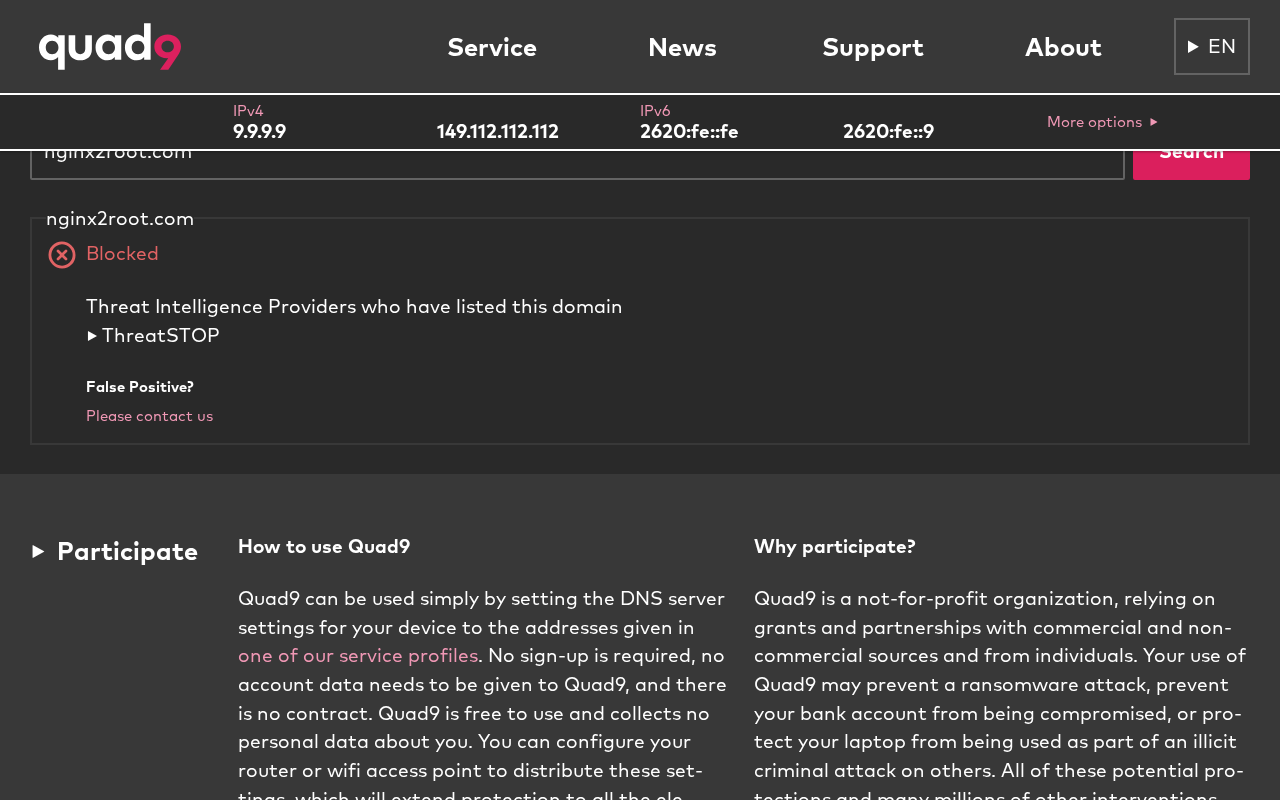
Quad9's blocking of nginx2root.com sparks community discussion about the transparency and boundaries of public DNS filtering.
The public DNS service Quad9 has blocked the domain nginx2root.com, sparking a small-scale discussion on Hacker News. Quad9 automatically judges and blocks malicious domains based on upstream threat intelligence feeds; the advantages are fast response and broad coverage, but false positives are hard to avoid and the appeals channel is not transparent. DNS-layer blocking has knock-on effects and may inadvertently harm all services—email, APIs, and more—of security research sites. The community is divided: supporters argue that users can switch resolvers, making this a matter of market choice; opponents worry that unilateral power over quasi-public infrastructure lacks oversight. Both sides agree that judgment criteria and appeals processes should be made public. The article suggests that site owners diagnose blocking through cross-verification with multiple resolvers and submit false-positive reviews to Quad9, while noting that a healthy ecosystem requires verifiable grounds, actionable appeals, and alternative choices.
Event Overview
According to discussions in the Hacker News community, the public DNS service Quad9 has blocked the domain nginx2root.com. The post received 13 points and 6 comments—a modest amount of discussion, but it touches on a long-standing core issue in public DNS filtering mechanisms: who should draw the boundaries of security filtering?
Quad9 is a public recursive DNS provider that markets itself on privacy and security. One of its core mechanisms is integration with threat intelligence feeds, returning blocking responses for known malicious domains and thereby intercepting risks such as phishing and malware distribution at the resolution layer. The inclusion of nginx2root.com in the blocklist means that, in Quad9's judgment system, this domain has been associated with some kind of security risk.
Judging from the domain name itself, the combination "nginx2root" readily evokes server privilege escalation, web service configuration, or security research–related content. If such a domain involves edge-case content like exploit demonstrations or penetration testing tutorials, it sits precisely in the gray zone of security filtering policy.
How Public DNS Filtering Works
Threat Intelligence–Driven Blocking
Quad9's filtering is not a manual, item-by-item review; instead, it relies on upstream threat intelligence feeds for automated judgment. When a domain is flagged as malicious or suspicious by multiple intelligence sources, DNS resolution requests are returned with a non-routable address, which manifests on the user side as the domain being unreachable. The advantage of this mechanism is fast response and broad coverage; the disadvantage is that false positives are hard to avoid, and blocked parties often lack a transparent appeals channel.
Threat intelligence feeds are services or platforms that collect, analyze, and classify cyber threat data. Common types include commercial intelligence providers (such as VirusTotal and AbuseIPDB), open-source intelligence communities (such as Spamhaus and PhishTank), and vendors' in-house malicious domain databases. They continuously flag malicious domains, IPs, and URLs through crawlers, honeypots, user reports, and machine learning models. Public DNS providers typically subscribe to multiple intelligence feeds and set aggregation rules (for example, "block only when at least two sources flag it as malicious") to reduce the impact of false positives from a single source. However, intelligence feeds vary widely in their judgment criteria, update frequency, and false-positive rates, and most do not publicly disclose their specific rules—which means the transparency of downstream DNS filtering is constrained by the upstream intelligence ecosystem.
The Knock-On Effects of Blocking
The impact of DNS-layer blocking extends far beyond a single website. If a domain hosts email services, API endpoints, or subdomain distribution, blocking it renders all services that depend on that domain unreachable as well. For security research sites, this knock-on effect may inadvertently harm normal technical exchange and learning activities.
In the DNS system, a registered domain can spawn a large number of subdomains (such as mail.example.com and api.example.com) that share the same set of authoritative DNS records. When a public recursive resolver returns a blocking response for the primary domain (typically 0.0.0.0 or NXDOMAIN), resolution requests for all subdomains are blocked as well, because the recursive resolver will not bypass a blocked parent domain to query subdomains individually. Furthermore, if the domain is used for email (MX records), API calls (CNAME records), or content distribution (NS delegation), all of these services become unreachable within the blocking network. This "one-size-fits-all" effect is a key difference between DNS-layer filtering and URL-layer filtering, and it is the root cause of why the scope of collateral damage is hard to control precisely.
Diverging Views in the Community Discussion
Although the 6 comments on Hacker News are limited in number, the points of divergence are clear. Those who support the blocking argue that DNS providers have the right to decide what results to return based on their own security policies, and that users who disagree are free to switch DNS resolvers—this is market choice, not censorship. Opponents point out that public DNS providers effectively hold gatekeeping power over what amounts to quasi-public infrastructure, and that unilateral blocking lacks transparency and appeal mechanisms, making it easy to slide toward over-filtering.
The consensus between the two sides is that the criteria for filtering and the appeals process should be publicly verifiable. The disagreement concerns how much should be disclosed, who should oversee it, and whether security research domains should receive exemptions.
Practical Impact on Users and Site Owners
For ordinary users, Quad9's blocking means certain domains become inaccessible without their knowledge, and error messages usually do not explain the reason for the block. For site owners—especially those operating security research, penetration testing, or vulnerability disclosure content—having a domain blocked by public DNS directly causes a cliff-edge drop in traffic, while troubleshooting and appealing carry high costs.
Pragmatic responses include: cross-checking with multiple DNS resolvers to confirm whether the issue is DNS-layer blocking; checking whether the domain has been mislabeled by major threat intelligence platforms; and, if a false positive is confirmed, submitting a review request through Quad9's official channels. For sites with sensitive content, proactively assessing how domain naming and content classification may affect filtering systems is also a preventive strategy.
Cross-verification with multiple resolvers is a low-cost diagnostic method: query the same domain against Quad9 (9.9.9.9), Google Public DNS (8.8.8.8), Cloudflare (1.1.1.1), and the local ISP's DNS, and compare the returned results. If only Quad9 returns a non-routable address or NXDOMAIN while other resolvers return A records normally, it can basically be determined that this is filtering on Quad9's side. Site owners can also use dig or nslookup tools to specify a DNS server for testing, and check the domain's threat intelligence reputation (such as a VirusTotal domain report). If a false positive is confirmed, they can appeal through the "false positive submission" form on Quad9's official website or via email channels, usually needing to provide an explanation of the domain's purpose and supporting materials.
Where Should the Boundaries of Security Filtering Lie?
The value of this incident lies not in whether a single domain stays or goes, but in the structural tension it exposes in public DNS security filtering: the balance between efficiency and transparency, and between security and openness. The business model of services like Quad9 is built on the "security" label—the more aggressive the filtering, the stronger the security narrative; but the less transparent the filtering, the more collateral damage and controversy arise.
A healthy ecosystem needs three things: verifiable grounds for judgment, actionable appeal paths, and alternative resolver choices. The first two depend on the provider's willingness to govern well; the third relies on market competition. For the technical community, continuing to pay attention to and discuss cases like this is itself a way of pushing filtering mechanisms toward transparency.
One-line Summary
Quad9's blocking of nginx2root.com has sparked community discussion about the transparency and boundaries of public DNS filtering.
Paragraph Summary
The public DNS service Quad9 has blocked the domain nginx2root.com, sparking a small-scale discussion on Hacker News. Quad9 automatically judges and blocks malicious domains based on upstream threat intelligence feeds; the advantages are fast response and broad coverage, but false positives are hard to avoid and the appeals channel is not transparent. DNS-layer blocking has knock-on effects and may inadvertently harm all services—email, APIs, and more—of security research sites. The community is divided: supporters argue that users can switch resolvers, making this a matter of market choice; opponents worry that unilateral power over quasi-public infrastructure lacks oversight. Both sides agree that judgment criteria and appeals processes should be made public. The article suggests that site owners diagnose blocking through cross-verification with multiple resolvers and submit false-positive reviews to Quad9, while noting that a healthy ecosystem requires verifiable grounds, actionable appeals, and alternative choices.
Related articles
Google Officially Supports Pi Coding Agent: The AI Programming Tool Ecosystem Expands Further
Google adds official Google AI plan support for the open-source coding agent Pi, signaling accelerating integration between large model vendors and coding agent tool ecosystems. This article analyzes the impact on developer workflows, the tool ecosystem landscape, and model binding relationships.

Loom: One Machine for Weaving, Knitting and Braiding
Loom is a device that aims to seamlessly combine weaving, knitting and braiding in a single machine, drawing attention on Hacker News. This article examines its engineering challenges, significance for flexible manufacturing, and lessons for makers and hardware developers.
Running Local AI Agents on Mac: A Full Breakdown of the MLX Four-Layer Stack
A breakdown of Apple engineer Joanna's local Mac AI agent solution: the MLX four-layer stack, a three-step setup, and how the neural network accelerator, continuous batching, and distributed inference solve local agent performance bottlenecks.