Query Fan-Out: How AI Search Is Changing Content Strategy

AI search decomposes questions and searches in parallel via Query Fan-Out, shifting SEO competition toward breadth of question coverage.
The article provides an in-depth analysis of the Query Fan-Out mechanism behind AI search: when a user asks a question, the AI system breaks it into multiple sub-questions, searches them simultaneously, and synthesizes a comprehensive answer. Google has officially confirmed this technique is used in AI Mode. Ahrefs' test data shows that only 12% of AI-cited pages appear in Google's top ten for the original question, with about 80% of citations coming from pages with no ranking—a sharp contrast to AI Overviews, where 76% of citations come from the top ten. Based on this, the article proposes four optimization strategies and concludes that SEO still works, but competition has expanded from keyword rankings to covering all related questions users might ask.
AI search is changing the way we access information, but most people focus only on the answer itself while overlooking a key mechanism behind it: Query Fan-Out. Simply put, when you ask a question in an AI search box, the system doesn't search your original question directly. Instead, it breaks it down into multiple sub-questions, runs several searches simultaneously, and then synthesizes them into a single response. What does this mechanism mean for content creators and SEO practitioners? We analyze this by combining information officially confirmed by Google with real-world test data from Ahrefs.
What Is Query Fan-Out?
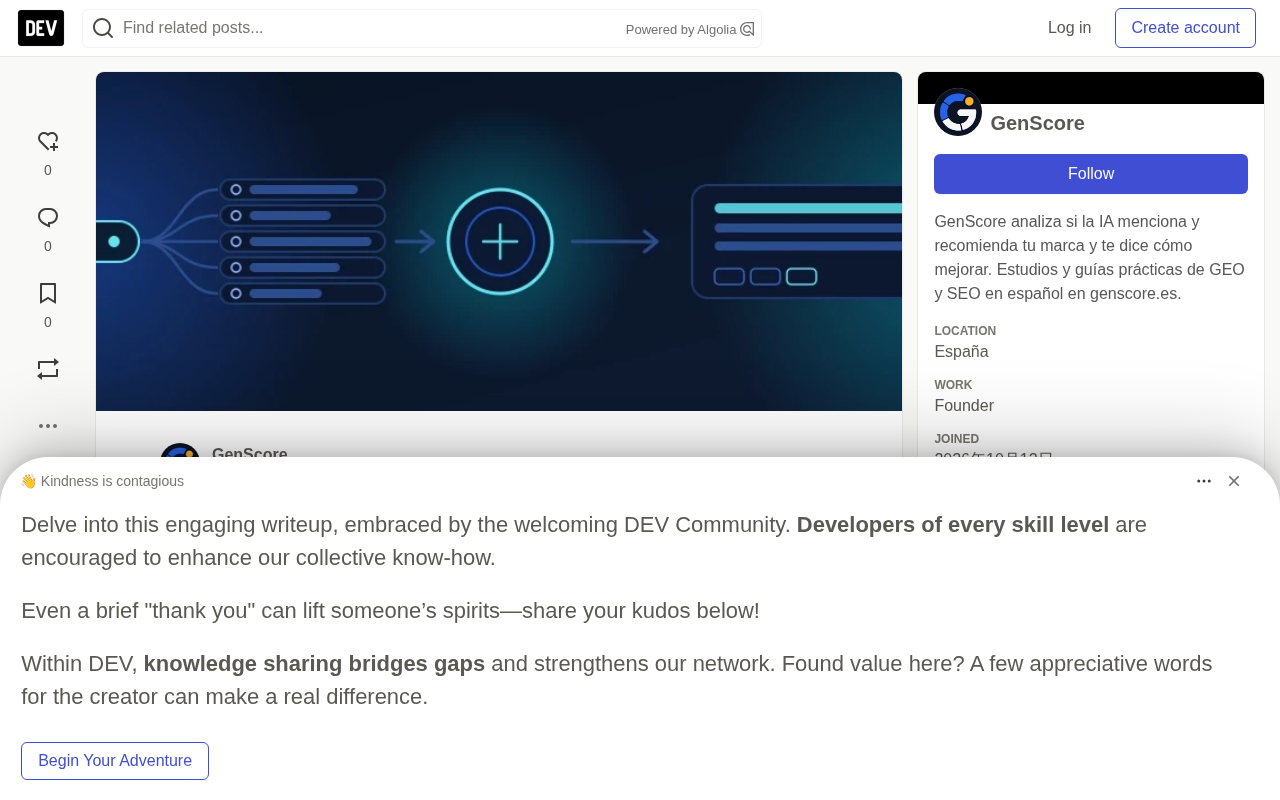
Query Fan-Out is the core technology AI search engines use to handle complex questions. Take "recommend a CRM suitable for a ten-person agency" as an example. A traditional search engine would match this phrase directly and return ten links. An AI engine, however, first thinks: to answer this question well, what information do I need to know? For example:
- Which CRMs are suitable for agencies?
- What is the price per user per month?
- Which CRMs integrate with Gmail?
- What do users at small agencies say in their reviews?
Then the system searches separately for each sub-question, reads the results, and finally generates a comprehensive answer. Users don't see these underlying searches—only the final response.
When Google launched AI Mode in May 2025, Director of Search Elizabeth Reid explicitly stated: "Internally, AI Mode uses our Query Fan-Out technique: breaking your question into subtopics and executing multiple searches for you simultaneously." Google's Deep Research mode may even "launch hundreds of searches."
Other AI assistants such as ChatGPT (with search functionality) and Perplexity employ similar strategies, though the details are not publicly disclosed.
AI Overviews is a search feature Google introduced at its 2024 I/O conference. It generates an AI-written summary at the top of the traditional search results page, along with links to cited sources. Unlike AI Mode, AI Overviews is not a standalone conversational interface but an enhancement layer embedded in the regular search experience. Under the hood, it still relies heavily on Google's existing search index and ranking signals, so its cited sources overlap significantly with the top ten results. This difference explains why 76% of AI Overviews citations come from the top ten, while standalone AI assistants like Perplexity cite pages in the top ten only about 8% of the time—the latter employs a more aggressive query fan-out strategy and is less constrained by traditional rankings. Understanding this distinction helps content creators develop differentiated strategies for different AI search entry points.
Key Data: Pages Cited by AI Are Not in Google's Top Ten
If AI simply searched your question as-is, the pages it cites should overlap heavily with Google's top ten. But an Ahrefs study from August 2025 shattered that assumption.
They took 15,000 long-tail questions and searched them on Google and four AI assistants, finding that only 12% of AI-cited pages appear in Google's top ten for the original question. Perplexity had the highest share at 28.6%, while the other assistants averaged about 8%. Even more striking, roughly 80% of citations came from pages that don't rank at all in Google for the original question.
Ahrefs attributes this phenomenon to Query Fan-Out: AI searches variants of the question and tends to favor pages that perform well across multiple variants.
Another comparison comes from the same organization: in Google's AI Overviews, 76% of cited pages come from the top ten. This shows that the closer a system is to a traditional search engine, the more it relies on classic rankings; and the more conversational the AI, the more it values a page's ability to cover related questions.
Long-tail queries are questions with low search volume but very specific intent, usually composed of multiple words—for example, "CRM price comparison for a ten-person agency." In traditional SEO, long-tail keywords are highly valued for their low competition and high conversion rates. In the context of AI search, long-tail questions take on special significance: they often contain multiple constraints (scale, budget, integration needs, etc.), which is exactly the scenario most likely to trigger Query Fan-Out decomposition. Ahrefs chose 15,000 long-tail questions as its sample precisely because such questions are most likely to expose the divergence between AI search and traditional search in terms of citation sources. For content creators, this means building in-depth content around long-tail questions is more likely to earn citations in AI answers than competing for high-competition short keywords.
How to Optimize Content for Query Fan-Out
1. List the Sub-Questions AI Might Ask
Start from your core business question and list the common questions surrounding it. These typically include: pricing, comparisons with alternatives, user reviews, use cases, how-to guidance, and trust issues (warranty, support, etc.). If your website doesn't answer any of these, AI will look for answers on other pages.
Quick action: Enter your core question in AI search and in Google respectively, and look at their recommended "related questions"—these are often the fan-out branches.
2. Give Each Sub-Question Its Own Section, with the Answer Up Front
Each sub-question should have its own independent section, with the answer at the beginning and details following. If the answer to "what is the price" is buried in the fifth paragraph of a page about something else entirely, AI searching specifically for pricing will be more inclined to cite a price-comparison site.
3. Establish a Presence on Third-Party Platforms
Many fan-out branches end up pointing to third-party pages: comparison sites, media outlets, forums, and directories. Questions about "reviews" or "alternatives" are rarely answered directly by a brand's official website. Appearing on these platforms in a legitimate, accurate, and timely manner is just as important as building your own site.
4. Focus on Questions, Not Just Keywords
Keywords tell you how people search on Google; questions tell you how people talk to AI. You need both: the former helps you understand which of your pages Google has already seen, while the latter helps you gauge whether AI mentions you when the fan-out concludes.
Answer-First is a content structuring strategy that requires each section to open with one or two sentences that directly answer the question posed by that section's heading, before expanding into background, data, and details. This approach stems from two realities: first, when reading web pages, AI tends to extract the passages semantically closest to the sub-question, and passages where the answer comes first are more easily identified as highly relevant snippets; second, users conversing with AI expect quick conclusions rather than long preambles. Implementing Answer-First does not mean simplifying content—it means placing the core conclusion in the most prominent position while subsequent paragraphs can still provide ample argumentation. For Query Fan-Out optimization, giving each sub-question its own section with the answer up front can significantly increase the probability of a page being hit by multiple fan-out branches simultaneously.
SEO Isn't Dead, but the Competitive Dimension Has Changed
Searches initiated by AI still rely on the index, so rankings still matter. What has changed is the goal of competition: you're no longer just ranking for a set of keywords, but providing high-quality content for all the sub-questions AI might pose when answering users.
Tools like GenScore attempt to integrate data from both sides: using Search Console to view search terms Google has already shown you for, converting those terms into questions, and tracking whether AI mentions your brand in its answers. This reflects the needs of the new landscape—monitoring both traditional rankings and AI citations.
The core of content strategy is shifting from "keyword coverage" to "question coverage." Websites that can comprehensively and clearly answer all the related questions users might have will gain more visibility in the AI search era.
Key Takeaways
- Query Fan-Out is the technique by which AI search breaks complex questions into multiple sub-queries and searches them simultaneously; Google has officially confirmed it.
- Ahrefs research shows that only 12% of AI-cited pages are in Google's top ten for the original question, and 80% come from pages with no ranking.
- Optimizing for AI search requires covering sub-questions surrounding the core question, putting answers up front, and establishing a presence on third-party platforms.
- SEO still matters, but competition has expanded from keyword rankings to the breadth of question coverage.
One-line Summary
AI search uses Query Fan-Out to decompose questions and search in parallel, shifting SEO competition toward breadth of question coverage.
Paragraph Summary
The article provides an in-depth analysis of the Query Fan-Out mechanism behind AI search: when a user asks a question, the AI system breaks it into multiple sub-questions, launches searches simultaneously, and synthesizes a comprehensive answer. Google has officially confirmed that this technique is used in AI Mode. Ahrefs' real-world test data shows that only 12% of AI-cited pages appear in Google's top ten for the original question, with about 80% of citations coming from pages that don't rank at all for that question—a sharp contrast to AI Overviews, where 76% of citations come from the top ten. Based on this, the article proposes four optimization strategies: list the sub-questions AI might ask, give each sub-question its own section with the answer up front, establish a presence on third-party platforms, and focus on questions rather than just keywords. The core conclusion is that SEO still works, but the competitive dimension has expanded from keyword rankings to the ability to cover all the related questions users might ask.
Related articles

Uber Deploys ChatGPT Work Company-Wide: AI in the Workplace Enters the Scaled Implementation Phase
Uber deploys ChatGPT Work to 30,000+ employees, extending it from engineering to all roles. We analyze its expert-engineer pairing, end-to-end automation, and questions of AI control and power concentration—insights for scaling AI in the workplace.

Shift at Midnight Hands-On: When "ID Verification" Becomes Alien Hunting
Shift at Midnight blends ID verification with horror survival in a four-player co-op game. We break down its inspection mechanics and chaotic humor.

Zelensky Recounts the Outbreak of War: I Need Ammunition, Not a Ride
Zelensky recalls the first day of war in a YouTube interview: farewell to family, rejecting Biden's evacuation offer with "I need ammunition, not a ride," and how Bucha shaped his stance on compromise and peace talks.