Qwen 2.1 License Debate: Small Commercial Use May Get Free Authorization

Developer suggests Qwen add a revenue cap for free small commercial use; team responds positively but no formal changes yet.
A debate has emerged around Alibaba Qwen's commercial license, with developer Ostris publicly suggesting a "revenue cap" clause to allow small-scale commercial use without paid authorization. Qwen team member Kun Yan responded informally, saying they'd consider it and joking they wouldn't pursue creators' YouTube revenue. Use cases in focus include monetized videos, social posts, and LoRAs on Civitai. The article cautions that informal team statements differ fundamentally from official license terms, and users should rely on published text until formal changes are made.
A License Discussion Sparked by a Tweet
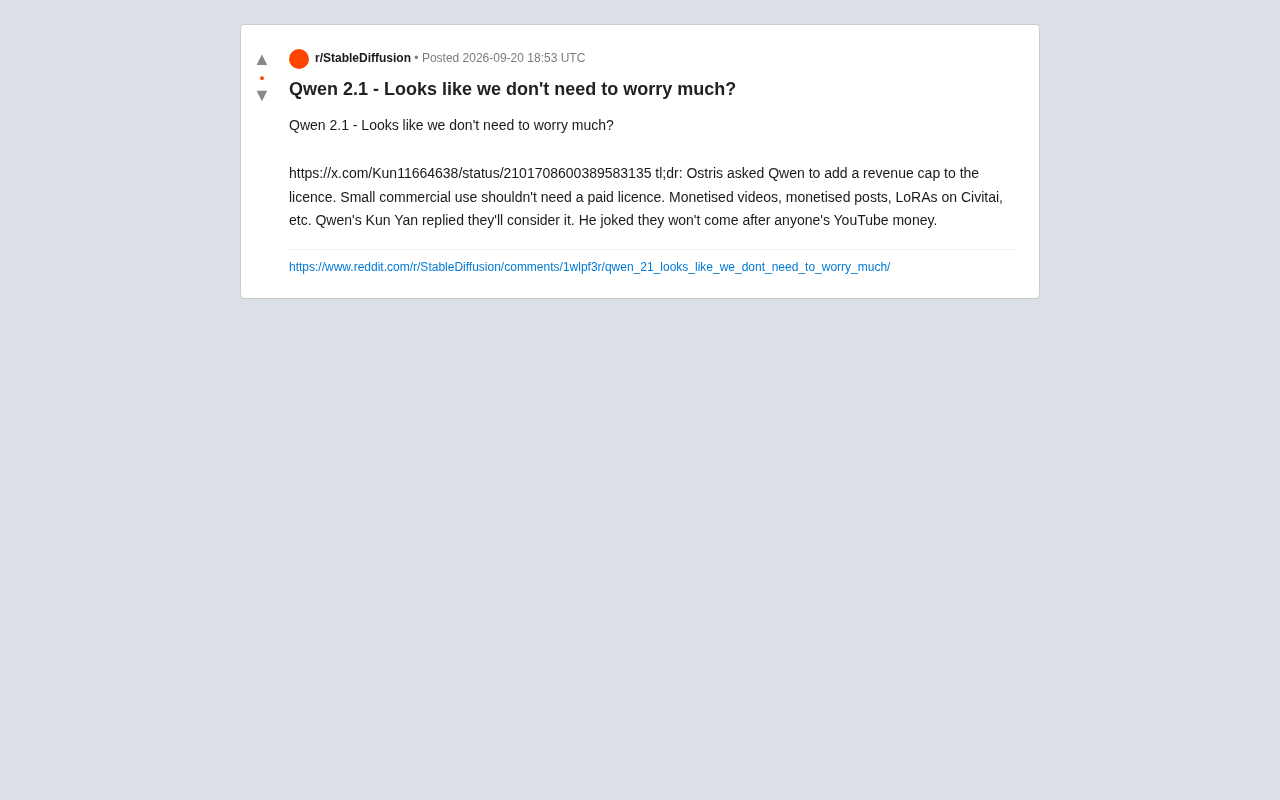
A noteworthy debate has emerged in the community around the commercial licensing terms for Alibaba's Qwen model series. Developer Ostris publicly suggested that the Qwen team add a "revenue cap" clause to their license — meaning small-scale commercial use would not require a paid commercial license.
This kind of request isn't unfounded. As open-source models are increasingly adopted by individual creators and small teams, ambiguity in license terms directly affects compliance costs for a large number of non-enterprise users. For independent creators who make a living from AI-generated content, unclear commercial terms can mean potential legal risk.
The Qwen Team's Response
According to the Twitter exchange referenced in the post, Qwen team member Kun Yan responded to the suggestion by saying they'll consider it. More notably, he half-jokingly indicated that they wouldn't go after anyone's "YouTube revenue."
While this quip doesn't constitute a formal legal commitment, it sends a relatively clear signal: the Qwen team takes a relaxed stance toward small-scale commercial use. The post's author concluded from this that "looks like we don't need to worry much."
It's worth noting, however, that there is a fundamental difference between an informal statement from a team member and a formally written license clause. Until terms are officially updated, this remains a personal response — not a binding licensing change.
Use Cases in Focus
The small-scale commercial scenarios specifically mentioned in the discussion include:
- Monetized videos: Video content published on platforms like YouTube that earns ad revenue
- Monetized posts: Social media content with commercial earnings
- LoRAs on Civitai: Fine-tuned weights published by creators on model-sharing platforms
These are among the most active use cases in the AIGC creator community — and the ones most likely to brush up against license boundaries. What they share in common is limited revenue scale and individual or small-team operation, clearly distinct from large-scale enterprise deployment.
LoRA (Low-Rank Adaptation) is one of the most popular fine-tuning techniques for large models. Its core idea is to insert small low-rank decomposition matrices alongside the pre-trained model's weight matrices, training only these newly added parameters — dramatically reducing VRAM usage and training cost. In image generation (e.g., Stable Diffusion), creators can train a LoRA using just dozens of images on a consumer-grade GPU and publish it to platforms like Civitai for others to download — sometimes for a fee or as a paid download. This is precisely why LoRA has become one of the most legally ambiguous artifacts in the AIGC community: it doesn't contain the base model weights, but its output quality is entirely dependent on the underlying model. Whether distributing a LoRA commercially constitutes "commercial distribution based on the model" is directly governed by the base model's license terms.
Why a Revenue Cap Clause Matters
A "revenue cap" is a common tiered licensing approach in open-source licenses. The logic is straightforward: users below a certain revenue threshold can use the model commercially for free, while larger commercial entities above that threshold must purchase a paid license.
This design is well-established in the industry. It balances two goals — lowering the barrier for independent developers and small creators to encourage ecosystem growth, while preserving the model developer's ability to monetize from large enterprises.
For Qwen, adopting a similar clause would help alleviate the concerns of many creators and further expand the model's adoption in the content creation space. After all, a license that lets users "use with confidence" is itself a component of an open-source model's competitive advantage.
Revenue cap clauses have well-established precedents in open-source software licensing. Elastic License 2.0, BSL (Business Source License), and some AI model licenses (such as early BigScience RAIL variants) all employ similar tiered authorization logic. In the AI model space, Meta's Llama series license requires companies with over 700 million monthly active users to obtain a separate license — a different kind of "scale threshold" design. The legal challenges with such clauses lie in defining revenue or user scale metrics, cross-jurisdictional applicability, and the tension with OSI's (Open Source Initiative) definition of "true open source" — licenses with commercial restrictions are not recognized as open-source licenses by the OSI, which remains an ongoing source of community debate.
Keeping a Rational Perspective
This discussion is still at an early, informal stage. The community's optimism is understandable, but before any official terms are published, a few points are worth watching:
- Whether the official response will translate into written amendments to the license
- The specific revenue threshold (if any)
- How the boundaries of covered use cases will be defined
For users relying on Qwen for commercial creative work, the safest approach remains to refer to the latest officially published license text — not informal statements on social media platforms.
That said, it's encouraging that the Qwen team is openly receptive to community feedback and willing to engage publicly. This kind of interaction is a positive signal for the open-source ecosystem. Ongoing improvements to license terms often begin with exactly this kind of community dialogue.
Related articles

GPT-Next Leak, Gemini 4 Argon Imminent: AI News Roundup
GPT-Next leak suggests extreme efficiency; OpenAI's 28-day shipping pledge boosts speed 50%; Gemini 4 Argon nears release; Anthropic subscription value report sparks debate.

GPT-Next Leaked, Gemini 4 Argon Speeds Up, Fable 5.5 May Launch Today
OpenAI's GPT-Next model leaks, expected to be extremely low-cost and possibly part of the 28-day release plan; Gemini 4 Argon internal testing accelerates, NanoBanana 2.1 is live; Semi Analysis tests show Claude Max's equivalent API value is about 5 times that of ChatGPT Pro; Fable 5.5 may launch today.

Gemini 4 Argon Launches Globally: Key Highlights from the AI Daily Brief
Google opens Gemini 4 Argon globally across Pro and Ultra subscriptions and the API, and demonstrates robot control. This article rounds up open-source models, Agent infrastructure, cost transparency, and safety governance updates.