Qwen 4 27B's Absence Sparks Discussion: Expectations vs. Reality in Model Iteration
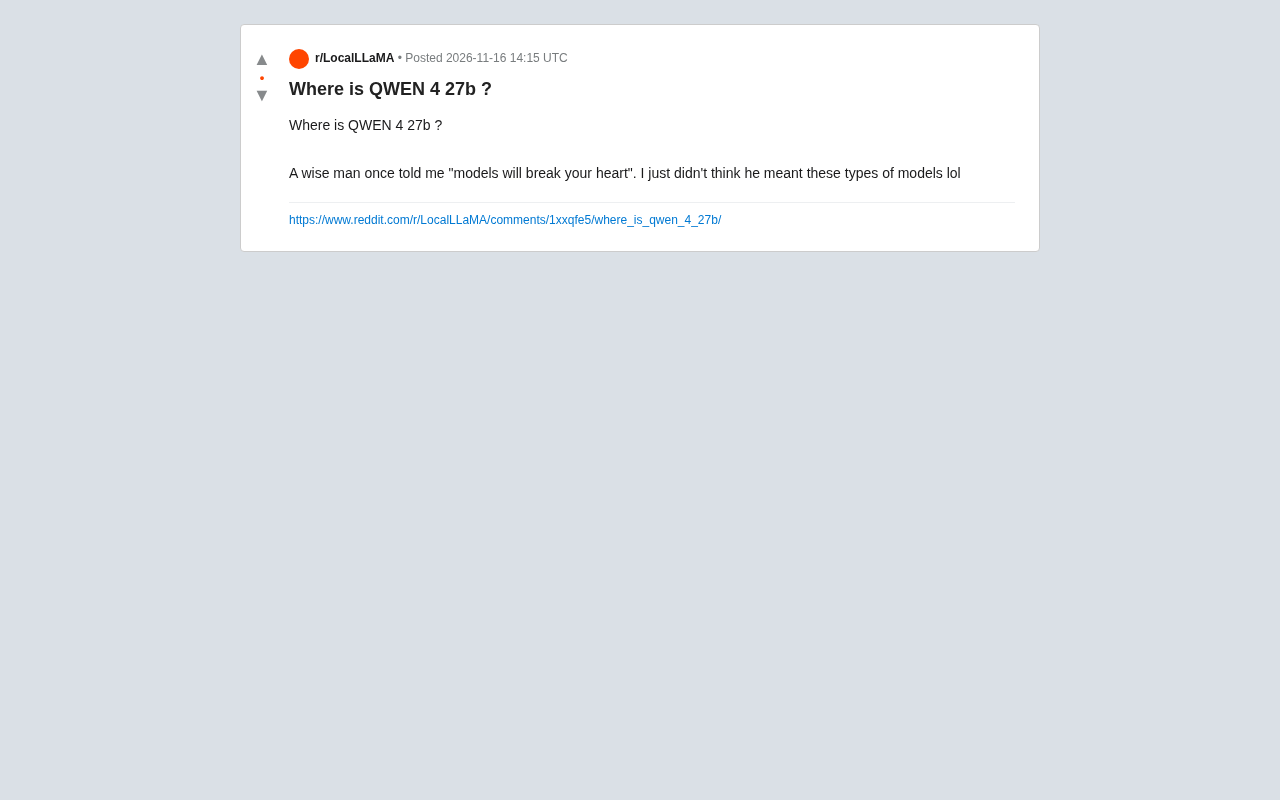
A Reddit post jokes about Qwen 4 27B's delayed release, reflecting the open-source community's anticipation and helplessness regarding mid-sized models.
The article centers on a Reddit post titled "Where is QWEN 4 27b ?", noting that despite its minimal content, it precisely captures the open-source model community's sensitivity to the iteration cadence of specific sizes. 27B is seen as the "sweet spot" between local deployment and inference quality—the range developers prioritize when evaluating fine-tuning, private deployment, and lightweight applications—so community discussion of the model's absence quickly gained traction. The article further analyzes that model releases are influenced by multiple factors such as training costs, data strategy, and product positioning, and that the sizes and timing circulating in the community are mostly speculation rather than official commitments. The author advises developers to focus on the actual performance of existing models, keep tracking official channels, and avoid binding project cadence to unreleased models.
A post titled "Where is QWEN 4 27b ?" recently appeared on the Reddit community, and the poster summed up what many developers are feeling with a wry joke: "A wise man once told me 'models will break your heart'. I just didn't think he meant these types of models lol." Behind the joke lies a collective sense of anticipation—and mild disappointment—over the long absence of the next mid-sized model in the Qwen series.
Community Sentiment Reflected in a Single Post
The post is extremely brief—no parameter comparisons, no performance speculation—yet it precisely hits on a common phenomenon: the open-source model community is unusually sensitive to the iteration cadence of models at specific sizes. The 27B range is often seen as the "sweet spot" between local deployment and performance, capable of delivering reasonable inference quality without imposing overly harsh hardware requirements. Once users grow accustomed to a series updating in a steady, predictable manner, the absence of an expected model naturally fuels discussion.
This sentiment is no isolated case. In an era of rapid model iteration, community attention to "when the next generation will arrive" sometimes even eclipses deeper exploration of existing models' capabilities. The poster's self-deprecating remark shows that everyone knows full well: the variables in a model roadmap have never been linearly predictable.
Why the 27B Size Draws So Much Attention
From an engineering practice perspective, mid-sized models have always been a key link in the open-source ecosystem. They don't rely on multi-GPU clusters like超大 models, nor do they struggle on complex tasks like smaller models. For developers who need to run fine-tuning locally, do private deployments, or build lightweight applications, models in this range are often the first to be added to the evaluation list.
That's precisely why when the community asks "where is Qwen 4 27B," what's really behind it is a desire for a deployable, affordable upgrade option. People aren't just expecting a new version number—they want an alternative that delivers visible improvements under existing hardware conditions.
"Sweet Spot" is a term commonly used in the local deployment community, referring to the size range that strikes a better balance between model parameter count, inference quality, and hardware thresholds. According to common estimates, at FP16 precision, roughly 2GB of VRAM is needed per billion parameters; a 27B model at full precision requires close to 54GB for inference, typically demanding multi-GPU setups or GPUs with large VRAM. However, with 4-bit quantization, VRAM usage can drop to about 14–16GB, allowing a single consumer-grade GPU (such as a 24GB VRAM class) to run it. By comparison, 70B-class models still impose high hardware requirements even after quantization, while 7B–8B models have limited capability on complex reasoning and long-context tasks. Therefore, the 20B–30B range is often regarded as a compromise choice that "runs on a single machine while delivering adequate performance"—this is the technical reason why the 27B model attracts particular attention.
The Uncertainty of Model Roadmaps
The reason the poster's line "models will break your heart" resonates is that it points to a reality: model release cadences are influenced by multiple factors—training costs, data strategy, product positioning, and more—making external speculation hard to hit the mark. The sizes and timing circulating in the community are often just inferences based on past patterns, not official commitments.
For developers, a more pragmatic approach is to focus on the actual performance of existing models while keeping an eye on official channels. There's nothing wrong with anticipation itself, but binding a project's cadence to an unreleased model carries no small risk.
There is an inherent tension between the release cadence of open-source models and the credibility of roadmaps. Most vendors do not publicly confirm the parameter counts and timelines of specific models before an official release; the "next-gen XX B" circulating in the community is mostly speculation based on historical release intervals, competitor moves, and clues from hiring or papers. Training costs (compute investment in thousand-GPU-scale clusters), data mixing and cleaning strategies, and product line positioning (such as whether to replace dense models with MoE architectures) can all lead to plan adjustments. Therefore, even if a certain size existed in the previous generation, there is no guarantee the next generation will use the same specification—developers doing capacity planning on this basis need to prepare alternatives.
Taking Community Expectations Rationally
This post offers no technical details; its value lies in presenting an authentic user mindset: both attentiveness and helplessness. For those following the Qwen series, rather than repeatedly asking in forums, it's better to keep tracking official release channels and build up technical reserves on existing versions. Models will come, but when and in what form only time will tell.
One-line Summary
A Reddit post jokes about Qwen 4 27B's delayed release, reflecting the open-source community's anticipation and helplessness regarding mid-sized models.
Paragraph Summary
The article centers on a Reddit post titled "Where is QWEN 4 27b ?", noting that despite its minimal content, it precisely captures the open-source model community's sensitivity to the iteration cadence of specific sizes. 27B is seen as the "sweet spot" between local deployment and inference quality—the range developers prioritize when evaluating fine-tuning, private deployment, and lightweight applications—so community discussion of the model's absence quickly gained traction. The article further analyzes that model releases are influenced by multiple factors such as training costs, data strategy, and product positioning, and that the sizes and timing circulating in the community are mostly speculation rather than official commitments. The author advises developers to focus on the actual performance of existing models, keep tracking official channels, and avoid binding project cadence to unreleased models.
Related articles

Gemini 4 Neon Review: Benchmark Scores Rival Carbon, API Pricing and Quota Breakdown
Google Gemini 4 Neon is now live, benchmark scores closely tracking Carbon, API pricing 3/15 at twice Hydrogen's rate. This article compiles Bilibili creator testing: Neon can replace 90% of Carbon scenarios, AntiGravity quota consumption is only one-third of Carbon, plus subscription channel restrictions and 2API ban risks.

Gemini 4 Helium Coming Soon? Signals of Google Loosening Subscription Restrictions
Google team member hints releases will continue; community speculates Gemini 4 Helium (Flash Lite) may be next. Subscription ban controversy gets a response as product lead says "Soon," suggesting restrictions may be lifted. This article covers Gemini developments, OpenAI Coding Agent and risk management, Doubao real-time audio-video API, and compute business dynamics.

AI-Assisted React Development in Practice: Optimizing a Video App and Handling Errors
A 14-year veteran developer demonstrates AI-assisted React video app optimization: compressing video from 80MB to 5MB (~94%) via ImageKit, plus reliable error handling and retry mechanisms. Includes planning, code understanding, and verification methods for working with AI.