Qwen 4 Max Review: A Frontier-Class Model at a Budget Price?

Qwen 4 Max approaches the frontier at one-ninth the price—outstanding value but not top-tier.
Alibaba released Qwen 4 Max at roughly one-ninth of Fable 5.2's output cost, with a 1M token context and three thinking levels, and closed weights. Its self-selected benchmark table shows 3 rows ahead and 7 behind Opus 5.5, skipping the strongest models; independent evaluation puts its intelligence index at 42.9, over 20 points behind the frontier. In real tasks it passed all 59 hidden tests where the previous generation failed, but took ~25 minutes and cost more than GPT-6.1 Sol. It doesn't beat the frontier but approaches it cheaply—upcoming open-source small models may be even more impactful.
Alibaba has officially released Qwen 4 Max, positioning it as a "frontier model." The most eye-catching aspect is the price: output cost is roughly one-ninth that of competitor Fable 5.2. But independent evaluation data and real user experiences paint a more complex picture—it's not a true top-tier contender, yet it may be the most cost-effective practical choice.
Release Timeline and Product Positioning
According to a breakdown by the YouTube channel AI Equator, Qwen 4 Max officially launched on November 16, but the Qwen 4 family didn't appear out of nowhere. As early as September at the Hangzhou Yunqi Conference, Alibaba showcased four versions: Max, Plus, Flash, and a 27B small model—at the time only names, with no specs, pricing, or benchmarks. A preview opened on November 11, and five days later Max became officially available.
On specs, Qwen 4 Max offers a 1 million token context window and three thinking levels: low, high, and ultra-high (default high). API pricing is $1.50 per million input tokens and $4.50 for output; by comparison, Fable 5.2 charges $8 for input and $40 for output—this is the source of the "nine times cheaper" claim. Users can try it free on QwenChat, and API subscriptions via the "Token PlanAd" start at about $6 per month, or $3 for new users.
Note that Max's weights are not open-sourced. Alibaba says smaller Qwen 4 models will later be released with open weights, but no timeline was given. As for the "2.4 trillion parameters" circulating online, treat it with caution: 2.4 trillion is the confirmed scale of the previous generation Qwen 3.8 Max, and Alibaba has not disclosed official parameters for Qwen 4 Max—no one currently knows the real number.
Benchmarks: Some Highlights, but Hand-Picked Opponents
Alibaba's comparison table selects Claude Opus 5.5, GPT-6.1 Sol, and Kimi K3.1 as opponents. A closer look reveals that Fable 5.2, Gemini 4 Carbon, and GPT-6 Astra are all absent from the table—meaning Alibaba did not directly compare against the strongest tier, but rather against second-tier models.
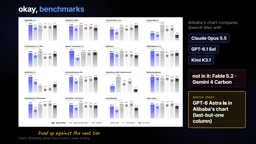
Even in this curated comparison, the results are mixed. Qwen 4 Max wins on the DeepSUE coding agent test with 75.7 points; leads on Agent's Last Exam, which assesses computer use, with 46.7 points; and scores 21.3 on the legal agent benchmark HLAB, versus just 9.2 for Opus 5.5—a clear advantage. But on Terminal Bench 4.0, Qwen 4 Max's 48.5 falls behind Opus's 59.6 and Kimi's 67.2; on Program Bench, 31.5 versus Opus's 65—a gap of more than double; on Humanity's Last Exam, 51.7 versus 59.8. In total, Qwen 4 Max leads in 3 rows while Opus 5.5 leads in 7—and this is still a table where Alibaba picked the opponents.
Independent evaluators are more direct. Artificial Analysis gives Qwen 4 Max an intelligence index of 42.9, versus 59.1 for Opus 5.5 in max-effort mode and 64.6 for Fable 5.2—a gap of over 20 points. Val's AI's evaluation is relatively closer: Qwen 4 Max scores 63.2% versus 71.3% for Fable 5.2. Overall, on major independent leaderboards, Qwen 4 Max clearly lags behind the frontier.
When interpreting benchmark conclusions, it's important to distinguish the "intelligence index" from single-task benchmarks. Artificial Analysis's intelligence index is a composite score that weights and combines multiple heterogeneous evaluations (reasoning, coding, math, instruction following, etc.) for easy cross-model comparison, but the choice of weights affects rankings and it shouldn't be treated as an absolute measure of capability.
Terminal Bench 4.0 assesses a model's ability to complete multi-step command-line tasks in a real terminal environment, emphasizing tool use and error recovery; Program Bench focuses on end-to-end generation from natural language to executable programs; Humanity's Last Exam is a set of highly difficult interdisciplinary expert questions used to probe the upper limits of knowledge; Agent's Last Exam and HLAB are closer to agentic operations and legal professional scenarios. So "leading in a few rows and trailing in most" often reflects task-type preference rather than overall strength.
Additionally, vendor-built comparison tables typically select opponents and task combinations that favor themselves; when evaluating, prioritize independent third-party reproductions using the same prompts and same scoring scripts.
Real-World Task Performance: It Can Do the Work, but It's Slow and Details Need Attention
Beyond leaderboards, actual use cases are more telling. The Atomic Agent team gave Qwen 4 Max a real coding task: a stock library containing 13 planted bugs and one missing feature, verified by 59 hidden tests. Qwen 4 Max passed all 59 tests across three runs, while the previous generation Qwen 3.8 Max failed to complete even once—a significant generational improvement.

But the time cost cannot be ignored: Qwen 4 Max took about 25 minutes, Opus 5.5 about 4 minutes, and GPT-6.1 Sol less than two and a half minutes—and Sol was also cheaper (about 29 cents versus Qwen's 65 cents).
Kingie.ai's larger-scale test covered 10 practical tasks, 5 models, 2 runs each, for a total of 200 scoring stages: GPT-6 Astra led with 19.8/20, Sol at 19.6, Opus at 19.2, Qwen 4 Max at 18.65, and Fable 5.2 came last at 17.3 due to partial output failures or truncation. On cost, Qwen 4 Max was about $3.60, while Fable 5.2 reached $61—fourth in quality, second-lowest in cost. Both notable failures occurred in customer support tasks, entering a zero value for a refund that had not yet been determined.
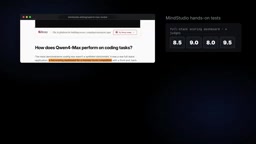
MindStudio's hands-on test showcased highlights: in a full-stack sports scoring dashboard, Qwen 4 Max found a hidden bug where < should be <= without prompting (the bug caused the fourth judge's score to be discarded), rebuilt the app, reset the database, and verified the fix; from a hand-drawn sketch of a grill, it built a working simulation in about 15 minutes, including rotation speed, heat, slice thickness, and meat color gradients; it invented sports team names in 82 languages, completing in about 4 minutes with none missed. A tester on X said Qwen 4 Max autonomously performed six rounds of improvement for his chip benchmark, visually checking frame by frame and repeatedly fixing, taking about a day and consuming only half of his $5 plan—and said this was the first Qwen model that truly surprised him.
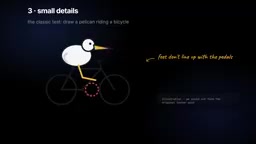
Problems also exist. First is speed: testers widely report it's slower than competitors, and the coding test confirms this. Second is game design judgment: in the GameFeel test, which assesses whether a model can judge if a game change is balanced, the preview version scored 10.3, lower than the older Qwen 3.8 Max's 12.1, and even worse than early small-size Qwen 4 models. Third is detail: in the classic "pelican riding a bicycle" test, a tester found the pelican's feet weren't actually aligned with the pedals—it looked complete, but wasn't precise enough. Fourth, the subscription behind the preview version doesn't allow app backends or automation scripts, making it still inconvenient to build real products.
"Thinking levels" refer to how many internal reasoning steps a model is allowed to take before answering. Qwen 4 Max offers three levels—low, high, and ultra-high—with high as default; the higher the level, the more likely the model is to perform multiple rounds of self-checking and tool calls, usually improving quality but also increasing latency and token consumption. This explains the real-test phenomenon of "high pass rate but long duration and non-trivial cost": the gap between 25 minutes and a few minutes in coding tasks largely comes from reasoning budget configuration and the number of agent loops.
For users, a reasonable approach is to switch levels based on task complexity—use low for simple rewrites, high for complex debugging—and set timeouts and retries in automated pipelines to avoid a single call stretching indefinitely.
Conclusion: Not Frontier, but Close Behind
Is Qwen 4 Max a frontier model? Based on independent data, the answer is no—Artificial Analysis shows it trails Fable 5.2 by over 20 points, and even in Alibaba's own hand-picked table, Opus 5.5 wins the majority of rows, while the strongest models weren't even invited to compete.
But the key point is: it doesn't aim to beat Fable at Fable's price, but to approach the frontier at extremely low cost. In real work tests, it completed tasks the previous generation Qwen couldn't, and stayed in the same order of magnitude at a price far below Opus. For users running agents daily or doing large-scale coding tasks, the bill matters more than the leaderboard. More noteworthy is the upcoming open weights—if Alibaba releases a similarly capable smaller Qwen 4 model, its impact could exceed that of Max itself.
"Open weights" and "open API" represent two different degrees of openness. Closed weights mean users can only call through Alibaba Cloud's interface, unable to deploy locally, fine-tune, or audit the model's internals; open weights allow downloading parameters to run yourself, facilitating data compliance, offline scenarios, and secondary training, but also impose compute requirements. Alibaba says it will later release smaller open-source Qwen 4 models; if such models maintain similar capability density, they could cover edge and private deployment scenarios at lower deployment cost, so their ecosystem impact may not be smaller than Max itself.
Another number that needs clarification is parameter count: the "2.4 trillion" circulating online is actually the confirmed scale of the previous generation Qwen 3.8 Max; Qwen 4 Max has not officially disclosed its parameters, and under a mixture-of-experts (MoE) architecture, total parameters and activated parameters are often conflated—interpretation should be based on official releases.
One-line Summary
Qwen 4 Max approaches the frontier at one-ninth the price—outstanding value but not top-tier.
Paragraph Summary
Alibaba released Qwen 4 Max, priced at about one-ninth of Fable 5.2's output cost, offering a 1 million token context and three thinking levels, with weights not open-sourced. In Alibaba's hand-picked benchmark table it leads in 3 rows while Opus 5.5 wins 7, and the strongest models weren't compared; independent evaluation gives an intelligence index of 42.9, over 20 points behind the frontier. In real tasks it passed all 59 hidden tests where the previous generation failed completely, but took about 25 minutes and cost more than GPT-6.1 Sol; generating in 82 languages and building a simulation from a sketch were impressive, yet issues remain: slow speed, degraded game-balance judgment, and imprecise details. The conclusion is that it doesn't beat the frontier on performance but approaches it at extremely low cost, suitable for high-frequency agents and large-scale coding, and upcoming open-source small models may be even more impactful.
Related articles
GPT-6.2 Sol/Astra Released: ChatGPT Plus Subscription Guide and Plan Comparison
After GPT-6.2 Sol/Astra's release, how should you choose a ChatGPT membership? This article distills a Bilibili tutorial's key points, explaining the differences between Go, Plus, and Pro tiers and who each suits, plus practical steps for account registration and quick subscription—helping you pick the right plan without wasting money.
GPT 6.2 Astra/Sol Community Use Cases and In-Depth Review
GPT 6.2 Astra/Sol review: strong in 3D modeling and Computer Use, but weak in aesthetic alignment and intent understanding. Benchmarks vs Claude Fable 5.2 and value analysis.
Anthropic IPO Explained: $104B Loss, $1T Valuation — How to Make Sense of It?
Anthropic IPO deep dive: $33B revenue, $104B loss, near-$1T valuation. Decode paper losses from convertible notes, 29x P/S, $900B commitments, and founder control.