Qwen-Audio-Jev: A Unified Audio Decision Interface with 20x Faster Inference

Qwen-Audio-Jev replaces autoregressive text generation with a decision head, achieving ~20x speedup in audio decision-making.
Qwen-Audio-Jev is the Qwen team's solution that layers a Jev decision head on top of Qwen-Audio-3.1-ASR-Flash-Next, unifying audio decisions into three primitives—CHOICE, NOUL, and SCORE—and directly outputting probability distributions or scores, skipping autoregressive text generation to achieve ~20x inference acceleration in high-throughput scenarios. Across 18 annotation configurations: MMAU-mini accuracy 78.70%, MMSU 84.06%, VoxCeleb1-O EER 6.50%, NISQA normalized MAE 0.1062, Pearson 0.8210, Spearman 0.8074. Its core value is decoupling decision efficiency from open-ended understanding generation while preserving underlying audio understanding, suitable for large-scale audio screening, speaker verification, and automated quality assessment. Limitations: answer specifications must be clear, and evaluation is concentrated on English benchmarks.
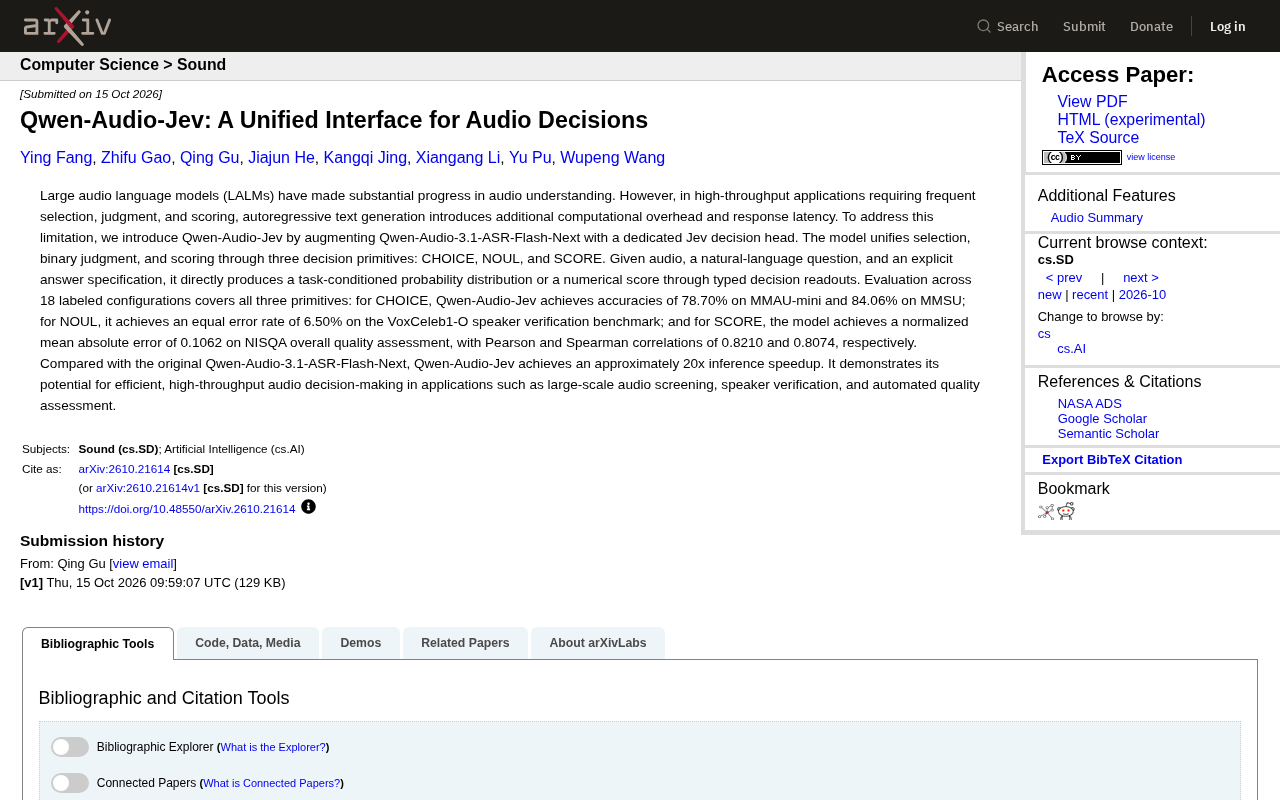
Large Audio Language Models (LALMs) have made significant progress in audio understanding, but in high-throughput scenarios that require frequent selection, judgment, and scoring, autoregressive text generation introduces extra computational overhead and response latency. The Qwen team's solution is Qwen-Audio-Jev—by adding a dedicated Jev decision head on top of Qwen-Audio-3.1-ASR-Flash-Next, it transforms audio decision-making from "generate text then parse" to "directly output decisions."
Core Idea: Replacing Text Generation with Three Decision Primitives
The traditional approach is to have an audio language model generate a natural language response, then parse out options, judgments, or scores from it. This pipeline works fine for a single interaction, but when applied to large-scale audio screening or batch quality inspection, running autoregressive decoding every time quickly escalates costs.
Qwen-Audio-Jev's approach is to converge decision tasks into three primitives: CHOICE (select from candidates), NOUL (binary judgment), and SCORE (numerical scoring). Given audio, a natural language question, and an explicit answer specification, the model directly produces the task-conditioned probability distribution or numerical score, returning results through typed decision readouts—skipping the intermediate step of text generation.
The value of this design lies in the fact that it does not overturn the original audio understanding capability, but rather layers a lightweight decision layer on top of it. The underlying model is still responsible for understanding the audio and the question; the decision head is only responsible for mapping the understanding results into usable decision outputs.
Autoregressive text generation refers to a decoding method where the model predicts and outputs a complete text sequence token by token, with each step depending on the output of the previous step. LLM responses, translations, and summaries are all essentially generated this way. The cost of this approach is that even if only a single label is ultimately needed (such as "yes/no" or a particular option), the model must first generate the entire sentence word by word, then parse out the result through post-processing. When Q&A becomes high-frequency requests like batch screening or quality inspection, the accumulated overhead of token-by-token decoding becomes the main bottleneck. The core improvement of Qwen-Audio-Jev is precisely to bypass this generation process and map directly from the model's internal representations to structured decision outputs.
Actual Performance of the Three Primitives
The paper evaluated 18 annotation configurations, covering all three primitives.
On CHOICE, Qwen-Audio-Jev achieved 78.70% accuracy on MMAU-mini and 84.06% on MMSU. Both benchmarks test the model's ability to select the correct answer from multiple options, representing typical audio understanding tasks.
On NOUL, on the VoxCeleb1-O speaker verification benchmark, the Equal Error Rate (EER) was 6.50%. Speaker verification is a classic binary judgment scenario—whether two audio segments come from the same speaker—and the model directly provides a judgment rather than generating an explanation.
On SCORE, on NISQA overall quality assessment, the normalized mean absolute error was 0.1062, with a Pearson correlation coefficient of 0.8210 and a Spearman correlation coefficient of 0.8074. This means the model's audio quality scores maintain a high correlation with human ratings.
Where Does the 20x Speedup Come From
Compared to the original Qwen-Audio-3.1-ASR-Flash-Next, Qwen-Audio-Jev achieves approximately 20x inference acceleration.
This number needs to be understood in its specific context. The speedup does not come from a smaller model or reduced precision, but from eliminating the overhead of autoregressive text generation. Under the original architecture, even if the question is simply "do these audio segments belong to the same speaker," the model must generate a complete response token by token; the decision head directly outputs a probability distribution or score, greatly shortening the computational path. For applications that need to process thousands of audio files, this difference directly determines whether a solution is viable.
Applicable Scenarios and Limitations
The paper explicitly points to three types of applications: large-scale audio screening, speaker verification, and automated quality assessment. The common characteristics of these three scenarios are fixed decision types, batch processing needs, and sensitivity to latency.
It should be noted that this "decision head" model presupposes that the answer specification is sufficiently clear. If the question itself is open-ended and requires generating explanations or reasoning processes, text generation is still necessary. Qwen-Audio-Jev solves the "decision" problem, not the "understanding" problem—it enables the model to quickly provide answers on the basis of already understanding, rather than replacing understanding itself.
Additionally, the evaluation is concentrated on English benchmarks, and performance in multilingual scenarios remains to be verified. The CHOICE primitive's 78.70% accuracy on MMAU-mini also indicates that audio selection tasks still have room for improvement.
A decision head is a lightweight output module attached after the backbone model in a neural network, responsible for mapping the representations extracted by the backbone into the output form required for a specific task. In classification tasks, it is typically a linear layer with softmax; in regression tasks, it is a linear output. Unlike generative decoding, the computation of a decision head involves only a single forward pass and does not require step-by-step token generation. Qwen-Audio-Jev's Jev decision head is exactly this structure: the underlying Qwen-Audio model continues to handle audio and text understanding, while the decision head directly reads out the corresponding probability distribution or numerical value according to the three task specifications of CHOICE, NOUL, and SCORE. This "separation of understanding and decision" design means the backbone model does not need to be retrained—only a small number of parameters need to be added at the output end to support new decision types.
Background Supplement
Equal Error Rate (EER) is a standard metric for binary judgment tasks such as speaker verification and biometric recognition. It refers to the error rate at a decision threshold where the false rejection rate (mistaking the same speaker for different) equals the false acceptance rate (mistaking different speakers for the same). A lower EER indicates that the system's balance between "sensitive" and "conservative" is more ideal. It should be noted that EER is not accuracy at a fixed threshold, but rather a comprehensive measure of the trade-off between the two types of errors, and is therefore often used to compare the discriminative ability of different verification systems horizontally. VoxCeleb1-O is a commonly used evaluation set in the speaker verification field, containing a large number of short speech segments from real-world scenarios.
Normalized mean absolute error (normalized MAE), Pearson correlation coefficient, and Spearman correlation coefficient are three commonly used statistics for evaluating scoring tasks. MAE measures the average deviation between predicted scores and human reference scores, and normalization facilitates cross-dataset comparison; the Pearson correlation coefficient characterizes the degree of linear correlation between predicted values and reference values, with values closer to 1 indicating more consistent linear trends; the Spearman correlation coefficient is based on ranking and measures the consistency of the two in terms of rank, being more robust to nonlinear monotonic relationships. NISQA is a representative dataset for speech quality assessment, and human ratings typically come from subjective listening experiments, so these three metrics together reflect how closely the model's scoring approaches human perception.
One-line Summary
Qwen-Audio-Jev replaces autoregressive text generation with a decision head, achieving approximately 20x acceleration in audio decision-making.
Paragraph Summary
Qwen-Audio-Jev is the Qwen team's solution that layers a Jev decision head on top of Qwen-Audio-3.1-ASR-Flash-Next, unifying audio decisions into three primitives—CHOICE, NOUL, and SCORE—and directly outputting probability distributions or scores, skipping autoregressive text generation to achieve approximately 20x inference acceleration in high-throughput scenarios. Across 18 annotation configurations, MMAU-mini accuracy is 78.70%, MMSU 84.06%, VoxCeleb1-O EER 6.50%, and NISQA normalized MAE 0.1062, Pearson 0.8210, Spearman 0.8074. Its core value lies in preserving the underlying audio understanding capability while decoupling decision efficiency from open-ended understanding generation, making it suitable for large-scale audio screening, speaker verification, and automated quality assessment. The limitation is that answer specifications need to be clear, and evaluation is concentrated on English benchmarks.
Related articles

Free Unlimited Claude Code Solution: Agnes AI + CC Switch Setup Guide
No paid subscription needed — pair the free AI platform Agnes AI with the open-source tool CC Switch to provide a backend for Claude Code, enabling unlimited free calls to text, image, and video models. This guide covers the full setup, test results, and usage boundaries.

A Complete Zero-Cost Guide to Getting Started with Claude Code for Beginners in China
A beginner's guide to Claude Code for users in China: two installation methods (command line and IDE plugin), full configuration steps for replacing the official API with the free domestic LongCat model, and a hands-on demo of building a small tool with natural language, plus tips.

When the NSA Gets Involved: The AI Supply Chain Crisis Behind Open-Source CVEs and API Key Hijacking
Multiple open-source projects disclosed severe CVEs in one day, PHP flaws alarmed the FBI, and Railway and OpenCode were breached with API keys stolen. This article breaks down the vulnerability window, AI-accelerated exploitation, and the AI supply chain crisis behind the API key black market, with a developer defense checklist.