Qwen Code CLI Review: A Terminal Coding Agent Where Five Models Race

Qwen Code is an open-source multi-model terminal coding agent; Agent Arena racing shines, but cost and configuration hurdles are high.
Qwen Code is Alibaba's open-source terminal coding agent derived from Gemini CLI, licensed under Apache 2.0. Its core selling point is connecting to any model — OpenAI, Anthropic, Gemini, local Ollama, and more — with runtime switching. The highlight of the review is Agent Arena: up to five models work on the same task in parallel, each in its own worktree, and only the winner's code is applied to the main workspace, turning model selection from an upfront decision into after-the-fact filtering. However, the feature is still experimental and the documentation is contradictory. The product also offers desktop, browser, and editor plugin forms, though the review only tested the terminal version. The main weaknesses are cost and configuration: the free login channel closed in April 2026, the official plan is $50 per month with daily quotas, local models require a seven-step wizard or manual command-line setup, and usage statistics are enabled by default. The final verdict is recommended, suited to developers who value model freedom and are willing to tinker with configuration.
Qwen Code CLI is Alibaba's open-source terminal coding agent derived from Gemini CLI, licensed under Apache 2.0 and built around "bring any model" and "Agent Arena multi-model racing." According to a hands-on review by the YouTube channel Nova, it stands out for open-source flexibility and multi-model comparison, but the shutdown of free login access and cumbersome local model configuration are major drawbacks.
A terminal agent grown from Gemini CLI
Qwen Code's DNA is clear: it was born from Google's Gemini CLI, but it completely decouples "model binding." Any model provider can be connected, including OpenAI, Anthropic, Gemini, and local Ollama-style services, with support for switching at runtime.
This matters a great deal for terminal workflows. Developers don't have to switch tools just to switch models — within the same CLI they can move back and forth between cloud LLMs and small local models. The open-source license is Apache 2.0, keeping barriers low for commercial use and redistribution.
Terminal coding agent refers to an AI program that uses a command-line interface as its interaction medium, capable of autonomously reading files, executing commands, modifying code, and iterating on verification. Unlike IDE autocomplete plugins, it typically has a high degree of autonomy: the user gives a natural-language goal, and the agent plans its own steps, invokes shell and file tools, and repeatedly corrects itself based on errors until the task is complete or human confirmation is needed. Gemini CLI, Claude Code, and Aider all fall into this category. Their value lies in packaging "model capability" into a scriptable, composable Unix toolchain, making it easy to plug into automation scenarios such as CI and batch refactoring.
Agent Arena: five models race, only the winner's code survives
The most highly regarded feature in the review is Agent Arena. In the Alibaba environment, it lets up to five models work on the same task in parallel, each running in its own worktree; when they finish, it presents a comparison of results and applies only the winner's code to the main workspace.
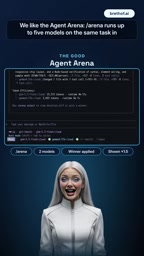
This design solves a real pain point: single-model output quality is inconsistent, and manually trying each one is costly. Letting multiple models race from the same starting line and then having the developer pick the result turns "model selection" from an upfront decision into after-the-fact filtering.
However, Nova also notes that the feature is still experimental, and the official documentation itself is contradictory on "whether you see the diff before applying." In other words, the direction of the racing mechanism is right, but the engineering maturity isn't yet at the level where you can rely on it blindly.
worktree is a multi-workspace mechanism provided by Git: the same repository can mount multiple independent working directories, each checking out a different branch, with file changes in each not interfering with the others. Compared with traditionally copying the repository or frequently stashing/switching branches, worktrees share the same .git object database, so creation and destruction are both cheap. Agent Arena leverages exactly this: each model independently modifies code in its own worktree, avoiding conflicts from multiple agents writing to the same files at once; after the race ends, only the winner's worktree is merged back into the main workspace, while the losers' changes are discarded without a trace.
Beyond the terminal: desktop, browser, and editor plugins
Qwen Code isn't limited to the terminal. It also offers a desktop app, a browser-based app, editor plugins, and even a chat app form.
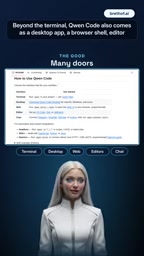
The reviewer only tested the terminal version, so there's no first-hand data on how these peripheral forms actually perform. But from the product layout, Alibaba clearly wants to make Qwen Code a cross-entry-point coding agent, not just a command-line tool. For developers used to graphical interfaces, this lowers the onboarding barrier; for terminal purists, the core capability remains in the CLI.
Cost and configuration: two unavoidable hurdles
The free era is over. Qwen's free login channel closed in April 2026, and Alibaba's own coding plan is priced at $50 per month, sold in limited daily quotas.

Local models are the other path, but the configuration experience is poor. The in-app wizard requires seven steps, manually entering the address, a placeholder key, and the model name; although there's also a command-line way to do it, it's not friendly to users unfamiliar with config files. The reviewer's assessment is blunt: local models have to be set up by hand.
There's another easily overlooked detail: usage statistics are enabled by default.
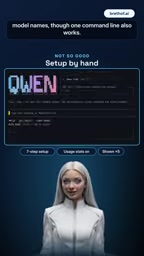
For privacy-conscious teams, this is an option that needs to be checked and adjusted before deployment.
Ollama is one of the most commonly used tools for running local LLMs today: a single command pulls and starts open-weight models like Llama, Qwen, and DeepSeekAd, and exposes an HTTP service on the local machine compatible with the OpenAI API specification (listening on port 11434 by default). As a result, any client that supports a custom base URL can point requests at Ollama for fully offline inference. The "enter the address, placeholder key, and model name" mentioned in the article is exactly this pattern: the address is the local port, the key is left blank or filled with anything, and the model name corresponds to an entry in ollama list. How smoothly you can connect a local model depends heavily on how friendly the client's guidance through this configuration process is.
Verdict and who it's for
Nova's final judgment is "recommended," for three reasons: Apache 2.0 open source, support for any provider including local models, and Agent Arena's multi-model racing capability. The deductions are equally clear: free login terminated, the official plan at $50 per month, and local model configuration done by hand.
This tool is better suited to developers willing to tinker with configuration and who value model freedom — especially teams already using local models or needing cross-validation across multiple models. If you expect an out-of-the-box, zero-config experience, the current Qwen Code still needs another round of polish. Note that this review was independently produced without sponsorship, with the full content published on breathoff.ai.
Qwen Code represents a pragmatic product philosophy: rather than betting on a single strongest model, it hands the choice to developers and engineers "model selection" through a racing mechanism. How far this path goes depends on whether Agent Arena can evolve from an experimental feature into stable infrastructure.
Related articles

WorkBuddy Agent in Action: From AI Q&A to Automated Office Work
WorkBuddy is Tencent's AI agent desktop workbench that reads local files, operates office software, executes multi-step tasks, and runs on schedules. This article explains its core features, key differences from traditional AI tools, and use cases.

Anthropic Research: LLMs Make Formal Software Verification at Scale Possible
Anthropic Frontier Red Team research shows LLMs can generate formal proofs at the RISC-V assembly level for over 100 real open-source libraries, covering 123 OSS-Fuzz libraries and 239 entry points, totaling about 180 million lines of Rocq proofs and finding hundreds of bugs. The article analyzes specification generation, the proof pipeline, trust boundaries, and cost reduction paths.

Prompt Engineering for Beginners: From Writing Prompts to Building AI Collaboration Skills
From the four functions of prompts to the six-step prompt engineering process, this article systematically covers core concepts, business value, and three layers of limitations to help beginners build a complete cognitive framework for prompt engineering.