Qwen Image 2.1 Comes to ComfyUI: Can It Shake Up the Open-Source Image Model Landscape?

Qwen Image 2.1 enters ComfyUI — community says weak datasets are its flaw, editing is its only edge.
Alibaba's Qwen Image 2.1 has submitted a PR to ComfyUI, sparking widespread discussion in the local AI image generation community. Users benchmarked it against Krea2 (diversity), ZIT (realism), and Klein9b (editing), noting the text-to-image space is already saturated and a new model only needs to win on one dimension. The most concentrated criticism targets the Qwen/Wan team's dataset quality — users feel the "lack of taste" in training data persists regardless of architecture updates. At the same time, the previous Qwen Edit's strong performance on animated character editing gives some users cautious optimism about the new version. The community broadly agrees: if Qwen Image 2.1 can differentiate itself in the editing space against Klein9b, it earns a clear place in the ComfyUI ecosystem — otherwise it risks becoming just another forgettable text-to-image competitor.
Alibaba's Qwen Image 2.1 submitted a PR to ComfyUI, sparking heated debate in the local AI generation community on Reddit. Whether this model can carve out a foothold in the fiercely competitive open-source image generation space has drawn a mix of praise and skepticism. This article breaks down those discussions to paint a clearer picture of where the open-source image model race stands today.
Three Mountains Qwen Image 2.1 Must Climb
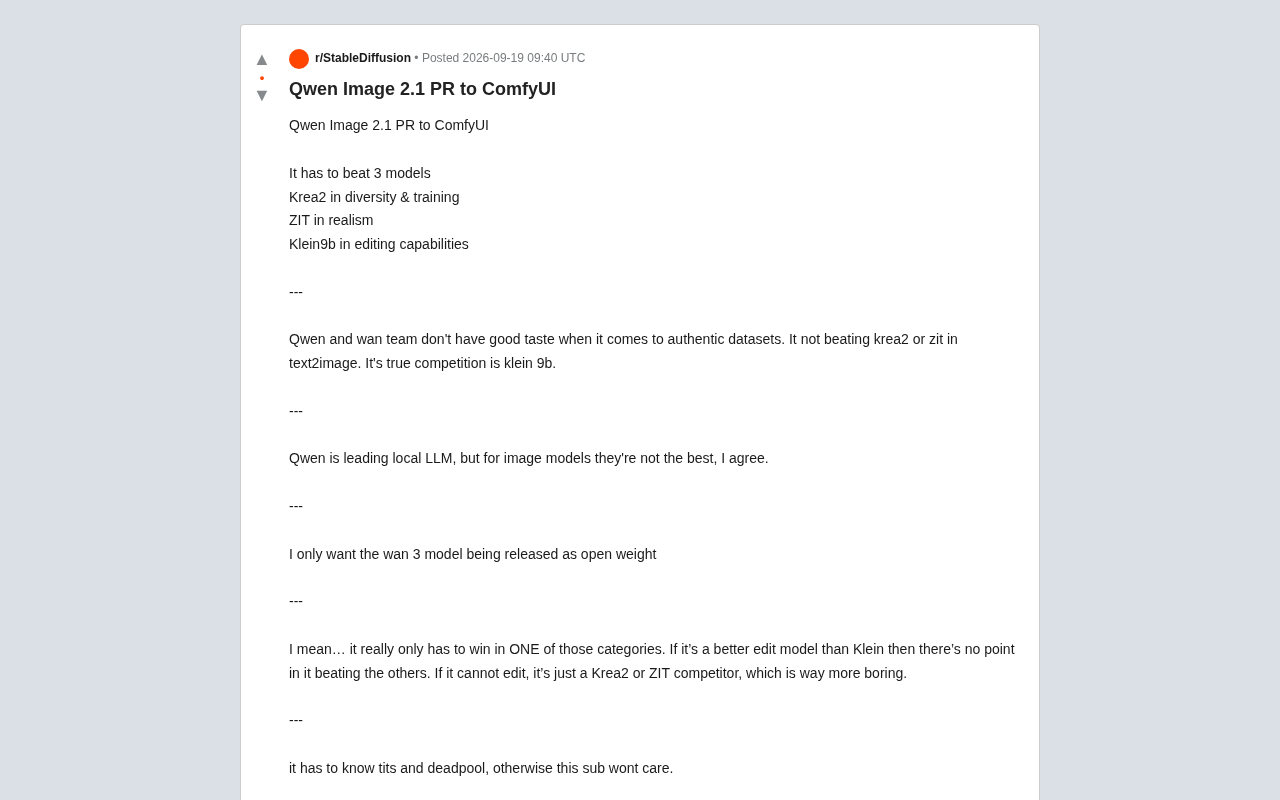
In community discussions, Qwen Image 2.1 is being benchmarked against three models, each representing a distinct technical direction:
- Krea2: Leading in diversity and training quality
- ZIT: Superior in realism
- Klein9b: Standout performance in image editing
One commenter cut straight to the point: Qwen Image 2.1 only needs to win on a single dimension to justify its existence. "If it's a better editing model than Klein, then it doesn't need to beat the others at everything else. But if it can't edit, then it's just another competitor to Krea2 or ZIT, which is way less interesting."
This observation captures a hard truth about the current open-source image model landscape — the pure text-to-image space is already crowded, and differentiation is the only viable path for any new model.
The competing models mentioned here all represent notable directions in recent open-source image generation. Krea2 is a generative model from Krea AI, known for stylistic diversity and high-quality training data, widely used in artistic creation workflows. ZIT (Zero-shot Image Translation) focuses on photorealistic output with a clear edge in portrait and scene fidelity. Klein9b is an image-editing-focused model with around 9 billion parameters, supporting operations like local modifications and style transfer on existing images — it has built a large user base in the ComfyUI community thanks to being open-source and locally runnable. ComfyUI itself is an open-source, node-based workflow frontend for Stable Diffusion that lets users freely chain together models and post-processing steps through a drag-and-drop interface, making it one of the dominant interfaces for local AI image generation. Submitting a PR to ComfyUI means the model developers want their support nodes merged into ComfyUI's official or community-maintained node library, significantly lowering the barrier to entry for everyday users.
Community Consensus: Dataset Quality Is the Achilles' Heel
Among all the discussion threads, criticism of dataset quality from the Qwen (and Wan) team is by far the most concentrated concern. Multiple users voiced similar takes:
"Qwen and the Wan team have no taste in real datasets. It won't beat Krea2 or ZIT on text-to-image. The real competition is Klein 9b."
"Qwen leads in local LLMs, but on image models they're genuinely not the best."
One user who tried Qwen Image 3.0 was even more blunt: "Tried Qwen image 3.0, same terrible dataset, this team won't change, I'm out." A highly upvoted reply added: "The most important part of training a model is dataset quality, and they still haven't figured that out — maybe they never will."
This criticism reflects a widely held belief in the field: while model architecture matters, the quality, diversity, and annotation standard of training data are often the deciding variables in image generation output. Qwen's success in language models has not translated directly to the image domain.
In image generation, "dataset quality" encompasses multiple dimensions: the aesthetic standard and resolution of the images themselves; the accuracy and granularity of text captions; data diversity (distribution across different styles, lighting conditions, and compositions); and data cleanliness (removing low-quality, duplicated, or mislabeled samples). Even with an identical diffusion model architecture, differences in training data will directly affect the model's ability to interpret prompts, the richness of its generation style, and the consistency of its outputs. The Qwen team has deep expertise in data engineering for large language models, but the logic behind curating and annotating image data is fundamentally different from text data — it relies far more heavily on human aesthetic judgment, something that can't simply be compensated for by scale alone. This is why some experienced users believe that even if Qwen Image upgrades to version 3.0, the "cheap" aesthetic of its outputs won't disappear unless the underlying data pipeline is fundamentally overhauled.
Editing Capability: Qwen's Potential Advantage
Despite the criticism, some users remain optimistic about Qwen's image editing capabilities. One user said:
"Can't wait. The old Qwen Edit is still my go-to open-source SOTA for editing animated characters, so I have high hopes this one will be even better."
This echoes the earlier point about only needing to win on one dimension — if Qwen Image 2.1 can build on and strengthen its editing capability to directly rival Klein9b, it will have a clear positioning and user base within the ComfyUI ecosystem, without needing to go head-to-head with Krea2 and ZIT on diversity and realism.
Image editing is a distinct technical direction within generative AI, with different core challenges from text-to-image generation. Text-to-image requires a model to generate an image from scratch that matches a prompt, while image editing requires the model to respond precisely to localized modification instructions (e.g., "replace the background with a forest" or "change the character's shirt to red") while preserving the original image's structure, lighting, and style. Achieving this typically relies on instruction tuning or diffusion-based inpainting techniques, and requires specially constructed training data in the form of (original image, instruction, modified image) triplets. SOTA (State of the Art) is a common AI term referring to the best-performing method or model on a given task at a particular point in time. The user noting that "the old Qwen Edit is still the open-source SOTA for editing animated characters" suggests the model is competitive at localized editing tasks that preserve character consistency — a niche capability in strong demand among the anime and animation creation community.
What the Open-Source Community Actually Wants
The discussions also surface the distinctly pragmatic motivations of this user community. One user half-jokingly noted that a model "needs to know how to generate certain types of content, otherwise this subreddit won't care" — an indirect reflection of one of the major draws of locally deployed image models: bypassing the content restrictions of commercial services.
Other users are looking further ahead: "I just want the Wan 3 model released with open-source weights." This suggests the community's expectations for Alibaba's model teams are ongoing — image models are just one piece of a larger picture.
Conclusion
Qwen Image 2.1's PR submission to ComfyUI marks its official entry into the local image generation arena. Based on community feedback, its biggest weakness is dataset quality, while its most promising opportunity lies in image editing capability. Whether it can carve out a differentiated foothold in the editing space dominated by Klein9b will determine whether this model becomes yet another "mediocre text-to-image also-ran" or a tool the community actually remembers.
It's worth noting that all opinions in this article come from Reddit community discussions. The model comparisons are largely based on subjective user assessments, and actual performance will need to be validated through broader hands-on testing once the model is officially integrated.
Related articles

GPT-Next Leak, Gemini 4 Argon Imminent: AI News Roundup
GPT-Next leak suggests extreme efficiency; OpenAI's 28-day shipping pledge boosts speed 50%; Gemini 4 Argon nears release; Anthropic subscription value report sparks debate.

GPT-Next Leaked, Gemini 4 Argon Speeds Up, Fable 5.5 May Launch Today
OpenAI's GPT-Next model leaks, expected to be extremely low-cost and possibly part of the 28-day release plan; Gemini 4 Argon internal testing accelerates, NanoBanana 2.1 is live; Semi Analysis tests show Claude Max's equivalent API value is about 5 times that of ChatGPT Pro; Fable 5.5 may launch today.

Gemini 4 Argon Launches Globally: Key Highlights from the AI Daily Brief
Google opens Gemini 4 Argon globally across Pro and Ultra subscriptions and the API, and demonstrates robot control. This article rounds up open-source models, Agent infrastructure, cost transparency, and safety governance updates.