Qwen Next-Gen, DeepSeek V4, New GLM Spotted Simultaneously: China's LLM Race Accelerates
Qwen KLab, DeepSeek V4 GA, and new GLM are all in testing at the same time, signaling rapid iteration in China's LLM race.
Three major Chinese AI labs — Alibaba (QWEN/KLab), DeepSeek, and Zhipu AI (GLM) — are simultaneously testing next-generation flagship models. Early results show strong performance in coding, 3D generation, and visual design, signaling an accelerating iteration pace and a new competitive battleground in China's large model ecosystem.
China's AI Lab Race Heats Up Again
There are no signs of the AI boom cooling down — especially in China's large model space, where several leading labs appear to be simultaneously in the final stretch of their next-generation flagship releases. Recent signals from multiple sources point to three major developments: Alibaba's Tongyi Qianwen (QWEN) next-generation model, the DeepSeekAd V4 GA (General Availability) release, and Zhipu AI's (Z.ai) new GLM version — all of which have entered closed testing or gradual rollout phases.
Taken together, these three developments send a clear signal: the iteration pace of Chinese large models is accelerating markedly, and these labs are no longer content with merely catching up — they're pushing for breakthroughs in high-difficulty domains like coding, 3D tasks, and visual design. This article breaks down all three developments and analyzes the underlying technical trends.
Qwen Next-Gen: The Mystery Contestant in Coder Arena
Two brand-new models under secret testing — codenamed KLab and Terrania Alpha — have been spotted on the Coder Arena platform.
About Coder Arena: Coder Arena is an evaluation platform specifically designed for assessing AI models' code generation capabilities. It operates similarly to Chatbot Arena (LMSYS) with a blind-testing mechanism — users rate multiple anonymous models without knowing their identities, producing relatively objective capability rankings. The platform's core value lies in measuring model performance through real user tasks rather than fixed benchmarks, and it's particularly effective at capturing differences in complex, open-ended programming tasks. Labs often use such platforms to test unreleased models anonymously, collecting genuine feedback without prematurely revealing product details. The appearance of KLab and Terrania Alpha on this platform is a typical signal that a lab has entered its final pre-release sprint.
The prevailing view in the community is that KLab is Alibaba's next-generation flagship QWEN model, with early test results — particularly on complex 3D programming tasks — looking quite impressive. Terrania Alpha remains more mysterious, with fewer test samples available, making it difficult to determine its origin.
One telling detail: both models appear to have recent knowledge cutoff dates, strongly suggesting they are the latest frontier model checkpoints. Interestingly, KLab repeatedly identified itself as "Cloud" during testing, but users have identified several output patterns and tokenization characteristics unique to the QWEN series — for example, it misinterprets NL postal codes as special strings, responds as if it received an empty prompt in some cases, and its handling of certain political questions points toward a Chinese AI lab.
According to messages circulating in QWEN-related communities, someone who spoke with an Alibaba contact at a conference in Paris revealed that the new Qianwen version aims to surpass GLM 5.2 in capability, with an even higher version to follow. These claims haven't been officially confirmed, but when a secret model enters public testing, a formal release is typically not far off.
Hands-On: Landing Pages and 3D Generation Stand Out
In hands-on tests, testers asked KLab to generate a landing page featuring multiple shaders and different component packages. Shaders are small programs running on the GPU that handle the rendering calculations for lighting, materials, shadows, and other visual effects in 3D scenes — they are a core component of modern real-time graphics rendering. Writing correct shader code (typically in GLSL or HLSL) requires a solid grasp of graphics math, GPU parallel computing principles, and the rendering pipeline, making it one of the most technically demanding programming tasks. A model's performance on such tasks offers a comprehensive look at its ability to handle complex multi-step reasoning, domain-specific knowledge, and long-context code generation. Compared to standard algorithm problems or web development tasks, 3D shader generation is much harder to tackle through simple memorization of training data, making it an important benchmark for evaluating the true reasoning capabilities of frontier models.
The test results were impressively complete: not only was an intuitive, user-friendly interface generated, but the model also added background animations, scroll-triggered effects, and demonstrated strong typography and design sensibility — exceeding prior expectations for AI-generated landing pages. On 3D tasks, its performance was strong enough to rival current mainstream flagship models, which is an encouraging sign for an as-yet-unannounced model.
DeepSeek V4 GA: Gradual Rollout Continues to Expand
The gradual rollout of DeepSeek V4 GA (General Availability) continues to expand, with more users gaining access and sharing impressive outputs across various platforms.
About Gradual Rollout: A gradual rollout (also known as gray release) is a standard engineering practice in internet product launches, where a new version or model is progressively made available to a small subset of users rather than being released to everyone at once. The core purpose is risk management: by testing with a small portion of real traffic, teams can verify system stability, catch potential bugs, assess server load, and collect user feedback — all before a full public launch. For large models, a gradual rollout also serves as an organic marketing warm-up: early-access users often share generated content on social platforms, creating natural word-of-mouth. The continued expansion of DeepSeek V4 GA's rollout typically signals that the technical team has high confidence in system stability, and a full launch is imminent.
Public outputs show significant improvements in code quality, visual design, and overall reliability.
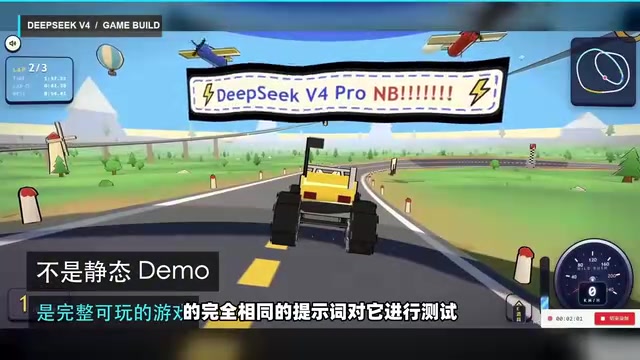
Two of the most striking examples: first, a Windows 11 recreation that mimics the look and feel of the real operating system with remarkable fidelity — numerous small components faithfully replicate system functionality, with SVG icon code written for each individual app, a well-rendered Microsoft Edge, and built-in Notepad, Paint, and even a 3D neon racing game. Second, a hybrid game built entirely in HTML that blends the aesthetics of Minecraft and No Man's Sky, supporting full exploration gameplay with terrain, environmental details, buildings, and a cohesive visual style — far from a crude tech demo.
How to Tell If You're Using the New Model
Users have noticed that the V4 GA version may use phrases like "I'm" and "Owl" in its chain-of-thought reasoning, rather than the "Let Me" phrasing common in older versions — a useful identification clue. Additionally, DeepSeek had previously promised to send a 24-hour notice before any pricing changes take effect, so if the official release announcement is real, users may receive an email ahead of time.
Distillation Controversy: Is DeepSeek Drawing on Closed-Source Models?
Leakers including Leo have investigated and found that DeepSeek may be collecting outputs from multiple closed-source models — including Claude — via API, for use in large-scale distillation.
Background on Knowledge Distillation: Knowledge distillation is a classic technique in deep learning, formally introduced by Hinton et al. in 2015. The core idea is to have a smaller "student model" learn from the output distribution of a large "teacher model," rather than only learning from raw labeled data. In the era of large models, this has evolved into calling top closed-source models' APIs at scale to obtain their outputs and using those as training data to improve one's own model — known in the industry as "API distillation" or "output distillation." This practice is legally and ethically controversial: the terms of service for OpenAI, Anthropic, and similar companies explicitly prohibit using their outputs to train competing models. However, because it's technically difficult to fully trace and prove, such practices remain common in the industry and have become a central point of tension between the open-source and closed-source ecosystems.
Several intriguing observations emerged during testing:
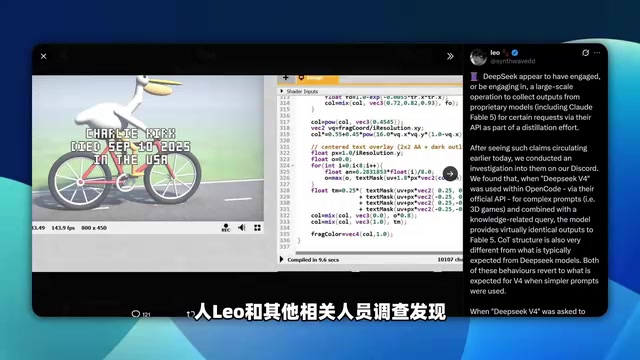
- When handling complex prompts, what appears to be the V4 checkpoint sometimes generates outputs highly similar to a certain closed-source frontier model, with a chain-of-thought style very different from the DeepSeek style users are familiar with;
- When switching to simpler prompts, the model's behavior reverts to the familiar DeepSeek style;
- Most interestingly, when cybersecurity or biology-related requests known to trigger safety classifiers were embedded within the same 3D coding prompts, output quality suddenly dropped sharply.
One explanation is that some complex requests are first processed by a closed-source proprietary model, and once a classifier is triggered, the request gets rerouted to a different model. The research team also found that DeepSeek's routing behavior appears to have been changing continuously. While this evidence isn't conclusive proof of distillation or routing, the consistency of the similarities, the classifier behavior, and the sudden quality drops make the hypothesis difficult to fully dismiss.
In fact, multiple labs have been accused of similar practices — Anthropic has even claimed that QWEN has done the same. From a user perspective, as long as it results in a product that performs close to top closed-source models at a fraction of the cost, it remains a significant net positive for the ecosystem.
New GLM Version: Zhipu's Next Move
The third piece of news comes from Zhipu AI (Z.ai). According to reports, the Zhipu team has launched public testing of the next-generation GLM model. The new model may be GLM 5.3 or 5.5, or could skip directly to a 6-series version (though the latter is considered less likely).
GLM Series Background: GLM (General Language Model) is a large language model series jointly developed by Tsinghua University and Zhipu AI. Its technical approach differs significantly from the mainstream GPT architecture — GLM uses an Autoregressive Blank Infilling pre-training objective that unifies both autoencoding and autoregressive language model tasks within a single framework. Since the open-sourcing of GLM-130B, Zhipu has continued iterating with the ChatGLM series, progressively evolving to GLM-4 and the 5.x versions, building strong competitive capabilities in Chinese language understanding, multimodal functionality, and tool calling. Zhipu's market strategy spans both enterprise (ToB) services and consumer (ToC) products, and its open-source tradition has maintained significant influence in the academic and developer communities.
Public details remain limited. The only certainty is that testing is underway on Zhipu's internal platform, and a contact from the Zhipu team has revealed that the new large model will officially launch soon — most likely within the next quarter.
Coding Capability Emerges as the New Battleground
Looking across all three developments, several common trends are visible in the race among Chinese large models:
Coding and 3D generation have become the core competitive arena. Whether it's KLab's landing pages and 3D tasks, or DeepSeek V4's OS recreation and game generation, the focus is on demonstrating comprehensive capability in complex engineering tasks.
Release cadence is unprecedentedly tight. All three labs are pushing new versions in nearly the same time window, with competitive pressure continuously shortening iteration cycles.
Cost efficiency and open source remain core advantages for Chinese models. With aggressive pricing, DeepSeek is poised to launch an extremely cost-effective coding model that could further challenge the market position of closed-source flagships.
It's worth emphasizing that none of the above information has been officially confirmed, and actual release timelines and final performance should be verified against official announcements. That said, given the signs — secret models entering public evaluation, gradual rollouts continuing to expand — a wave of dense new model releases may already be imminent.
Key Takeaways
Related articles

Cursor AI Programming in Practice: Build a Student Management System from Scratch in 30 Minutes
A Bilibili creator demonstrates Cursor AI programming: generating a student management system in 30 minutes with natural language. Details on Agent mode, Claude selection, prompt techniques, and thresholds.

Top 20 AI Coding Tools Ranking: From Rock-Solid to Lackluster, a Scored Matrix
Bilibili creator releases top 20 AI coding tools ranking, tiered T0–T4 from rock-solid to lackluster, with Claude Code and Codex tied at T0. This article details the scoring dimensions (capability, reliability, robustness, durability, cost, domestic availability) and tool performances to help developers choose the right AI coding assistant.

Vibe Coding Systematic Tutorial: Master AI-Assisted Programming from Zero
A three-month Vibe Coding tutorial from a Bilibili creator covering Codex, ClaudeCode, and Cursor, from core logic to commercial project practice for beginners.