Qwen3 27B + DeepSeek Harness: Local AI Finally Breaks Free from Frontier Models
Qwen3 27B + DeepSeek Harness combo lets local AI fully replace cloud frontier models for the first time.
A hands-on review of the new Qwen3 27B finds roughly 30% improvement at matched quantization levels — notable but not the generational leap hoped for. The real breakthrough comes from DeepSeek's Harness tool framework, which uses intelligent context compression and task tracking to sustain stable sessions of 38 million tokens on local hardware. Combined with the new model, the author built a browser-controlling local agent and went 24 hours of intensive use without once needing to switch to a cloud-based frontier model — calling it another "DeepSeek moment." Harness is MIT-licensed, making it a meaningful step forward for AI sovereignty.
When the next-generation Qwen3 27B model launched, many local AI enthusiasts had high hopes. One content creator who had been using the previous Qwen3 27B as their daily driver — and even bought a new machine with a 5090 GPU specifically for it — came away with a nuanced verdict: the model itself didn't improve as dramatically as expected, but its combination with DeepSeek's new tool framework, Harness, finally freed him from depending on cloud-based frontier models entirely.
This article breaks down the real gains from this upgrade based on his hands-on testing, the "DeepSeekAd moment" the tool framework delivered, and the hardware realities of running large language models locally.
The Model Upgrade: Clear Progress, But Not a Generational Leap
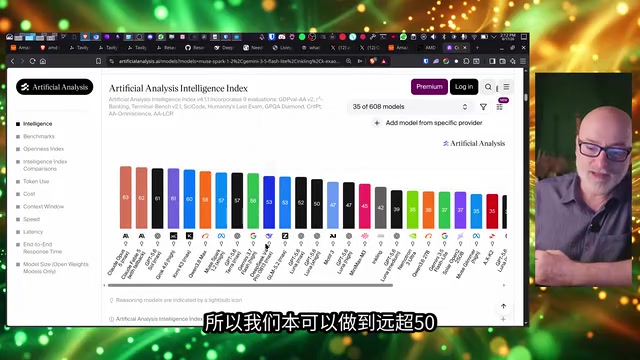
On paper, the new Qwen3 27B's improvements look substantial. Agentic coding scores jumped from 13.3 to 42.2, software engineering tasks climbed from 49.3 to 79, and frontier agentic benchmarks more than doubled from 10.6 to 20. These numbers briefly put it in the same conversation as top-tier models like Opus 4.6.
But hands-on testing told a more measured story. Comparing the previous Q6 quantized version against the new Q5 on a vulnerability-finding task, the older Q6 actually found one more bug. For a fair comparison, he ran both at the same quantization level (Q6 for both old and new), and only then saw a real difference — roughly a 30% improvement, notable but not transformative.
The disappointment stems from higher expectations. Looking at how models like Luna leaped when reasoning was added (jumping from 27 to 47, more than doubling), he had hoped that the new Qwen combining model improvements with enhanced reasoning would break past 50 — reaching the level of top DeepSeek or GLM configurations. The actual result landed around 40. "Maybe my expectations were just too high," he joked.
The Real Surprise: DeepSeek Harness
The model fell short of expectations, but the headline news from this review is at the tooling layer. He emphasized a point that often gets overlooked: intelligence isn't just about the model itself — it's also about the tool framework built around it.
He had long relied on Hermes paired with OpenCode, but grew uncertain about Hermes after it introduced a subscription model. Right at that moment, DeepSeek released a brand-new tool framework called Harness, built around the philosophy of "everything is a plugin" — a design that closely matched his own approach of "everything as an add-on" when building systems. He didn't even install it manually; he had Hermes handle the Harness installation and model configuration automatically.
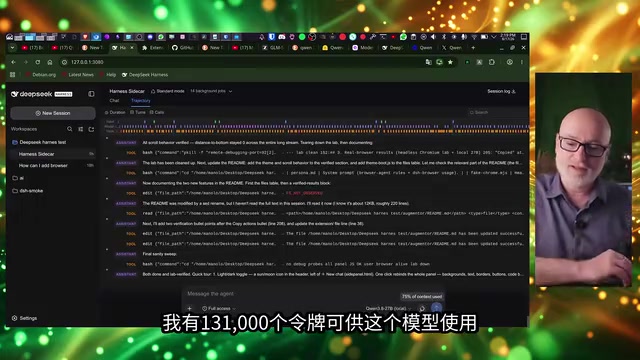
What impressed him most about Harness was its approach to context window management. The framework tracks all completed tasks, which means it uses the context window far more efficiently. On his 32GB VRAM machine, the model has around 13,000 tokens available, but those tokens "last longer and compress more stably." He demonstrated a session that had been running for a long time, accumulating 38 million input tokens while still operating reliably. As a caveat, Harness is still a "developer preview" and occasionally crashes if compression is triggered at the wrong moment — but a simple "continue working" prompt is enough to resume.
Context Window refers to the total amount of text a large language model can "see" at once, which directly determines its memory boundary during long conversations or complex tasks. Locally-run smaller models are constrained by VRAM, so their usable context is often far smaller than cloud-based models. Harness innovates here by using task tracking and intelligent compression to make better use of limited token budgets — completed subtasks are offloaded from the active context, leaving only key summaries, significantly extending effective working length within the same VRAM. This is fundamentally different from the blunt approach of "fill the context then truncate," and more closely resembles how humans maintain "working memory" across long projects.
In Practice: Building a Fully Local Browser Agent
To test this combination's capabilities, he used it to build an agent called "Enhancer" as a plugin for his ResonantOS (Fair Operating System). This agent includes a deep search tool, can fully control a browser, click automatically, and extract information.
He tasked the agent with reviewing videos from a specific channel, reading comments, and generating content ideas. The agent autonomously checked four or five videos, read the comments, and offered suggestions. He admitted the ideas themselves weren't particularly valuable (due to lack of channel context), but the point was that the entire pipeline ran successfully.
One finding was repeatedly emphasized: there was no need to switch to a larger model at any point. With the previous Qwen3 27B, roughly 80% of tasks could be completed locally, but complex problems forced a switch to cloud-based frontier models. With the new model plus DeepSeek Harness, across 24 hours of intensive use, he "not once" felt the need for a more powerful model.
He called this "another DeepSeek moment" — but this time, the breakthrough wasn't in the model; it was in the tooling, and it came from DeepSeek. Even more significantly, Harness is MIT-licensed, free to modify and use commercially, which represents a meaningful step forward for local AI and the concept of AI sovereignty.
Agent in AI refers to a system capable of autonomously planning and executing multi-step tasks, as opposed to a "chat model" that handles single exchanges. Its core capability lies in tool-calling — the model doesn't just generate text, it can trigger external actions (like browser clicks, file reads and writes, code execution) and adjust its next steps based on the results. Browser agents are among the more demanding types, requiring the model to reliably map natural language instructions to precise DOM operation sequences and self-correct when page structures change. Local models at the 27B parameter scale were previously considered insufficient for reliably driving such tasks — which is exactly why the author treats this successful run as a "DeepSeek moment."
Hardware Reality: How to Balance Quantization and VRAM Bandwidth
Understanding the limits of local deployment matters too. He offered detailed configuration guidance.
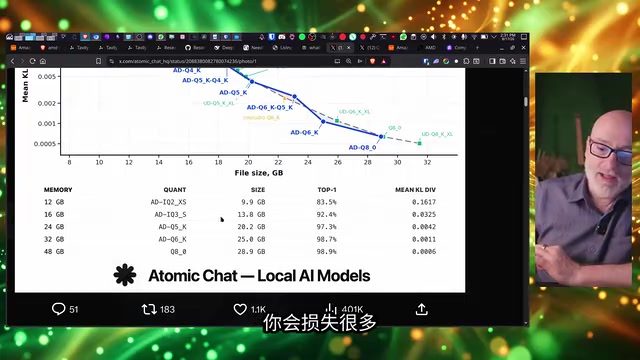
Quantization trade-offs: Q6 loses only about 0.2% performance compared to Q8 — a worthwhile compromise. Q5 loses roughly 1.4%–1.6% compared to the highest-precision version, which is generally acceptable. But on precision-sensitive tasks like vulnerability hunting, Q6 can find one more bug than Q5. His recommendation: choose Q5 if you need a larger context window, and upgrade to Q6 for advanced specialized tasks.
VRAM and bandwidth: Whether a model runs depends on VRAM capacity; how fast it runs depends on bandwidth.
- The official minimum is 12GB VRAM, with 48GB as ideal. He personally agrees with 48GB, since it unlocks a much larger context window.
- 32GB tier: The 5090 delivers ~1,792 GB/s bandwidth, reaching roughly 110 tokens/sec on his machine; AMD's equivalent at ~640 GB/s comes in at close to one-third of that speed.
- 24GB tier: The 3090 is affordable used and offers ~1,000 GB/s bandwidth with strong price-to-performance; AMD's equivalent is cheaper than a 4090 while approaching similar speeds.
- Two 24GB cards can combine for 48GB — he'd choose Q6 with a larger context rather than Q8 (since Q8 is actually slower than Q6 at this tier).
- DGX Spark can also run the model at around 20–30 tokens/sec, which is still usable; the ASUS DGX Spark variant includes 128GB memory, enabling an extra-large context or multiple simultaneous instances.
Quantization is the technique of compressing model weights from high-precision floating point (e.g., FP16/BF16) into lower-bit integer representations, trading some accuracy for smaller VRAM footprint and faster inference. Q8 means 8-bit quantization (close to original precision); Q6 and Q5 reduce precision further. The key distinction: VRAM capacity determines whether a model can be loaded at all, while VRAM bandwidth (data transfer rate, measured in GB/s) determines inference speed — because generating each token requires the GPU to read all weights from memory. This explains why the 5090 with its higher-bandwidth HBM memory (1,792 GB/s) runs nearly three times faster than comparable AMD solutions (~640 GB/s), and also why the smaller Q6 can sometimes outrun Q8 in speed: a smaller model means lower bandwidth consumption per token.
Closing Thoughts: The Value of Local AI Is Shifting
Summing up the experience, his take is clear and measured: the new model didn't deliver the leap he was hoping for, and the real generational jump might have to wait for the fourth generation. But the combination of DeepSeek Harness with Qwen3 27B showed him something he'd never seen before.
He likened the feeling to when OpenCode (then called Cloudbot) first launched — the moment everyone suddenly had an agent that could control a computer and complete tasks autonomously. Now DeepSeek has achieved a similar leap through tooling, dramatically expanding what a 27B local model can actually do.
It may be too early to draw firm conclusions, but a trend is clearly emerging: when the tool framework is strong enough, the practical value of local AI is improving at a visible pace. For developers who care about data sovereignty and cost control, "saying goodbye to frontier models" may no longer be just a slogan.
Related articles

GPT-Next Leak, Gemini 4 Argon Imminent: AI News Roundup
GPT-Next leak suggests extreme efficiency; OpenAI's 28-day shipping pledge boosts speed 50%; Gemini 4 Argon nears release; Anthropic subscription value report sparks debate.

GPT-Next Leaked, Gemini 4 Argon Speeds Up, Fable 5.5 May Launch Today
OpenAI's GPT-Next model leaks, expected to be extremely low-cost and possibly part of the 28-day release plan; Gemini 4 Argon internal testing accelerates, NanoBanana 2.1 is live; Semi Analysis tests show Claude Max's equivalent API value is about 5 times that of ChatGPT Pro; Fable 5.5 may launch today.

Gemini 4 Argon Launches Globally: Key Highlights from the AI Daily Brief
Google opens Gemini 4 Argon globally across Pro and Ultra subscriptions and the API, and demonstrates robot control. This article rounds up open-source models, Agent infrastructure, cost transparency, and safety governance updates.