Qwen3-4B Fine-Tuned to Remove AI Writing Tics, Show HN Project Draws Attention

Show HN project fine-tunes Qwen3-4B to remove AI writing clichés, exploring a path for style control in small models.
This article introduces a Hacker News project that fine-tunes the Qwen3-4B model to remove AI writing clichés. It analyzes the causes of mechanical AI writing, including templated pre-training data and RLHF's preference for safe, polite responses. The project uses instruction fine-tuning (SFT or DPO) to teach more natural expression, choosing the 4B model for its low cost, easy iteration, and easier taming. It notes small model fine-tuning is an underestimated path suitable for individual developers but requires balancing accuracy and professionalism. Despite cold community reaction, the direction is worth watching and could transfer to other open-source models for a universal de-AI-flavor solution.
In today's world flooded with AI-generated content, a project titled "Show HN: Qwen3-4B with the AI writing tics trained out" quietly appeared on the Hacker News community. The project attempts to fine-tune the Qwen3-4B model to remove common "clichés" and "verbal tics" in AI writing, making the output closer to natural human expression. Although the post has low engagement (only 3 points, 0 comments), the pain point it targets—the mechanical feel of AI text—is worth discussing in depth.
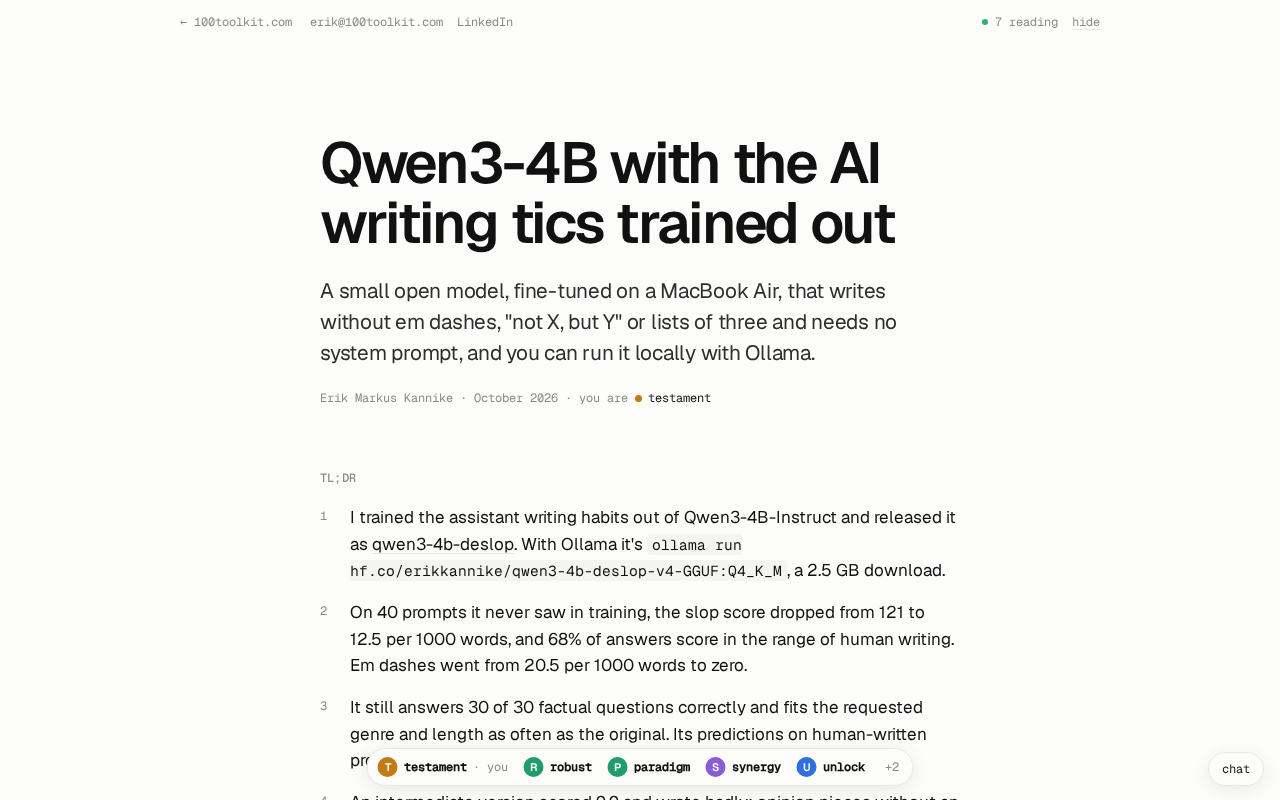
Why Does AI Writing Always Have a "Flavor"?
If you frequently use large language models, you'll notice they favor certain sentence patterns: opening with "First," using "To touch on a detail" for transitions, and always ending with "In the end." These writing habits are jokingly called "AI tics" by the community.
The reasons for this phenomenon are not complicated. During the pre-training phase, models absorb massive amounts of text, which includes a large amount of templated and structured content (such as Wikipedia, tutorials, and press releases). At the same time, Reinforcement Learning from Human Feedback (RLHF) tends to reward "safe, comprehensive, and polite" responses, further reinforcing this steady and unremarkable style. As a result, the model learns to use a set of universal phrases to respond to various questions, sacrificing diversity and personality of expression.
For content creators, marketers, and even ordinary users, this "AI flavor" not only affects the reading experience but may also raise trust issues—readers can recognize machine-generated content at a glance, thereby reducing their evaluation of the information's value.
RLHF (Reinforcement Learning from Human Feedback) is a key training stage that aligns model outputs with human preferences. Its process typically has three steps: first, collect human preference ranking data for multiple model responses, train a reward model to predict which responses humans would prefer, and then use reinforcement learning algorithms (such as PPO) to optimize the language model so that it generates high-reward responses. The problem is that the reward model often prefers "safe, comprehensive, and polite" responses because annotators tend to give higher scores to such responses. This leads the model to learn a set of "universal phrases," i.e., using steady and unremarkable templates to respond to various questions, thereby sacrificing diversity and personality of expression.
Qwen3-4B Fine-Tuning Approach
The core idea of this Show HN project is straightforward: use instruction fine-tuning to make the model "forget" those clichés. Although the project page does not disclose complete training details, it can be inferred from the title that the author built a contrastive dataset containing "AI-flavored" text and "humanized" text, and adjusted the model's output distribution through supervised fine-tuning (SFT) or preference optimization (such as DPO).
Qwen3-4B is a small model with 4 billion parameters, suitable for running on consumer-grade hardware. Choosing this scale for experiments is wise: fine-tuning costs are low, iteration is fast, and small models are often easier to "tame" for specific style control than large models. Large models, due to their stronger capabilities, may stubbornly retain writing patterns learned during pre-training.
This "de-AI-flavor" fine-tuning is not an isolated case. Previously, community projects have attempted to weaken AI traces through prompt engineering (such as asking the model to "write like a high school student") or post-processing, but fine-tuning starts from the model weights level, making the effect more thorough and stable.
Supervised Fine-Tuning (SFT) refers to continuing training a pre-trained model with "input-output" paired data so that the model learns to follow instructions or imitate a specific style. Its essence is maximum likelihood estimation: given an input, maximize the probability of the target output. In the "de-AI-flavor" task, SFT data is usually "AI-flavored" input paired with "humanized" output, and the model changes its writing habits by imitating the latter. DPO (Direct Preference Optimization) is a preference optimization method that does not require a reward model. It directly uses "preference pairs" (a chosen response and a rejected response) to optimize the model, making the model more inclined to generate the chosen response. Compared to RLHF, DPO is simpler and more stable, suitable for small-scale fine-tuning.
Small Model Fine-Tuning: An Underestimated Path
Under the industry trend of pursuing larger parameter counts, fine-tuning practices for small models like Qwen3-4B provide a reverse perspective: rather than using hundred-billion-parameter models to generate uniform text, it is better to use hundred-million-parameter models plus carefully designed fine-tuning data to produce more personalized content.
This is especially attractive for individual developers and small to medium-sized teams. On one hand, the 4B model can be fine-tuned on a single consumer-grade GPU (such as RTX 3090/4090), with controllable costs; on the other hand, open-source models (such as the Qwen series) allow free modification and distribution, without API call restrictions.
However, small model fine-tuning also has obvious shortcomings. The 4B model has limited knowledge capacity and performs weakly on tasks requiring deep reasoning or specialized knowledge. While removing AI writing habits, how to maintain content accuracy and logic is a difficult balance that such projects need to address. If the fine-tuning data quality is not high, the model may learn new bad habits or become too casual and lose professionalism.
Parameter-Efficient Fine-Tuning (PEFT) techniques such as LoRA (Low-Rank Adaptation) can significantly reduce fine-tuning costs. LoRA freezes the original model weights and only injects trainable low-rank matrices into the attention layers, reducing the number of training parameters to less than 0.1% of the original model. For the 4B model, using LoRA, fine-tuning can be completed on a single RTX 3090 (24GB VRAM) in just a few hours. In addition, the 4B model has limited knowledge capacity and performs weakly on tasks requiring deep reasoning or specialized knowledge, which is an inherent shortcoming that small model fine-tuning needs to weigh.
Community Reaction and Future Highlights
This Show HN post currently has only 3 points and zero comments, indicating that it has not yet attracted widespread discussion. This may be related to limited presentation information—no demo, no detailed technical report, and it is difficult for community members to evaluate the effect based solely on the title.
However, the direction of the project is worth watching. As the proportion of AI-generated content on the internet continues to rise, "how to make AI write like a human" is becoming a real demand. Whether for social media copy, personal blogs, or customer service conversations, removing the mechanical feel can improve user experience. In the future, if the author can disclose training data, evaluation results, and comparison examples, it is believed that more developers will be interested.
Another highlight is whether this "style fine-tuning" can generalize to other models. If the method is effective, it can theoretically be transferred to open-source models such as Llama and Mistral, forming a universal "de-AI-flavor" fine-tuning solution.
Final Thoughts
The "verbal tics" of AI writing are a byproduct of technological development and a result shaped by human feedback mechanisms. This fine-tuning experiment with Qwen3-4B reminds us that a model's capabilities depend not only on parameter scale but also on how we guide it to express itself. While pursuing stronger performance, teaching AI to "speak well" may be the next direction worth investing in.
One-line Summary
Show HN project fine-tunes Qwen3-4B to remove AI writing clichés, exploring a path for style control in small models.
Paragraph Summary
This article introduces a Hacker News project that fine-tunes the Qwen3-4B model to remove AI writing clichés. The article analyzes the causes of the mechanical feel in AI writing, including templated content in pre-training data and RLHF's preference for safe and polite responses. The project uses instruction fine-tuning (SFT or DPO) to teach the model more natural expression, choosing the 4B small model because of its low cost, easy iteration, and easier taming. The article points out that small model fine-tuning is an underestimated path suitable for individual developers, but it needs to balance content accuracy and professionalism. Despite the cold community reaction, the direction is worth watching, and in the future it can be transferred to other open-source models to form a universal de-AI-flavor solution.
Related articles

WorkBuddy Full Tutorial: Build an AI Office Automation Agent from Scratch
A complete WorkBuddy tutorial: installation, three working modes, multimodal picture book video practice, expert team agent building, and workflow configuration for low-cost AI office automation.

WorkBuddy Agent Complete Guide: From Beginner to Automation in 7 Days
Based on Bilibili's 256-episode WorkBuddy masterclass, this systematically breaks down Tencent's AI office workbench core capabilities: Agent principles, Skill encapsulation, cross-platform connectors, scheduled automation, knowledge bases, and zero-code development, with learning path recommendations.

8 AI Accounts, 7 Failed: An Honest Review of Using AI to Get Work Done
Only 1 of 8 AI-run Bilibili accounts succeeded. We break down the real difference between "performing AI" and "using AI to get work done."