Qwen3.7 Max Deep Dive: 1T Parameter MoE Architecture with Full Agent Framework Compatibility

Alibaba's Qwen3.7 Max uses a 1T-parameter MoE architecture to build a unified model compatible with all major agent frameworks.
Alibaba's Qwen3.7 Max features approximately 1T parameters in an MoE architecture with a 256K context window, excelling across four dimensions: agent programming, general agents, hard reasoning, and multilingual support. Its core selling point is full compatibility with mainstream agent frameworks like LangChain, Claude Code, and Hermes, embodying a "good driver doesn't pick the car" philosophy of fundamental capability generalization. The model has also sparked industry debate on whether strong foundation models can reduce Harness toolchain dependency, with Alibaba providing evidence for the "model-first" viewpoint through environment-driven tool training methods.
Alibaba's "Unified" Model: What Makes Qwen3.7 Max Stand Out
Alibaba's latest release, the Qwen3.7 Max model, not only breaks records in parameter scale and performance metrics but also demonstrates an entirely new product philosophy — building a "globally unified" model. The official promotional materials cleverly incorporate elements from agent frameworks like LangChain, Hermes, and Claude Code, making it clear that this model's core selling point isn't just breakthroughs in individual capabilities, but comprehensive compatibility with mainstream agent ecosystems.
Notably, these three elements represent different layers of the current agent technology stack: LangChain is the most mainstream LLM application development framework, founded by Harrison Chase in 2022, providing standardized components for chain-of-calls, memory management, and tool integration; Claude Code is Anthropic's vertical agent product focused on software engineering scenarios; and Hermes is a model fine-tuning series specialized in optimizing Function Calling capabilities. Being compatible with all three means Qwen3.7 Max's compatibility spans the entire depth of the agent technology stack.
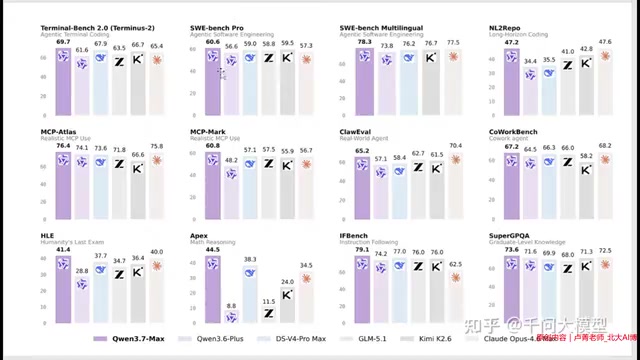
In terms of fundamental parameters, Qwen3.7 Max uses an approximately 1T-parameter MoE (Mixture of Experts) architecture with a context window of 256K tokens. MoE is a sparsely-activated neural network design whose core idea is to partition model parameters into multiple "expert" sub-networks, activating only a small subset during each inference pass — typically just 10%-20% of total parameters. This stands in stark contrast to traditional Dense Models that activate all parameters during every inference. The MoE architecture was first proposed by Jacobs et al. in 1991, but it truly shined in the large language model domain after 2022, when Google's Switch Transformer and Mistral's Mixtral 8x7B validated its industrial-scale feasibility. Therefore, a 1T-parameter MoE model's actual inference computational cost is far lower than a dense model of equivalent scale, striking an excellent balance between "model capability ceiling" and "inference economics." While the 256K context length isn't the absolute highest among current models, this architectural combination itself constitutes a significant competitive advantage.
Four Core Capabilities: Qwen3.7 Max's All-Round Performance
Based on officially published benchmark data, Qwen3.7 Max demonstrates clear competitiveness across four key dimensions.
Agent Programming: The Capability Developers Care About Most
Agent programming is the hottest direction in current AI applications and the capability developers focus on most. Qwen3.7 Max's performance in this area is described by the official team as "extremely formidable." In scenarios including code generation, tool calling, and long-workflow task execution, the model can handle complex programming agent tasks, standing toe-to-toe with mainstream solutions like Claude Code.
General Agent and Desktop Automation Capabilities
In general agent scenarios — including desktop application control, web interaction, and tool calling tasks — Qwen3.7 Max also shows a slight but clear leading edge. This "generality" is exactly what Alibaba is pursuing — not being the best in one specific scenario, but maintaining high standards across all scenarios.
The Business Logic Behind Hard Reasoning and Multilingual Support
In high-intellectual-intensity tasks like mathematical reasoning and logical analysis, Qwen3.7 Max maintains its leading position. The strengthening of multilingual capabilities reveals Alibaba's deeper commercial considerations: in the Token Economy era, exporting compute power overseas through API services is essentially a new export economic model of "selling Chinese electricity through tokens."
The "Token Economy" refers to a business model where billing is based on token consumption in API calls — each token corresponds to approximately 0.75 English words or 0.5 Chinese characters. From a macroeconomic perspective, large model inference is essentially highly intensive compute consumption, and China has a relative advantage in electricity costs and data center construction. When overseas users call Chinese large models through APIs, they are effectively purchasing Chinese compute resources — logic highly similar to traditional manufacturing export of goods, except the "goods" have shifted from physical products to computational services. The global non-English user base far exceeds English-speaking users, and the stronger the multilingual capability, the higher overseas users' willingness to pay — this is the core commercial driver behind Alibaba's strengthening of multilingual capabilities.
Framework Compatibility Testing: Why "A Good Driver Doesn't Pick the Car"
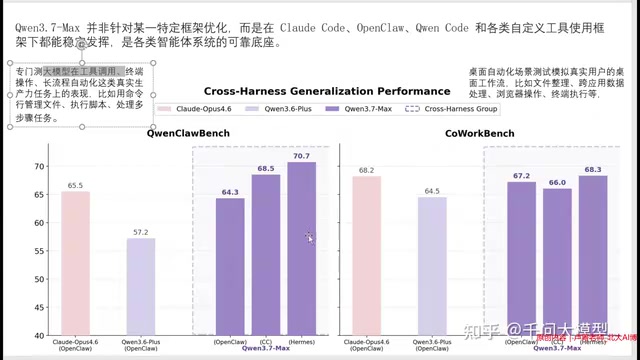
One of Qwen3.7 Max's most noteworthy features is its broad compatibility with different agent frameworks. The official team tested it on multiple mainstream agent frameworks including Claude Code and LangChain, with results showing excellent performance across evaluation metrics for tool calling, terminal operations, and long-workflow tasks.
This sends a clear signal: A model's strength should not depend on adaptation to a specific framework, but should be a manifestation of fundamental capability. To use a vivid analogy: "A good driver doesn't pick the car" — regardless of which agent framework you use, Qwen3.7 Max delivers stable performance.
In desktop automation scenarios, the model also surpassed Claude-series models and its predecessor Qwen3.6, further validating this framework-agnostic generalization capability.
Model Capability vs. Harness Dependency: An Unresolved Industry Debate

Qwen3.7 Max's performance has sparked an ongoing industry debate: When the foundation model is powerful enough, can dependency on Harness (toolchain/framework layer) be reduced?
"Harness" in the AI engineering context broadly refers to the toolchain and framework layer built around foundation models, including Prompt Engineering, Retrieval-Augmented Generation (RAG), tool call orchestration, error retry mechanisms, output format validation, and more. In the early days when large models had limited capabilities, well-designed Harnesses could often multiply a model's actual performance several times over, spawning numerous startups and open-source projects focused on "model wrapping." However, as powerful foundation models like GPT-4 and Claude 3 emerged, some problems that previously required Harness solutions (such as format adherence, multi-step reasoning, and tool calling) have been internalized by the models themselves, causing the marginal value of the "Harness tax" to decline. The essence of this debate is: Does the core competitive advantage of AI applications lie in the model layer or the engineering layer?
Two opposing viewpoints currently exist:
-
The Harness-first camp believes that models inherently have flaws and must rely on robust Harnesses to apply various "patches" to compensate for model shortcomings. Well-designed prompt engineering, tool orchestration, and error recovery mechanisms are all indispensable.
-
The model-first camp argues that as long as the foundation model is powerful enough, dependency on Harness can be significantly reduced. Harness is still needed, but is no longer the determining factor.
Through Qwen3.7 Max, Alibaba appears to be providing evidence for the latter viewpoint. From the training data perspective, the model employs environment-driven tool training methods — a specific application of reinforcement learning in large model training. Unlike traditional Supervised Fine-Tuning (SFT), this approach has the model execute tool-calling tasks in real or simulated environments, receiving reward signals based on execution outcomes (success/failure/partial success), and iteratively optimizing through reinforcement learning.
Related articles
 Tech Frontiers
A Rare Quiet Day in AI: Recursive Self-Improvement Stirs Beneath the Surface
A rare quiet day in AI sees multiple sources go silent simultaneously. Behind the calm, Recursive Self-Improvement (RSI) research continues. What this means for the industry.
 Tech Frontiers
Reve 2 vs. Ideogram 4: A Deep Dive into Layout Control in AI Image Generation
A deep comparison of Reve 2 and Ideogram 4's layout control capabilities, covering technical approaches, real-world use cases, and industry trends for designers and creators.
 Tech Frontiers
In the Weights: Check Your Influence Score in the AI World
In the Weights is an AI influence search engine that quantifies your presence in the AI world with a score. Explore how it evaluates practitioners and what it means for digital identity.