Qwen3.8 27B Scores 52 Points: How a Mid-Size Open-Source Model Is Rewriting the Performance Landscape

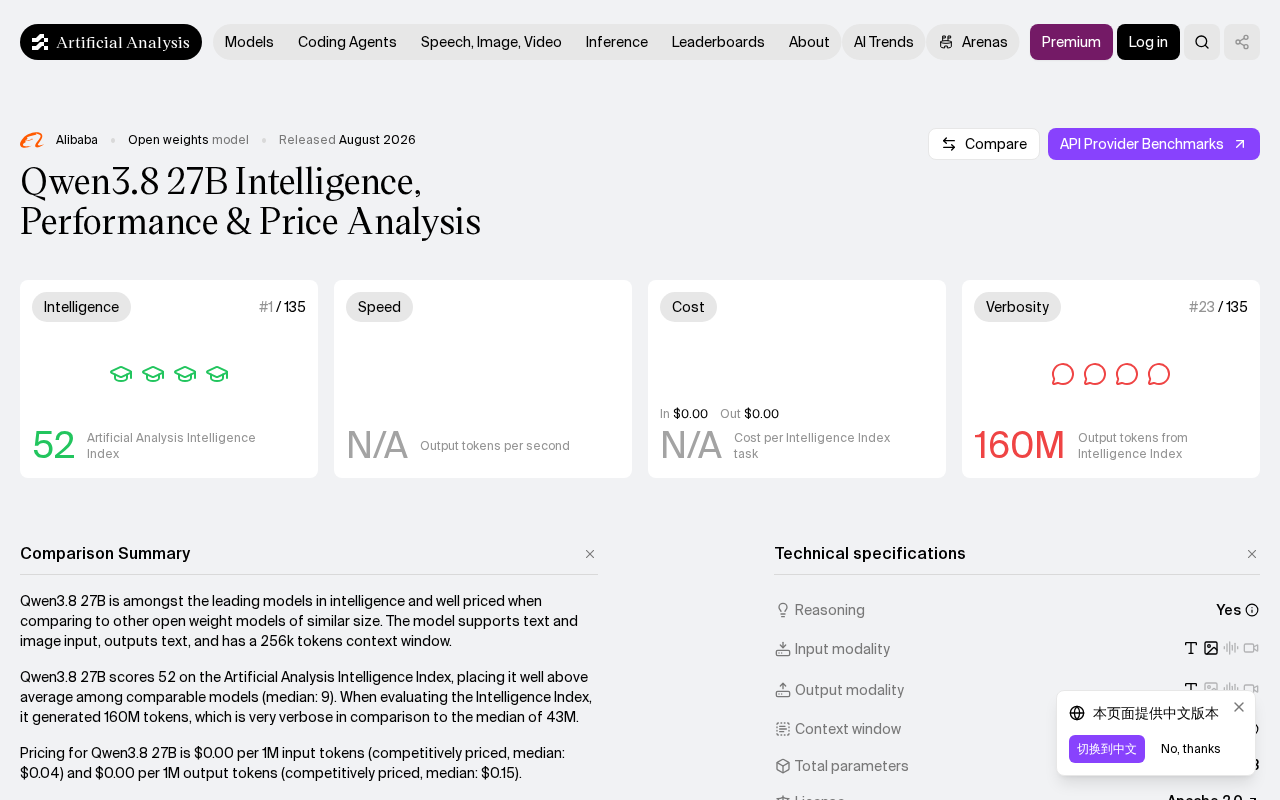
Qwen3.8 27B scores 52 on Artificial Analysis, proving mid-size open-source models can rival flagships.
Alibaba's Qwen3.8 27B achieved a composite score of 52 on Artificial Analysis, approaching flagship-level performance with only 27 billion parameters. The 27B size hits a deployment sweet spot—quantized to 4-bit, it runs on a single RTX 4090. This milestone highlights how better training data, post-training techniques, and efficient architectures are closing the gap between mid-size and massive models, reshaping open-source AI competition.
A 27B Model Shakes Up the Performance Leaderboard
Alibaba's Qwen team released a new model, Qwen3.8 27B, which scored 52 points on Artificial Analysis, a respected third-party evaluation platform. The news sparked heated discussion on Hacker News, garnering 291 upvotes and over 125 comments.
For a model with only 27 billion parameters, this score carries significant weight. Artificial Analysis is a widely recognized independent evaluation organization run by a team focused on AI benchmark transparency. Unlike community-driven leaderboards such as HuggingFace's Open LLM Leaderboard, it uses a unified, controlled testing environment to evaluate models across multiple dimensions. Its composite score (Intelligence Index) aggregates capabilities across reasoning, math (e.g., GSM8K benchmark), code (e.g., HumanEval benchmark), knowledge QA (e.g., MMLU benchmark), and other dimensions through a weighted algorithm—so a single number represents the model's overall intelligence level. Thanks to its consistent and independent testing methodology, the platform is considered a more reliable third-party evaluation source than self-reported scores from model developers. A score of 52 means Qwen3.8 27B is approaching, and in some scenarios even surpassing, flagship models with much larger parameter counts.
Why 27B Is the "Sweet Spot" for Open-Source Models
The Optimal Balance Between Performance and Deployment Cost
In the open-source model world, parameter scale often determines viable deployment scenarios. 7B-class models are lightweight enough to run on consumer-grade GPUs but have limited capability ceilings. 70B and larger models are powerful but impose steep memory and compute requirements that individual developers and small businesses can rarely afford.
27B sits right at a "sweet spot." At FP16 precision, a 27B model requires roughly 54GB of VRAM to load all weights—far exceeding the capacity of any single consumer GPU. But quantization changes the picture entirely. Quantization is a technique that compresses model weights from high-precision floating point (e.g., FP32 or FP16) to lower-precision formats (e.g., INT8, INT4), with common methods including GPTQ, AWQ, and GGUF formats. With 4-bit quantization, a 27B model's VRAM requirement drops to approximately 15–17GB, enabling smooth operation on a single 24GB GPU (such as an RTX 4090). Modern quantization algorithms use calibration datasets and mixed-precision strategies to keep accuracy loss minimal, so quantized models perform nearly as well as full-precision versions on most tasks. This means developers can deploy a model that is "good enough and genuinely useful" in local or private environments without relying on expensive cloud APIs or multi-GPU clusters.
Mid-Size Models Are Redefining Competitiveness
Qwen3.8 27B's performance further confirms a trend: model capability improvements no longer depend solely on stacking more parameters. Through higher-quality training data, more refined post-training, and more efficient architecture design, mid-size models are steadily closing the gap with much larger models.
Post-training refers to the process of further improving a model's capabilities and alignment after large-scale pretraining, through a series of fine-tuning techniques. This stage typically involves multiple steps: Supervised Fine-Tuning (SFT) uses high-quality instruction-response pairs to teach the model to follow human instructions; Reinforcement Learning from Human Feedback (RLHF) or Direct Preference Optimization (DPO) uses preference data to help the model distinguish good responses from poor ones; more recently, rule-based reinforcement learning (such as the GRPO method used by DeepSeekAd-R1) has shown significant results on math and code reasoning tasks. Post-training quality often matters more than pretraining data volume in determining the final user experience—and this is the key technical lever that enables mid-size models to approach the performance of much larger ones.
For the vast majority of real-world business applications, a 27B model that runs locally, responds quickly, and keeps costs under control may offer far more practical value than a massive model requiring prohibitively expensive compute.
Key Concerns from the Developer Community
Judging by the discussion activity on Hacker News, developers are paying close attention to advances in open-source mid-size models. Several recurring themes in the comments are worth noting:
Feasibility of Local Deployment
Many developers are interested in actual VRAM usage and inference speed after quantization, as well as performance differences across hardware configurations. The 27B size transforms "running a high-quality model on your own machine" from a slogan into reality. With inference frameworks like llama.cpp, vLLM, and Ollama, developers can conveniently load quantized models locally, and combined with memory optimization techniques like FlashAttention, achieve usable inference speeds on consumer hardware.
Horizontal Comparisons with Similar Models
The community instinctively compares new models against the broader ecosystem—is it stronger than similarly sized open-source models (such as Google's Gemma 2 27B or Mistral's mixture-of-experts models)? Where does it stand relative to closed-source APIs? The current open-source LLM competitive landscape is thriving: Meta's Llama series pioneered the open-source movement, Google's Gemma is known for efficient architecture, Mistral AI is recognized for elegant designs (such as Grouped Query Attention/GQA and sliding window attention), and Alibaba's Qwen series continues to push boundaries in multilingual capabilities and tool calling. The score of 52 sparked discussion precisely because it challenges established assumptions about the "capability ceiling" of smaller models.
The Reference Value of Benchmark Scores
More measured voices also remind us that any single benchmark score is just a reference point. Real-world performance—especially on domain-specific tasks, long-context processing, and instruction following—is the ultimate test of a model.
Long-context processing is one of the core technical challenges facing large language models. The attention mechanism in standard Transformer architectures scales quadratically with sequence length, meaning that processing 128K tokens or longer requires enormous compute resources and VRAM. The industry has adopted various techniques to address this, including Rotary Position Encoding (RoPE) and its extrapolation methods (such as YaRN and NTK-aware scaling), FlashAttention memory optimization, and sparse attention. For 27B-class models, long-context capability directly impacts usability in practical scenarios like document analysis and code comprehension. Therefore, high benchmark scores don't guarantee strong performance in every specific scenario—thorough scenario-specific testing remains essential.
The Qwen Series and the Evolution of the Open-Source Model Landscape
The Qwen series has consistently been a major force in the open-source LLM camp. From early versions to the current Qwen3.x, its iteration speed and capability improvements are evident. Qwen's technical evolution follows a clear trajectory: architecturally, it employs efficient designs like GQA (Grouped Query Attention) to reduce inference costs; for training data, it covers high-quality corpora in Chinese, English, and multiple other languages; in the post-training phase, it integrates alignment techniques including SFT, DPO, and function calling. The achievements of this 27B version reflect the technical maturity of Chinese teams in large model training and optimization.
More importantly, the continuous evolution of open-source models is reshaping the competitive landscape of the entire industry. When high-quality mid-size models can be freely obtained and deployed locally, developer dependence on closed-source APIs will gradually decline. This not only lowers the barrier to entrepreneurship and R&D—a startup team no longer needs to worry about tens of thousands of dollars per month in API fees—but also forces commercial model providers to respond on cost-effectiveness. The recent frequent API price cuts by closed-source providers like OpenAI and Anthropic are, to some extent, driven by the pressure of open-source models rapidly catching up.
A Milestone in the Era of Efficiency
Qwen3.8 27B scoring 52 points is a milestone that is both symbolically significant and practically valuable. It signals that the race for model capability has entered the "efficiency" era—achieving higher intelligence with fewer parameters and lower costs is becoming the core metric for measuring technical prowess. This parallels the trajectory of the chip industry: when Moore's Law encounters physical limits, architectural innovation and process optimization become the main battleground. Similarly, in the LLM domain, as the marginal returns on data and compute diminish, innovation in training methodology and model architecture becomes the decisive factor.
For developers and enterprises focused on real-world AI deployment, these mid-size open-source models may be the ones truly worth investing effort to explore and deploy. Of course, the final verdict still needs to be based on real-world scenario testing—benchmark scores are just the starting point, not the answer.
Related articles

GPT-Next Leak, Gemini 4 Argon Imminent: AI News Roundup
GPT-Next leak suggests extreme efficiency; OpenAI's 28-day shipping pledge boosts speed 50%; Gemini 4 Argon nears release; Anthropic subscription value report sparks debate.

GPT-Next Leaked, Gemini 4 Argon Speeds Up, Fable 5.5 May Launch Today
OpenAI's GPT-Next model leaks, expected to be extremely low-cost and possibly part of the 28-day release plan; Gemini 4 Argon internal testing accelerates, NanoBanana 2.1 is live; Semi Analysis tests show Claude Max's equivalent API value is about 5 times that of ChatGPT Pro; Fable 5.5 may launch today.

Gemini 4 Argon Launches Globally: Key Highlights from the AI Daily Brief
Google opens Gemini 4 Argon globally across Pro and Ultra subscriptions and the API, and demonstrates robot control. This article rounds up open-source models, Agent infrastructure, cost transparency, and safety governance updates.