Qwen3.8 Flash Benchmark: Running a 200+ TPS Open-Source LLM on a Single AI Compute Box

Qwen3.8 Flash hits 241 TPS on a single 128GB compute box and attempts AI-driven Blender modeling.
A Bilibili creator benchmarked Qwen3.8 Flash on a 128GB compute box, showing that its MoE architecture allows the 130GB model to run smoothly on a single device by activating only a fraction of parameters per inference. Decode speed reached a sustained 241 TPS and peaked at 274 TPS — well beyond everyday chat needs and sufficient for concurrent workloads and automation pipelines. The demo also explored using the model as an AI Agent to control a computer and perform Blender 3D modeling, suggesting the open-source/closed-source capability gap is narrowing. Caveats include high hardware costs, single-source data, and a lack of failure rate records for the agent demo.
Running a 130GB MoE Model on a Single Compute Box
Local deployment of open-source large language models has always been constrained by hardware requirements. This benchmark brings the conversation back to a core question: can consumer-grade hardware smoothly run models with massive parameter counts?
According to benchmarks published by a Bilibili content creator, Qwen3.8 Flash carries roughly 130GB of weights — but thanks to its MoE (Mixture of Experts) architecture, only a subset of parameters are activated during inference. This means the real-time hardware load is far less demanding than the raw weight size might suggest. The test device was a 128GB compute box (referred to as the "Thor T5000" in the video) that the creator claims delivers twice the performance of NVIDIA's DGX Spark. The model reportedly ran with what was described as "buttery smooth" performance.
MoE architecture is currently the dominant approach for balancing scale and efficiency in large models — total parameter count can be enormous, but each inference pass only calls upon a small subset of "expert" networks, achieving near-large-model performance within limited VRAM and compute budgets. This is precisely why a 130GB model can run on a single device.
The core idea behind MoE (Mixture of Experts) is to divide the model's internals into multiple "expert" sub-networks. During each forward pass, a lightweight "router" module dynamically selects a small number of experts to participate in the computation, while the remaining experts' weights sit in memory but are not used. In the Qwen3 series, for example, total parameters may reach tens of billions, but the number of parameters actually activated per inference is typically only about 1/8 to 1/4 of the total. This yields two key benefits: first, VRAM usage is determined by the total weight size (which must be loaded), while compute consumption is determined by the activated parameter count (which is much smaller) — so inference remains fast even on compute-constrained hardware; second, the model can expand its knowledge capacity by adding more experts without linearly increasing inference cost. This contrasts with traditional dense models like GPT-2 or early LLaMA, where every inference uses all parameters and scaling costs grow proportionally.
Decode Speed: 241 TPS Sustained, 274 TPS Peak
Speed is the headline stat from this benchmark. The creator reported a decode speed of 241 TPS (Tokens Per Second), with peak throughput reaching 274 TPS.
What does this number mean for local deployment? Generally speaking, human reading speed corresponds to roughly 10–20 TPS for a smooth, lag-free experience. Output exceeding 200 TPS is far beyond what everyday conversation requires — it can support concurrent multi-task workloads, rapid long-form text generation, and even automated pipelines that call the model frequently.
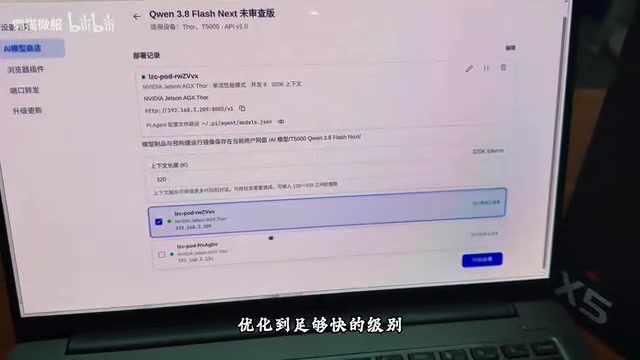
The creator makes a practical point here: if model inference can be optimized to be fast enough, you can route every AI-dependent step of your daily work through a single device and fully utilize its compute capacity. From an ROI perspective, the faster the throughput and the more tasks a device can handle, the better its cost-effectiveness becomes.
TPS (Tokens Per Second) is the core metric for measuring LLM inference throughput, but its meaning varies by context. The "prefill" phase processes the input prompt and is generally fast; the "decode" phase generates output one token at a time and represents the response speed users actually perceive — this is what the reported 241 TPS refers to. It's worth noting that TPS is influenced by multiple factors: larger batch sizes improve per-token compute efficiency and typically boost TPS, but also increase latency; quantization precision (FP16, INT8, INT4, etc.) directly affects memory footprint and compute efficiency; and memory bandwidth is often the true bottleneck during decoding, rather than raw floating-point compute. The 241 TPS figure should therefore be interpreted alongside the specific batch size and quantization settings used.
From Chat to Computer Control: Pushing the Boundaries of Open-Source Models
What made this demo genuinely compelling was the creator's attempt to use the model to "control a computer" and complete real tasks.
The creator noted that OpenAI had previously used Blender for numerous modeling demos when launching new GPT models, so they tried having Qwen3.8 Flash drive the computer to perform its own 3D modeling operations — and expressed genuine surprise at the result. An open-source model managed to complete tasks that require understanding intent, invoking tools, and executing multi-step operations.
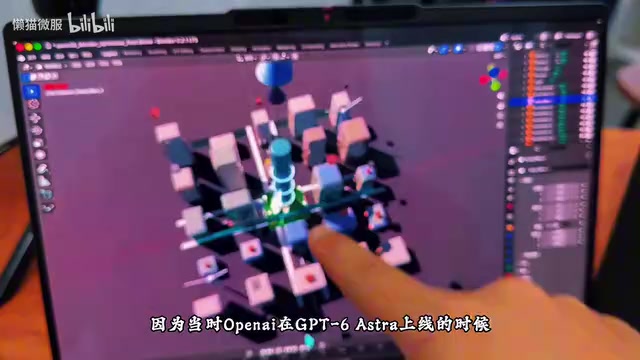
This direction — having a model operate software to complete real-world tasks — sits at the heart of current AI Agent exploration. It moves beyond chat and Q&A, using the language model as a decision-making and execution hub to drive actual applications. The fact that an open-source model can approach this capability suggests that the gap between open-source and closed-source frontier models is narrowing in at least some scenarios.
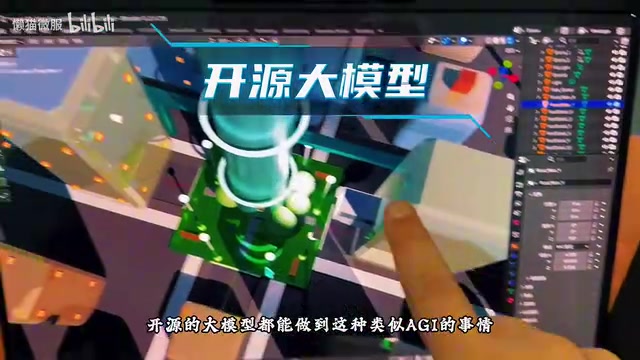
Of course, the creator's invocation of "open-source AGI" reads more as enthusiastic hyperbole than a rigorous claim. A single demo case is insufficient to support a definition as broad as AGI (Artificial General Intelligence). Whether results are consistently reproducible and what the success rate looks like on complex tasks still requires more systematic testing. Readers are advised to maintain a measured perspective on such conclusions.
AI Agent refers to a system architecture that uses a large language model as its core decision-making engine, completing multi-step, cross-application tasks by calling external tools (such as browsers, code executors, file systems, GUI operation interfaces, etc.). Unlike pure chat Q&A, agents require the model to have capabilities including task planning, tool selection, result feedback, and error recovery — typically involving multiple "perceive-think-act" cycles. "Computer control" agents (also known as Computer Use or GUI Agents) represent one of the most challenging frontiers: the model must understand screenshots or application state, decide on sequences of clicks, inputs, and menu selections, and adjust subsequent steps based on execution results. Anthropic's Claude and OpenAI's Operator are both exploring this direction. Open-source models reaching similar capabilities signals that the technical barrier in this space is spreading to a broader ecosystem — though stability and task success rates remain the primary challenges.
Key Practical Caveats
This benchmark offers useful reference points, but also leaves some gaps worth noting.
First, the test hardware itself is expensive. A "128GB compute box" remains a significant investment for individual users. The 200+ TPS result is built on specialized hardware, and ordinary consumer devices may not be able to replicate it.
Second, the benchmark data comes from a single source. The creator mentioned that complete test data for other models including Qwen3.8 and 7B variants is available on request, but the video itself doesn't present a comprehensive comparative benchmark — accuracy and stability across other task types remain unknown.
Third, while the "computer control for 3D modeling" demo is promising, the absence of a complete process log and failure rate data makes it difficult to assess real-world production viability.
Overall, Qwen3.8 Flash demonstrates genuinely impressive local inference speeds enabled by its MoE architecture, providing a compelling data point for open-source model local deployment. For teams and developers focused on private deployment and high-throughput workloads, this is a direction worth tracking and validating further.
Related articles

AI Agent Fundamentals: The Three Core Components — Brain, Memory, and Tools
A beginner's guide to AI Agents: covering the three core components (brain, memory, tools), four stages of LLM deployment, and why Agents matter for real business use cases.

Boycotting Software That Doesn't Support Linux: One Developer's Philosophy of Choice
A Linux-only developer shares his philosophy of boycotting non-Linux software — without sacrificing productivity — and explains how coding agents like Claude Code are closing the gap with commercial tools.
Why Do All AI-Generated Projects Look the Same? The Aesthetic Homogenization Problem in Vibe Coding
Why do vibe coding projects all use purple gradients and dark glassmorphism? We break down the technical roots of AI aesthetic homogenization and how to escape it.