Qwen3.8-Max 2.4T Parameters Deep Dive: Pricing, Capabilities, and the Domestic Model Competition Landscape

Alibaba's Qwen3.8-Max Preview hits 2.4T parameters, reshaping China's large model competition.
Alibaba released Qwen3.8-Max Preview with 2.4T parameters and a 1M context window, focused on coding and productivity. This article analyzes its pricing tiers, competitive positioning against Kimi K3 and DeepSeek, the shift from benchmark scores to deployment economics, geopolitical risks, and how improved model capabilities could boost Alibaba Cloud's MaaS margins.
Qwen3.8-Max Preview Launch: Parameters Jump to 2.4T
China's large language models are entering a new phase of rapid releases and rapidly scaling parameter counts. According to institutional communications disclosed on Bilibili, Alibaba recently released Qwen3.8-Max Preview via its Token Plan personal edition, with users already able to get early access.
The most eye-catching aspect of this version is its parameter count reaching 2.4T, making it the second domestic large model product to enter this parameter tier after Kimi K3's 2.8T. Officials position it as one of the most capable large models outside a handful of top-tier models, with a primary focus on code engineering and professional productivity scenarios.
Parameters are one of the core metrics for measuring a large model's capacity, representing the number of learnable weights in the model. 2.4T means 2.4 trillion parameters — for reference, GPT-3 has 175 billion parameters, and GPT-4 is reportedly around 1.8 trillion. Once models enter the trillion-parameter range, they typically require distributed training techniques such as tensor parallelism, pipeline parallelism, and expert parallelism, placing extremely high demands on compute infrastructure. Of course, total parameter count does not equal the number of parameters actually activated during inference — under a MoE architecture, a model with 2.4T total parameters may only activate a portion of them per inference pass.
It's important to emphasize that what's been released is still a Preview version that hasn't been trained on full data and hasn't participated in authoritative third-party benchmarks. The official version is expected to launch within the month with open weights, and final capabilities will need to be assessed through standardized cross-comparisons once it's live. From initial experience, the Preview version's overall capability is close to Qwen3.5 levels, and since official releases typically undergo further performance optimization, the market still expects additional improvement.
Iteration Cadence and Capability Upgrade Focus
From a product iteration perspective, Qwen3.7-Max was released in May 2026, and roughly two months later the 3.8-Max Preview arrived, with parameter scale increasing from the previous trillion-plus level to 2.4T — a notable jump in model size.
This upgrade focuses on:
- Coding capabilities and front-end development
- Long-horizon tasks and productivity scenarios
- Ultra-long context: context window up to 1M, supporting million-character-level inputs
The context window refers to the maximum number of tokens a model can process in a single inference pass. 1M means 1 million tokens, roughly equivalent to 700,000–1,000,000 Chinese characters or the content of multiple books. Ultra-long context capability is highly significant for enterprise applications: it enables processing entire codebases, lengthy legal documents, or collections of financial reports in a single pass. Achieving ultra-long context requires solving the quadratic computational complexity of the Transformer attention mechanism, typically relying on techniques like Sparse Attention, sliding window attention, chunked processing, or linear attention, along with efficient KV Cache management strategies to control GPU memory usage.
In tests involving front-end pages, 3D generation, and simple games, the 3.8-Max Preview showed noticeable improvement over version 3.7. However, performance varies across tasks — in deep research scenarios, the gap between the preview and 3.7-Max isn't obvious; in tasks like replicating apps, completion rates and stability for certain instructions still have room for improvement. This illustrates that scaling model parameters doesn't automatically translate into proportional improvements across all tasks.
Qwen3.8-Max Pricing Structure and Access Channels
The Token Plan currently comes in two main categories: Personal and Team editions. The Personal edition has three tiers — Lite, Standard, and Pro — with standard monthly fees of 39 yuan, 139 yuan, and 499 yuan respectively. There's currently a promotional discount period, with the Lite tier at roughly 65% off. The Team edition's three tiers are priced at 150 yuan, 550 yuan, and 1,398 yuan per seat per month.

During the current promotional period, credit consumption is approximately 10% of normal levels, and personal edition users get an additional 80% off during nighttime usage. Additionally, developers can get first access to the preview version through tools like Tony Coder, and the Qwen PC client also offers a free trial channel.
From a developer workflow perspective, Qwen3.8-Max focuses on coding and productivity applications and supports OpenAI-compatible protocols, enabling integration with development tools like Claude Code and Cursor. The OpenAI API protocol has become the de facto standard interface specification for large model invocation, defining standardized request and response formats for Chat Completions, Embeddings, and more. When Qwen announces compatibility with this protocol, it means developers can call the Qwen model using exactly the same code they'd use to call the GPT series. Tools like Claude Code (Anthropic's command-line programming tool) and Cursor (an AI-assisted programming IDE) can seamlessly switch backend models, dramatically reducing developer migration costs. This product design signals that model competition is extending beyond simple chat interfaces into programming, office productivity, and enterprise workflow automation.
Four Key Strengths and Clear Weaknesses
Overall, the Qwen3.8-Max Preview has four distinct characteristics:
- Leading parameter scale: 2.4T ranks among the top publicly disclosed large models, second only to Kimi K3's 2.8T;
- Significant pricing incentives: The preview stage benefits developers and enterprises in testing capabilities and inference costs early;
- Open-weight commitment: If the official version's weights are released on schedule, it will be a significant event for domestic open-weight models;
- Strong ecosystem synergy: Deep integration with developer tools and Alibaba Cloud infrastructure.
A special note on weight release: open weight means publishing the trained parameter files publicly, allowing anyone to download, deploy, and fine-tune them — but this differs from fully open source (which includes making training code, datasets, and everything else public). Open weights enable enterprises to do local private deployments and avoid transmitting sensitive data externally; developers can fine-tune for specific scenarios; and academia can conduct model mechanism research. For the publisher, releasing weights rapidly expands the developer ecosystem, creating community contribution and feedback loops, while generating commercial revenue through cloud inference services and technical support.
The weaknesses are equally clear: weights haven't been officially released yet, so enterprises cannot perform complete local hosting; Preview version stability is relatively limited; and there's no unified third-party professional evaluation — current capability assessments are primarily based on official disclosures and initial hands-on experience.
Domestic Large Model Competition Landscape: Qwen vs Kimi K3 vs DeepSeek
Analysts suggest the gap between domestic models and leading overseas models has narrowed from the previous three to six months down to under three months. Multiple models — including DeepSeek V4 official version, MiniMax M3 Pro, and Qwen3.5 — are expected to launch in succession, indicating that China's leading large models remain in a period of rapid advancement.

Different vendors are forming differentiated strategies:
- Kimi K3: Emphasizes comprehensive capability, especially in code and multimodal understanding, ranking first domestically and third globally, with some individual benchmarks reaching the global top two;
- DeepSeek: Core positioning remains high cost-effectiveness, expanding usage through controlled training and inference costs;
- Qwen: Emphasizes an integrated commercial path combining models, cloud computing, and proprietary chips, leveraging Alibaba Cloud compute to connect model capabilities with enterprise customers, developer tools, and cloud services.
The Competitive Shift from Benchmark Scores to Deployment Costs
The most critical insight from this discussion is that as more and more domestic models approach or cross the "viability threshold for large-scale commercial deployment," industry comparison standards will no longer be limited to benchmark scores. Instead, the focus will increasingly be on:
- Can deployment be completed at lower cost?
- Can the ecosystem function?
- Can commercial revenue materialize?
- Can enterprise customers achieve reasonable ROI?
This is also a key reason why the logic for internet ecosystem companies may improve in the second half of the year. China's leading models predominantly use MoE sparse architectures, which can deliver significantly lower inference costs at comparable capability levels compared to overseas closed-source models.
MoE (Mixture of Experts) is a sparsely-activated model architecture that stands in stark contrast to traditional Dense models. In a Dense model, every inference activates all parameters, with compute scaling proportionally to parameter count. MoE architecture divides the model into multiple "expert" sub-networks, with a gating network (Router) selecting only a small number of experts to participate in each inference pass. For example, a 2.4T total-parameter MoE model might only activate 200–400B parameters per inference, allowing it to possess greater knowledge capacity while keeping actual compute and latency per inference far below that of a Dense model of equivalent parameter scale. DeepSeek V3, the Qwen series, and GPT-4 are all believed to use MoE architecture — this is the core technical foundation enabling domestic models to achieve the "low-price API + high performance" combination.
The "low price + high performance" combination of domestic model APIs is creating real competitive pressure on overseas vendors — after Kimi K3's launch, OpenAI and others have responded by lowering API prices and relaxing enterprise subscription limits.
Global Market Dual-Track Structure and Geopolitical Risks
The global model market has temporarily formed a "dual-track structure": US closed-source models dominate high-end sensitive scenarios, while Chinese open-source models leverage cost-effectiveness to penetrate the mass market. Previously, US closed-source models held over 70% of the global enterprise API market share, but by mid-year, domestic model API call share had doubled compared to the beginning of the year.

Domestic open-source models are initially penetrating through SME customers, while high-end government/enterprise and sensitive business scenarios still predominantly use overseas closed-source models. The open-source approach attracts developers for secondary development and drives enterprise private deployment. As overseas localized deployment orders increase, monetization paths for domestic models become clearer — local deployment generates licensing fees, while cloud usage generates revenue through API and cloud compute services.
However, global expansion of large models also faces geopolitical regulatory risks. According to media reports, the US Department of Commerce's BIS (Bureau of Industry and Security) and other agencies are internally discussing draft regulations targeting Chinese large models. BIS has previously imposed export controls on high-end AI chips (such as NVIDIA A100/H100), and if controls expand to the model layer, they could potentially restrict Chinese model API services in the US market or prohibit US companies from using Chinese model weights. It must be emphasized that these discussions remain at the internal deliberation or media reporting stage — no formal documents or official announcements exist, and whether they materialize, their scope, and enforcement mechanisms all carry significant uncertainty. The US-China large model ecosystems may further diverge in both directions.
Transmission Effects on Alibaba Cloud's MaaS Business
As large models cross the commercial viability threshold, MaaS (Model as a Service) is poised to become a significant growth driver for cloud computing. MaaS is a new commercial model for cloud computing in the AI era. Unlike traditional IaaS (Infrastructure as a Service, providing underlying resources like servers and storage) and SaaS (Software as a Service, providing application-layer software), MaaS delivers large model inference capabilities to enterprises and developers via API interfaces, charging based on token usage. Its commercial value lies in the low marginal cost of proprietary models (training costs are already sunk; the incremental cost of an additional API call is primarily inference compute), enabling gross margins significantly higher than traditional IaaS's 15%–25% levels. For cloud vendors, owning powerful proprietary models means not having to pay third-party model licensing fees — the higher the proportion of proprietary model calls, the better the overall MaaS profit margins.
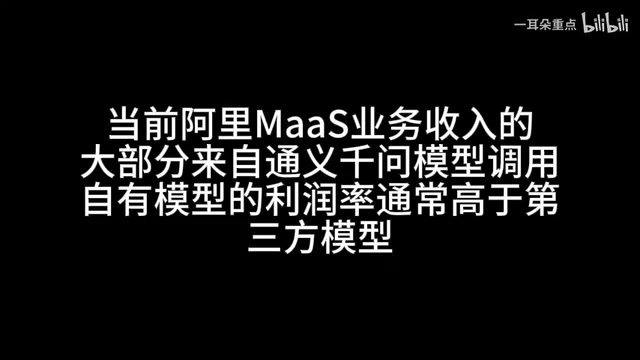
A notable detail: the majority of Alibaba's current MaaS business revenue comes from Tongyi Qwen model calls. Proprietary model profit margins are typically higher than third-party models, so if Qwen3.8-Max's official version maintains first-tier status, increased Qwen call volume would not only expand revenue but also help improve MaaS business profit margins.
Previously, the market had two concerns about Alibaba Cloud's valuation: insufficient proprietary large model capability, and rising API channel business (third-party model calls) share compressing profit margins. If Qwen model capability and call volume improve simultaneously, both concerns could be alleviated.
Alibaba Cloud Financial Outlook
Relevant forecasts suggest that Alibaba Cloud's revenue growth in the April–June 2026 quarter could reach approximately 45%, above the market's prior expectation of 40%; full-year growth could land in the 45%–50% range. On margins, the January–March 2026 quarter was approximately 9%, the April–June quarter could improve to 11%–12%, potentially reaching 15% by year-end, with a medium-to-long-term target of 20%.
Industry Chain Impact and Investment Implications
Some large model platforms are currently experiencing compute shortages where new users cannot sign up normally, reflecting that domestic model compute supply remains tight. Global inference compute demand continues to grow, and combined with domestic models continuously compressing per-unit inference costs, this will drive increased demand for cost-effective domestic compute chips.
The industry chain can be divided into four directions:
- Compute layer: Domestic GPUs/TPUs are poised to capture more demand
- Cloud vendors: Growing model invocation and inference demand
- Large model vendors: Increasing token call volume opens up revenue opportunities
- Enterprise AI applications: Office automation, coding, and other use cases are landing fastest
Overall, Qwen3.8-Max Preview's 2.4T parameters, 1M context window, and improved coding capabilities reflect that China's leading models are still iterating rapidly. However, since this is still a preview version with unreleased weights and no comprehensive third-party evaluation, its final industry positioning awaits confirmation with the official release. If the official version can maintain first-tier status and drive growth in call volume, enterprise deployment, and developer ecosystem expansion, its impact will extend beyond the model product itself — potentially transmitting further to Alibaba Cloud revenue, MaaS profit margins, proprietary chips, and enterprise AI applications.
Note: This article is for industry research and information exchange purposes and does not constitute investment advice. Markets carry risk; decisions should be made with caution.
Related articles

Claude Autonomously Designs Proteins with 35% Success Rate, Far Exceeding Human Expert Performance
Anthropic's Claude achieves 35% wet-lab success rate in autonomous protein design, far surpassing the 10-15% human expert average, signaling AI's move toward real scientific productivity.

Perplexity Discover's Multilingual Support Suddenly Disappears — Why Are International Users Upset?
Perplexity Discover's multilingual news feature suddenly dropped non-English support, frustrating international users. We analyze possible causes and the broader challenges of AI product internationalization.

GitHub Daily · August 20: Mojo Tops the Charts & The Local-First Open Source Rebellion
GitHub Trending Aug 20: Mojo tops charts for AI compute stack ambitions, OpenLogi surges 1225 stars with local-first philosophy, and privacy rebellion dominates.