Qwen3.8-Max Hands-On Test: All 4 Brutal Challenges Passed, Nearly 3 Hours to Complete

Qwen3.8-Max passes all four extreme challenges, showing high capability ceiling but nearly 3-hour duration exposes efficiency weakness.
A Bilibili creator ran four extreme hands-on tests of Qwen3.8-Max on the "Qianwen Office" platform: hard-constrained writing with perfect incremented character counts, a night Ferris wheel with only one occlusion glitch, retro handheld Tetris with normal logic, and a fully playable 3D racing scene with corner recovery. All four passed, proving competitive ability across Chinese writing, 3D scenes, and game logic, but the whole process took nearly three hours. The article argues this flagship's 950B total parameters and extremely long activation context provide a foundation for complex tasks, but overly long reasoning and generation pipelines make efficiency a clear weakness. Conclusion: Qwen3.8-Max can chew hard bones but chews slowly — suitable for complex tasks where you're willing to wait, still needs optimization for instant-feedback scenarios.
Four Challenges, from Text to 3D
AI large model evaluations never lack benchmarks. What truly separates the contenders are those seemingly "unreasonable" extreme tasks. A Bilibili creator ran a hands-on test of Qwen3.8-Max on the "Qianwen Office" platform, with four challenges spanning from Chinese character structure constraints all the way to 3D physics engines. All four passed in the end, but the entire test burned through nearly three hours. The actual capability of this generation's flagship deserves a careful breakdown.
Challenge 1: Hard-Constrained Writing — the "Russian Doll" of Word Counts
The task required writing ten sentences: the first with three characters, the second with four, and so on, with the tenth sentence having exactly twelve characters. This kind of task would make even a human writer repeatedly count on their fingers, and the model not only had to get the increasing character counts perfectly right but also make the whole passage read naturally.
The result: structure and format held steady, with the character count increments never breaking down. This shows the model's counting ability under long-range constraints is quite solid — after all, many large models start "miscounting" by the third or fourth sentence.
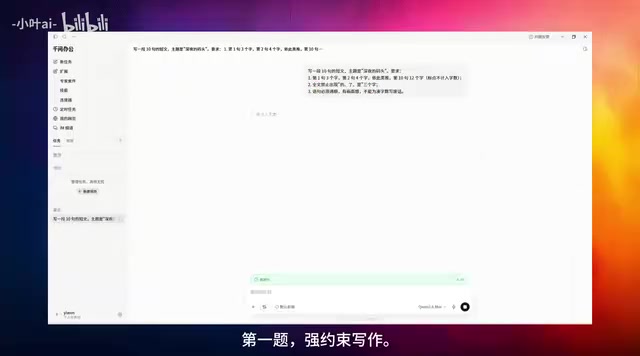
Hard-Constrained Writing and Counting Ability Under Long-Range Constraints
Hard-constrained writing refers to generation that, beyond semantic coherence, must also satisfy a series of rigid format conditions — word counts, sentence counts, rhythm, frequency of specific characters, and so on. These tasks are often used as "stress tests" in large model evaluations because autoregressive models generate token by token; once a miscount or missed constraint occurs at any intermediate step, the error accumulates forward and the entire output collapses.
Among these, "counting ability under long-range constraints" is especially critical. The model must maintain an internal counter throughout the generation process and ensure each subsequent sentence strictly follows an increasing or decreasing pattern. Many models perform fine on short texts, but once the constraint chain extends beyond seven or eight steps, they start "miscounting," sentence lengths jump, or semantics break down just to hit word counts. In this test, the character count increments never broke once, indicating the model has strong global constraint retention during the planning phase.
Challenge 2: Night Ferris Wheel — Only One Glitch
The second challenge required generating a city nightscape featuring a Ferris wheel, a moon obscured by the wheel's spokes, and a complete layered city lighting composition. This type of composite scene best tests a model's understanding of spatial occlusion relationships.
The creator's assessment: the Ferris wheel structure was clear, cabin and gear linkages were correct, and the city nightscape had every layer. The only flaw was a single glitch where the moon was occluded by the wheel spokes. Considering the overall completeness, this qualifies as a "minor flaw" that doesn't undermine the image.
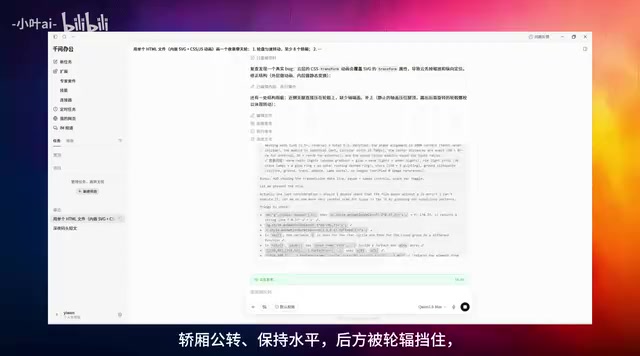
Spatial Occlusion Relationships and Spatial Consistency in Generative Images
Spatial occlusion is an important indicator for judging whether a model truly "understands" a 3D scene in image generation. Occlusion refers to a foreground object blocking part of a background object, where the blocked area should no longer show the background object's texture or contours. In the Ferris wheel and moon-obscured-by-spokes combination, the model must simultaneously handle the wheel's spoke structure, the moon's circular contour, and their front-back layering.
Generative models typically learn occlusion patterns implicitly through large volumes of training images, but in complex composite scenes, "glitches" can still occur — for example, part of the moon's circular surface incorrectly appearing in front of the spokes, or texture breaks at the junction between spokes and moon. A single minor glitch is usually acceptable when overall completeness is high, but it also shows the model's spatial reasoning still relies on statistical priors rather than strict geometric computation.
Double Pressure on Logic and Engineering
Challenge 3: Retro Handheld Running Tetris
The third challenge was Tetris running inside a retro handheld shell, testing logical rigor, UI aesthetics, animation state machines, and whether the Game Boy-style shell, buttons, and screen color scheme were on point.
The model's output: block falling, stacking, and line-clearing logic worked normally, ran without errors or clipping. The UI and animation state machine held up, and the shell, buttons, and screen colors were all faithfully reproduced. This was no longer "drawing an image" but maintaining state consistency within an interactive framework.
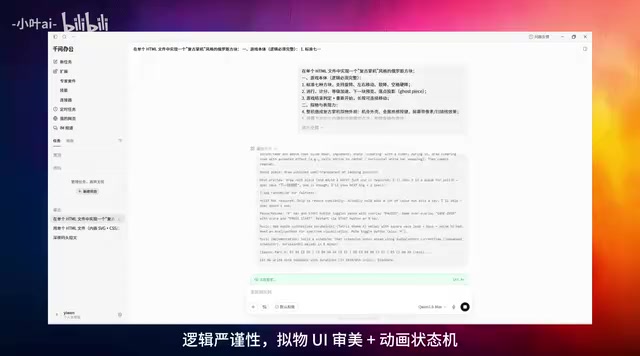
Animation State Machines and Interactive Logic Consistency
An animation state machine is a mechanism in games and interactive interfaces for managing "what state we're currently in and what state to transition to next." Take Tetris: blocks have multiple states — falling, moving left/right, rotating, locking, line-clearing — each corresponding to different animations and logic branches. To present Tetris inside a retro handheld shell, the model must not only draw the static UI but also ensure state transitions don't conflict, clip, or error out.
This is far harder than simply generating an image, because the output must maintain internal state consistency over time: when stacking height changes, line-clearing logic must trigger accordingly; shell buttons and screen colors must remain unified throughout. Running correctly with normal logic shows the model's ability to model interactive frameworks already exceeds the scope of static image generation.
Challenge 4: 3D Racing — Physics Feel Is the Biggest Test
The finale was a 3D racing scene called "Sunset Circuit," directly testing the agent's 3D engineering capability and physics feel tuning. Requirements included a 3, 2, 1, Go countdown, speedometer, lap times, full HUD, and multiple cars on track.
In testing, the model not only produced a complete playable track but could also recover from cornering slides on its own — proving the physics feedback wasn't just for show. The creator explicitly said it was "not an empty shell dream" and that the completeness reached playable standard.
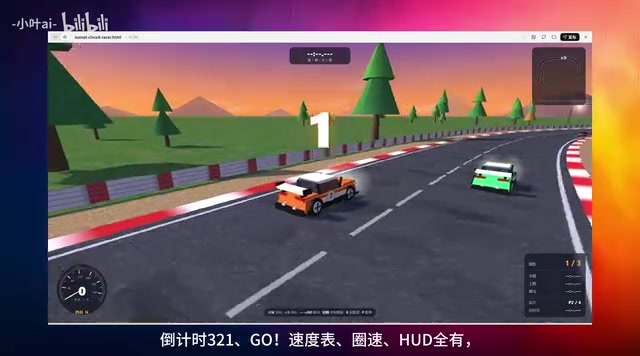
Physics Feel Tuning and Corner Recovery
Physics feel tuning refers to making an object's motion feedback match player intuition in a game or simulation: acceleration gives a push-back sensation, braking has inertia, turning has lateral slide, and these feedback parameters require repeated adjustment to feel natural. In a 3D racing scene, whether a car can self-recover after cornering slides is the key to judging whether the physics system is "alive."
If physics feedback is merely decorative, a sliding car typically spins out of control or slides off track, unable to regain grip through counter-steering or lifting off the throttle. The model achieving a "self-recovery after sliding" effect shows that when generating the track and vehicle behavior, it implicitly built a responsive set of dynamics rules rather than just rendering a fixed animation set. This also upgrades "Sunset Circuit" from a visual demo to a playable prototype.
Behind the Full Pass: The 3-Hour Cost and Real Capability
All four challenges passed, and this result itself shows Qwen3.8-Max has competitive capabilities across three fronts: Chinese writing, 3D scenes, and game logic. But the creator also highlighted a key detail: the entire process took nearly three hours.
This time cost is worth pondering. On one hand, it shows the model's reasoning and generation pipelines are very long when handling highly complex, multi-constraint tasks; on the other, it means there's still room for optimization at the efficiency level before it's "ready at hand."
In terms of parameter scale, this generation's flagship has 950B total parameters and an activation context stretched to extremely long text, which indeed provides a foundation for complex tasks. The four challenges' pass rate validates the capability ceiling, while the three-hour duration exposes the speed weakness.
So what level is Qwen3.8-Max at? From this hands-on test, it belongs to the "can chew hard bones, but chews slowly" category. Chinese writing, 3D modeling, and game logic are all competitive; the weakness isn't capability but efficiency. For complex tasks where you're willing to wait, it can already deliver usable results; for scenarios demanding instant feedback, you'll need to wait a bit longer.
Related articles
LLaMA-Factory in Practice: A Complete No-Code Guide to Fine-Tuning Large Models
An introduction to LLaMA-Factory, the open-source fine-tuning tool: its 60.1K-star background, supported models and algorithms, local vs. cloud deployment, and CUDA setup steps.

Zeng Ming's Deep Retrospective: Why OpenAI May Not Be the Ultimate Winner — and Why the Corporate System Will Disappear
Zeng Ming's deep retrospective on the AI endgame: model companies are just infrastructure, OpenAI and Anthropic won't be the final winners; the next battle is the Agent entry point standard; the corporate system will disappear as AI restructures collaboration, and only mission-driven companies can survive the cycle.

OpenHands v1.28.0: OpenCode and PI Added as Built-in Agents, API Keys Requestable In-Conversation
OpenHands ships 5 releases in 21 days: v1.27.0 adds OpenCode and PI as built-in agents, v1.28.0 enables in-chat key requests. ACP integration, credential reuse, model list changes, and upgrade advice.