Qwen3 Max Latest Checkpoint Tested: Higher Scores, But Why Did Some Capabilities Regress?

Qwen3 Max 0902 hits 86.25% on KingBench 3 with the first-ever perfect score on the 3D watch task, despite frontend interaction regressions.
Alibaba's Qwen3 Max checkpoint 0902 scored 86.25% on KingBench 3, landing third on the leaderboard — a 5-point jump from the previous version. Nearly all of that gain came from a single task: the notoriously hard 3D watch, which leaped from 3 to a historic perfect 10, signaling a major boost in 3D and geometry capabilities. At the same time, the elevator simulation, contact lens case, and archery game all regressed in feel and polish. In the same test round, Gemini 3.8 Flash surprised at 81.25% while Muse Spark 1.3 slipped to 71.25%. With 2.4 trillion parameters, a 1M-token context window, and a confirmed open-weight release, Qwen3 Max remains one of the most closely watched frontier models.
Alibaba's flagship model Qwen3 Max has a new checkpoint — codenamed 0902. A tech blogger ran a third round of benchmarks on this version and got a surprising result: overall scores went up, not down. But break it apart, and several frontend interaction capabilities actually regressed. This seemingly contradictory test result perfectly illustrates the reality of rolling-preview model iteration.
Background: A 2.4-Trillion-Parameter Flagship About to Go Open-Weight
Qwen3 Max is Alibaba's flagship model, boasting 2.4 trillion parameters, a 1-million-token context window, and an officially confirmed open-weight release — a rare move at this scale among closed-source flagship competitors.
The blogger had already tested two previous versions. The earliest preview scored 65/80 (81.25%) on his KingBench 3 benchmark, placing second on the leaderboard. A subsequent preview update brought noticeable improvements to frontend performance, tool calling, and Cloud Code environment behavior. This 0902 checkpoint is the next step along that same rolling-improvement track.
The Qwen team has been remarkably transparent about this iteration style — they've stated the model evolves almost daily during the preview period and actively encourages users to keep testing and providing feedback. So the blogger ran the full benchmark again.
Open-weight vs. fully open-source: Open-weight means the model weights are available for download and local deployment, but training code, datasets, or commercial licensing terms may still be restricted. Even so, releasing weights at the 2.4-trillion-parameter scale is exceptionally rare. Among publicly available large-scale MoE models, Meta's Llama series tops out in the hundreds of billions of parameters, and DeepSeek V3/R1, while open-weight, sits at "only" 671 billion parameters. If Qwen3 Max releases its weights as planned, it would become one of the largest open models available for self-deployment — a significant development for enterprises with data residency requirements or deep customization needs.
Rolling preview: This refers to a model continuously iterating before an official release by frequently pushing checkpoints — each representing a snapshot of the training or post-processing pipeline. This approach allows teams to gather real-world feedback quickly, but it also means capabilities can fluctuate non-monotonically between adjacent checkpoints rather than steadily improving.
KingBench 3 Breakdown: Some Up, Some Down
KingBench 3 consists of eight tasks covering frontend and animation generation capabilities. The results showed clear divergence.
Tasks That Regressed
The first task — elevator simulation — involves three elevators, passengers spawning at different floors, and hover tooltips showing destination floors. The 0902 checkpoint scored 7/10: the simulation ran, queuing logic was mostly correct, but several handoff scenarios failed and the animation was stiffer than before. The previous version scored 8 — a one-point drop.
The second task — a contact lens case with clickable L/R lids — also scored 7/10. The case model was fine and the lids opened, but the L/R labels weren't prominent enough and the open/close animation had frame-skipping issues. The previous version scored 8 on this task and had previously achieved the second-highest score ever recorded — another one-point regression.
The most painful regression was Task 5 — a bow-and-arrow shooting mini-game. The game ran, all four targets and the leaderboard worked, but the aiming feel was "floatier" than before and the arrow arc was off. It scored 8/10, whereas the previous version earned a perfect 10 — a 2-point drop that represents the largest single regression in this entire test round.
Tasks That Improved or Held Steady
Task 4's panda-eating-burger SVG improved from 8 to 9 — well-proportioned and clearly recognizable, one of the highest scores the blogger has ever given on that task. Task 3's 3D folding table held at 8. Task 6's combinatorics math problem (answer: 2460) and Task 7's full agent task (generating a panda dataset, locally fine-tuning Gemma 2B, and deploying a web UI that serves a new panda fun fact on each page refresh) both earned perfect 10s.
About KingBench 3: This is the blogger's custom evaluation suite, designed to test LLMs on frontend UI generation, animation logic, interactive physics, and complex programming tasks. Scored out of 80 points (8 tasks × 10 points each). Unlike academic benchmarks like MMLU or HumanEval that focus on Q&A or function-level code generation, KingBench 3 is closer to real-world "vibe coding" — generating a complete, runnable application from a natural language prompt in one shot. This places extremely high demands on spatial reasoning, animation timing, and multi-component coordination, which explains why the 3D watch task creates such a wide gap between models.
One Watch Drove All the Gains
What truly defined this test round was Task 8 — the 3D watch.
This is the hardest task in the entire benchmark: build a genuinely functional 3D wristwatch with smooth second, minute, and hour hands synchronized to the real current time, plus date/day-of-week display and dual-timezone tracking. Most models score 0 or single digits here. The previous Qwen3 Max version scored just 3; the all-time record before this test was 8, held by Muse Spark 1.3.

The 0902 checkpoint scored a perfect 10 — the first perfect score any model has ever achieved on this task. The watch looked realistic, hands moved smoothly and tracked real time, date and day-of-week were present, and the second timezone was genuinely functional rather than decorative. A jump from 3 to 10.
This creates the peculiar arithmetic of this test round: 0902 lost points on three tasks and only gained points on one — yet that one watch caused an overall gain of 4 points. Strip out the watch, and this version is actually worse than the previous one. Include it, and it represents the biggest single leap this model has ever made.
Why the 3D watch is so hard: It simultaneously tests WebGL/Three.js or pure CSS 3D scene construction, real-time binding via the
DateAPI, trigonometric calculation of hand angles, dual-timezone offset logic, and frame-rate control for smooth animation. Any single failure — such as the minute hand jumping once per minute instead of rotating smoothly, or an off-by-one error in second-hand angle calculation — directly tanks the usability score. Most models produce a static "watch-shaped shell" that fails to actually track the system clock, which is why the historical high score was stuck at 8 for so long, with many models scoring 0.
Head-to-Head Comparison: Three Recent Models
The 0902 checkpoint finished with 69/80 (86.25%), landing third on the blogger's overall leaderboard — behind only Fable 5.1 (92.5%) and GLM 5.3 (91.25%), and a full 5 percentage points ahead of the previous Qwen3 Max version.
The blogger also tested two other models in the same period, forming an interesting comparison:
- Gemini 3.8 Flash: 65/80 (81.25%). Impressive for a Flash-tier model (Gemini 3.5 Flash only scored 30%), but it only beat Qwen on the contact lens case and the archery game. The biggest gaps were on the folding table (Flash 5 vs. Qwen 8) and the watch (Flash 6 vs. Qwen 10).
- Muse Spark 1.3: 57/80 (71.25%) — a regression from version 1.2's 76.25%. The only thing propping it up was the 8-point watch score — a record that lasted approximately four days before Qwen smashed it.
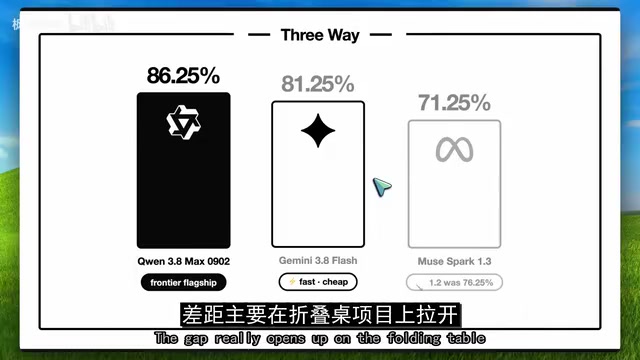
The three models occupy entirely different niches: one is a frontier flagship, one is a fast and cheap Flash model, and one is a minor update that went the wrong direction.
On Gemini 3.8 Flash: Google's "Flash" series is positioned as low-latency, low-cost inference models with significantly fewer parameters and lower compute overhead than flagship "Pro/Ultra" versions, trading some capability ceiling for extreme cost-efficiency. A Flash-tier model scoring 81.25% on KingBench 3 — matching or exceeding many flagships' historical scores — suggests Google has invested meaningful optimization resources into frontend code generation for its latest small models. Muse Spark 1.3's regression illustrates another common phenomenon: minor version updates sometimes inadvertently damage certain capabilities while improving others — the so-called "capability seesaw" effect, especially pronounced without systematic regression testing.
Real-World Feel: Beyond the Benchmark Numbers
Scores never tell the whole story. The blogger shared a few impressions from actual use:
Harness behavior remains stable. The long-session "stalling" and missing file creation in Cloud Code that were criticized in the first video were fixed in the previous version and have stayed fixed. This matters — rolling checkpoints often quietly break things that were working.
3D and geometry capabilities are noticeably stronger. Not just the watch. The success rate of getting Three.js scenes built correctly on the first try is significantly higher now, and the blogger spent noticeably less time correcting floating or clipping objects.
Frontend interaction feel has softened slightly. The elevator and archery regressions make this concrete — the physical feel and interaction polish took a small step back. You'd probably never notice it in daily work, but it showed up twice in the benchmark.
The blogger's assessment: this is the normal rhythm of a rolling preview. The team is clearly tuning certain parameters, and different checkpoints excel in different directions. For 3D and geometry-heavy work, 0902 is a major upgrade; if your workflow is all about game feel and interactive physics, the previous version was actually slightly better.
Availability and Final Verdict
The 0902 checkpoint is currently available through token plans and Coder-related services. Token plan subscribers can already use it for free, and it can also be tried for free on Studio. However, the free tier for Code was removed entirely earlier this year.
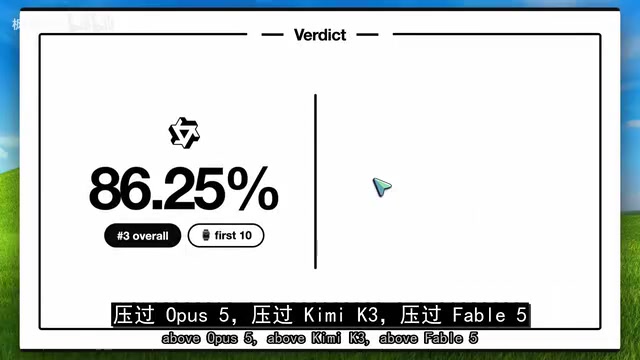
The blogger's bottom line: Qwen3 Max 0902 is the best version of this model to date — 86.25%, third on the overall leaderboard, and the first perfect score on the watch task that has stumped countless models for months. It's not a clean sweep (the interaction tasks did regress, and hopefully those recover), but the net result is clearly positive, making it the strongest model on the benchmark outside of Fable 5.1 and GLM 5.3.
Recommendations for the three models: send heavy tasks to Qwen3 Max 0902; use Gemini 3.8 Flash when you need speed; skip Muse Spark 1.3 for now and stay on 1.2.
A 2.4-trillion-parameter model sitting third on the leaderboard, outperforming Opus 5, Kimi K3, and Fable 5 — and eventually going open-weight — is genuinely significant. Once the official release and model weights drop, it'll be worth watching whether it has a shot at overtaking GLM 5.3 and Fable 5.1 at the top.
Related articles

LynnReal-Omni: 32B Unified Video Diffusion Model Goes Open Source with Multi-Task Coverage in Four Steps
LynnReal-Omni is a 32B unified video diffusion model on MiniMax H3, covering text-to-video, pose guidance, style transfer, restoration in 4 steps. Flash version generates 540p video in 377ms on one H100.

Anthropic Co-Founder: AI 'Kill Switch' May Need to Be Mandatory by Law
Anthropic's co-founder tells the BBC that AI 'kill switches' may need to be legally mandated. We analyze the industry logic, technical challenges, and the tension between regulation and innovation.

The AI Data Center Boom Is Colliding With Cities Scarred by Heavy Industry
The AI data center boom is clashing with post-industrial communities. Philadelphia's case reveals structural conflicts between AI growth, energy use, water, and environmental justice.