Qwen4-Max In-Depth Analysis: The Capability Boundaries of Alibaba's Most Powerful AI Model

Qwen4-Max uses a 2.4T-parameter sparse MoE architecture focused on long context and Agent capabilities, with notable strengths and clear weaknesses.
This article analyzes Alibaba's flagship Qwen4-Max across architecture, capabilities, benchmarks, and cost. It has about 2.4 trillion total parameters but activates only about 71 billion per token through sparse MoE and hybrid attention, supporting roughly 1 million tokens of context, dual thinking/standard modes, multimodal input, and a five-stage Agent workflow. Benchmarks show it leads on Agent tasks but trails in terminal coding and chart understanding. International API pricing is $1.50/$4.50/$0.075 per million input/output/cached-input tokens, with thinking mode raising output costs. Document analysis and professional Agent scenarios are worth prioritizing; coding, chart, and video tasks require careful comparison, and production decisions should rely on testing with real workloads.
Qwen4-Max In-Depth Analysis: The Capability Boundaries of Alibaba's Most Powerful AI Model
Alibaba's Qwen4-Max is positioned as its flagship large language model, focused on long-context processing, complex reasoning, multimodal understanding, and AI Agent workflows. Whether a model is truly "the strongest" depends not only on parameter scale but also on architecture design, actual performance, and suitable use cases. Based on publicly available tutorial information, this article examines the real picture of Qwen4-Max across four dimensions: technical architecture, core capabilities, benchmark tests, and cost structure.
Sparse MoE Architecture: How 2.4 Trillion Parameters Operate Efficiently
The overall architecture of Qwen4-Max contains approximately 2.4 trillion parameters, but only about 71 billion parameters are activated per token. The key to this design lies in the Sparse Mixture of Experts (Sparse MoE) mechanism.
MoE can be understood as a company with finance, legal, development, and research experts: each time a problem arises, not all experts need to meet at once. Instead, a routing mechanism determines which experts are relevant to the current task and invokes only the corresponding "expert paths." When processing financial data, finance-related paths are activated; when handling programming instructions, another set of paths is activated. This gives the model enormous total capacity while avoiding the computational overhead of running the full network for every token.
In addition to MoE, Qwen4-Max also adopts a hybrid attention mechanism, combining gated DeltaNet memory with sparse retrieval, and introduces n-gram embeddings to recognize local token patterns and enhance representation capability. Together, these components serve one goal: efficiently managing information in ultra-long contexts.
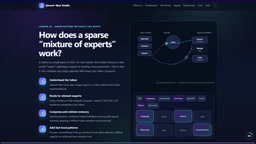
Mixture of Experts (MoE) is an architecture that splits the model's feed-forward network layers into multiple parallel "expert" subnetworks. During inference, each token does not pass through all experts. Instead, a lightweight Router computes matching scores between the token and each expert, selecting only the few experts with the highest scores (usually 1 to 4) to participate in computation while the remaining experts stay idle. As a result, the total parameter count of an MoE model can be far larger than the number of parameters actually activated per token, significantly expanding model capacity while keeping computational cost controllable. The core challenge of MoE is load balancing: if routing always favors a small number of experts, those experts become overloaded while others receive insufficient training. A common solution is to introduce auxiliary loss functions to constrain expert utilization. In addition, MoE's memory requirements are still determined by the total parameter count, and deployment typically requires an Expert Parallelism strategy to distribute different experts across multiple GPUs.
Million-Level Context: A Bigger Whiteboard, but Clear Instructions Still Required
Qwen4-Max supports a context window of approximately 1 million tokens. Using the analogy from the tutorial, the context window is like a giant digital whiteboard—the larger the whiteboard, the more materials can be "laid out" simultaneously when handling a task. When facing hundreds of PDFs, technical reports, tables, and meeting records, users no longer need to frequently split documents.
But a large window does not equal perfect memory. The model still requires clear instructions: state the goal, specify the documents to be analyzed, explain constraints, and describe the expected output format. For important research tasks, the model should also be required to cite the corresponding sections of the source text so results can be verified. No matter how large the context, retrieval quality still depends on question quality.
Context Window refers to the maximum number of tokens a model can simultaneously receive and process in a single inference, covering user instructions, input documents, conversation history, and the output already generated by the model. The larger the context window, the more information the model can reference in a single request, but this also brings two practical problems. The first is attention computation cost: the computation of standard self-attention grows quadratically with sequence length, and a million-token sequence would be extremely expensive with full attention, so long-context models generally adopt sparse attention, linear attention, or hybrid attention to reduce overhead. The second is effective recall rate: research shows that a model's ability to recall information in the middle of a long context is often weaker than at the beginning and end (the "lost in the middle" phenomenon), so window length does not mean the model can use every segment of content with equal quality. This is also the technical reason the article emphasizes the need for clear instructions, specified documents, and source citations.
Thinking Mode and Standard Mode: Choose Reasoning Depth by Task
Qwen4-Max offers two practical modes. When thinking mode is enabled, the model invests additional reasoning steps before giving the final answer, making it suitable for complex multi-step tasks such as analyzing large technical reports, reviewing legal documents, or coordinating Agent workflows. When thinking is disabled, it enters standard mode with more direct responses, suitable for high-frequency simple requests such as information extraction, data classification, and text rewriting.
Cost needs attention: thinking-generated tokens count toward the output budget, and enabling thinking increases both processing time and API costs. The tutorial recommends running both modes in actual applications before deciding which to use.
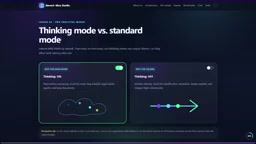
Thinking / Reasoning Mode originates from the technical approach of having a model generate an internal reasoning chain before giving a final answer. Unlike traditional direct output, the model first unfolds intermediate reasoning steps—decomposing the problem, listing assumptions, and calculating step by step—and then generates a conclusion based on this reasoning. Such methods usually significantly improve accuracy on tasks involving mathematics, code, multi-step logic, and legal analysis, because explicit reasoning reduces the probability of the model "skipping steps" and making errors. The cost is a substantial increase in output tokens: an answer that is only a few hundred tokens long may consume thousands of tokens of reasoning behind it, and these reasoning tokens are also billed as output. Therefore, thinking mode is essentially a switch that trades cost for accuracy, and whether to enable it should be judged based on task difficulty and the cost of errors, rather than being turned on by default.
Multimodal and Agent Workflows: Where Are the Capability Boundaries?
Qwen4-Max supports three types of input: text, images, and video. On the text side, it can process structured information such as documents, contracts, code, transcripts, and JSON; on the image side, it can analyze screenshots, photos, charts, and scanned documents; on the video side, it can analyze temporal information across frames and scenes.
Agent capability is another focus. Unlike traditional chatbots that engage in "question-and-answer" interactions, an Agent can understand goals, formulate plans, call external tools, check results, and iteratively revise. The tutorial breaks this into five stages: receiving the task brief, decomposing the plan, invoking tools, revising and refining, and delivering results. In finance, legal, and research scenarios, this workflow can automatically produce cited reports, tables, and presentations. The model provides reasoning capability, while the surrounding Agent system provides tools and the execution environment; both are indispensable.
AI Agent refers to a system that uses a large language model as its decision-making core and can autonomously plan and call external tools to complete multi-step tasks. The fundamental difference from single-turn Q&A lies in closed-loop execution: an Agent not only generates text but also calls tools such as search, code execution, database queries, and file reading/writing, observes the results returned by tools, and adjusts the next action accordingly until the task is complete. Key capabilities supporting this process include Function Calling—the model outputs the tools to be called and their parameters in a structured format; planning and decomposition—breaking high-level goals into executable subtasks; and memory management—retaining necessary intermediate states across multiple iterations. It should be noted that the model itself only provides reasoning and decision-making capability. The tool execution environment, permission control, error retries, and security boundaries are all handled by the surrounding Agent framework, and the engineering quality of both jointly determines the final outcome.
Benchmarks: Strengths Are Prominent, Weaknesses Are Equally Clear
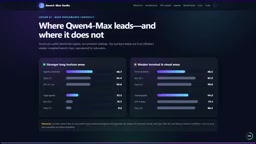
According to vendor-compiled release comparison data in the tutorial, Qwen4-Max performs strongly on Agent-type tasks: Agent Last Exam score of 46.7, higher than Opus 5.5 and GPT 6.1 Sol in the comparison; legal Agent task score of 21.3, compared with Kimi K3.1's 11.7 and Opus 5.5's 9.2. This confirms its positioning in long-process Agent and document-intensive professional tasks.
The weaknesses are also clear. Terminal Bench score is 48.5, lower than the comparison scores of Kimi K3.1 and Opus 5.5; chart understanding score is 54.2, clearly behind GPT-6 Astra's 71.1. The tutorial also explicitly states that Qwen4-Max does not comprehensively surpass leading competitors in chart and video understanding. The conclusion is straightforward: document analysis and professional Agent scenarios deserve priority consideration, while terminal coding, complex chart analysis, and video understanding require careful evaluation against competitors.
API Pricing: Low Price Does Not Equal Low Cost
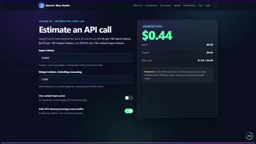
International API pricing is divided into three tiers: input tokens at $1.50 per million, output tokens at $4.50 per million, and cached input tokens at $0.075 per million. Input covers instructions, documents, and conversation history; output includes model-generated content and reasoning tokens in thinking mode; cached input applies to scenarios with reusable prompts.
The calculation example in the tutorial is 250,000 input tokens plus 12,000 output tokens. The calculator estimates input and output costs separately and then aggregates them, with options to enable cached pricing and a 20% planning buffer. The key reminder is: a low per-token price does not mean low total cost—retry counts, reasoning length, and total request volume all affect the final bill.
Selection Recommendations
Qwen4-Max is suitable for scenarios that require analyzing massive long documents, generating structured reports with citations, building multi-tool Agent workflows, and producing tables and presentations. If the task focuses on shell coding, complex chart analysis, or video understanding, or if the application requires open model weights and extremely low response latency, other options should be carefully compared. No benchmark score can replace testing with your own real workloads—model specifications, API availability, and pricing may all change, so be sure to verify the latest information before making production decisions.
One-line Summary
Qwen4-Max features a 2.4-trillion-parameter sparse MoE architecture focused on long context and Agent capabilities, with prominent strengths but also clear weaknesses.
Paragraph Summary
This article analyzes Alibaba's flagship model Qwen4-Max across four dimensions: technical architecture, core capabilities, benchmark tests, and cost structure. Architecturally, it has about 2.4 trillion total parameters but activates only about 71 billion per token, relying on sparse MoE and hybrid attention to balance capacity and efficiency in ultra-long contexts; in terms of capability, it supports a context of about 1 million tokens, dual thinking/standard modes, multimodal text/image/video input, and a five-stage Agent workflow. Benchmarks show it leads competitors on Agent-type tasks but clearly trails in terminal coding and chart understanding. International API pricing is $1.50 per million input tokens, $4.50 per million output tokens, and $0.075 per million cached input tokens, and thinking mode increases output costs. The conclusion is that document analysis and professional Agent scenarios deserve priority consideration, while coding, chart, and video tasks require careful comparison, and production decisions should be based on testing with your own workloads.
Related articles

AI Writes Your Code—Do You Still Need to Learn Git? Five Reasons
AI coding agents handle Git operations automatically—is it still necessary to learn Git? Five reasons: team communication, reviewing agent PRs, monitoring code changes, fallback when AI goes down, and the joy of learning—plus how the focus of learning Git is shifting in the agent era.

Anthropic Reportedly Prices IPO at $83 Per Share, Valuing Company at $1.5 Trillion
Anthropic reportedly prices IPO at $83 per share, above the expected range, with a fully diluted valuation of $1.5 trillion. This article analyzes the signal significance of the pricing and its impact on the AI industry's financing environment.

Open-Source Code Hosting Platform Codeberg Suffers Outage, Sparking Debate in Developer Community
Open-source code hosting platform Codeberg.org suffered an outage, sparking Hacker News debate over nonprofit platform stability and open-source infrastructure dependency risks.