QwenPaw 2.1.0 Cross-Runtime Integration: One Unified Entry Point for Codex and Qoder

QwenPaw 2.1.0 unifies Codex and Qoder access through cross-Runtime Agent integration in one interface.
QwenPaw 2.1.0 introduces cross-Harness Agent integration, letting developers access both Codex and Qoder from a single unified interface. Key features include automated environment detection, four-tier permission governance that decouples execution from authorization, flexible model and reasoning intensity selection, and full preservation of native Agent capabilities and MCP service synergy.
Introduction: AI Coding Tools Are Moving Toward an "Aggregation Layer"
With the emergence of various coding Agents like Codex, QoderAd (Coder), and others, developers' workbenches are piling up with increasingly fragmented tools. Each Agent has its own Runtime, account system, and interaction interface. The context loss from constantly switching between them is becoming a new pain point in AI-assisted programming.
Here, Runtime refers to the underlying environment that a program depends on during actual execution, including interpreters, virtual machines, system libraries, and process sandboxes. In the context of AI coding Agents, each Agent typically maintains its own independent Runtime — for example, Codex needs its own sandbox execution environment to run and verify code, while Qoder has its own independent code execution container. These Runtimes don't communicate with each other, forcing developers to separately configure environment variables, authentication credentials, and workspace paths for each tool.
QwenPaw 2.1.0's answer is to serve as a "unified entry point." According to a live demo by a Bilibili content creator, the most significant update in this version is cross-Harness (cross-Runtime) Agent integration — you can connect to and invoke both Codex and Qoder within a single unified interface, eliminating the need to constantly jump between multiple tools.
Core Capability: Cross-Harness Agent Integration
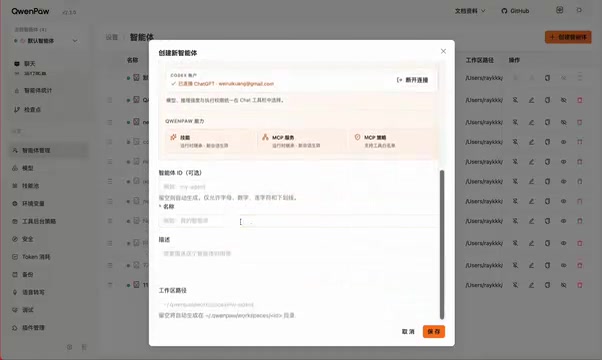
The term "cross-Harness" means QwenPaw is no longer limited to calling its own models. Instead, it can directly leverage the authorized Runtimes of external Agents. What QwenPaw does with its "cross-Runtime" integration is essentially bringing multiple heterogeneous Runtimes under a single interaction interface through a unified orchestration protocol — all without replacing each Agent's native execution environment. When creating an agent, users simply select "Third-party Agent," and the system automatically detects the local environment and account connection status.
Taking Codex as an example, the demo showed the system automatically detecting whether the corresponding environment is installed locally and whether the account is logged in — no need to manually configure complex connection parameters. After entering a name and saving, an agent based on the Codex Runtime is created and ready for immediate use.
The value of this design lies in QwenPaw acting as the "orchestration and governance layer" while the actual code execution is still handled by each Agent's native Runtime. Developers get the convenience of a unified entry point without sacrificing any Agent's native capabilities.
Skills and MCP Service Synergy Preserved
You might not have noticed, but after integrating third-party Agents, QwenPaw's existing Skills, MCP services, and MCP policies can still be used in concert. This means aggregation isn't an either-or tradeoff — the execution capabilities of external Agents and QwenPaw's own tool ecosystem can work additively, complementing each other.
It's worth explaining the background of MCP here. MCP (Model Context Protocol) is an open standard introduced by Anthropic in late 2024, designed to establish a unified communication interface between AI models and external tools and data sources. Its core concept is similar to what USB-C is for hardware — regardless of the underlying tool, AI models can discover, invoke, and receive results through standardized MCP interfaces. MCP Servers are responsible for exposing specific tool capabilities as standardized interface descriptions, while MCP Policies define under what conditions and with what permissions models can call these services. QwenPaw's preservation of MCP ecosystem synergy means that developers' pre-configured MCP tools — file system access, database queries, API calls, and more — remain available when switching to external Agents, without losing toolchain completeness due to aggregation.
Flexible Model and Reasoning Intensity Selection
After integrating external Agents, users can still freely choose models and reasoning intensity based on task requirements. For simple completions or Q&A, lightweight models can be selected to save costs; for complex refactoring or architecture design, users can switch to more powerful reasoning configurations.
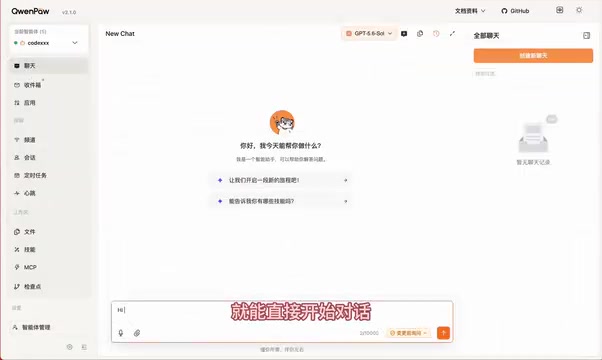
Reasoning Intensity refers to the computational depth a model invests when generating responses. Taking OpenAI's o-series models as an example, higher reasoning intensity means the model performs more rounds of internal "thinking" — decomposing problems, verifying hypotheses, backtracking and correcting — which significantly increases token consumption and response latency but improves accuracy on complex tasks. In practical development, a simple variable rename might only need low reasoning intensity, while an architectural refactoring involving multi-file dependency analysis might require the highest level of reasoning depth. Dynamically adjusting reasoning intensity at task granularity is both a cost optimization strategy and an engineering tradeoff between response speed and quality.
Different tasks have vastly different requirements for computing power and reasoning depth. A one-size-fits-all fixed configuration either wastes resources or falls short. QwenPaw hands the choice back to developers, with dynamic adjustment at task granularity — a pragmatic product approach.
Permission Governance: Execution Belongs to Runtime, Control Belongs to QwenPaw
The most easily overlooked yet most critical aspect of cross-Agent integration is permission governance. The demo explicitly stated: while messages are handed to the Codex Runtime for processing, execution permissions are still managed centrally by QwenPaw.
In traditional software development, permission management follows the "Principle of Least Privilege" — each execution entity should only receive the minimum permissions needed to complete its task. When AI Agents gain code execution capabilities, this principle becomes particularly crucial — an Agent with full file system access could theoretically delete critical files, modify configurations, or execute arbitrary system commands. Multi-Agent environments further amplify this risk, as each Agent may come from a different vendor with different behavior patterns and security boundaries.
The specific permission tiers include:
- Ask before changes: Request confirmation before any modification;
- Read-only: Only reading is allowed, no writing;
- Workspace access: Operations are restricted to a designated workspace;
- Full access: All permissions are granted.
This tiered control is critically important in multi-Agent environments. QwenPaw's four-tier permission hierarchy — from "Ask before changes" to "Full access" — essentially sets up unified security checkpoints across the multi-Agent execution pipeline, ensuring that regardless of which external Agent is performing an operation, it must pass through the same authorization policy review. When external Agents have code execution capabilities, a unified permission guardrail effectively reduces the risk of misoperations and security incidents. QwenPaw decouples "execution" from "authorization," keeping developers in control of Agent behavior boundaries.
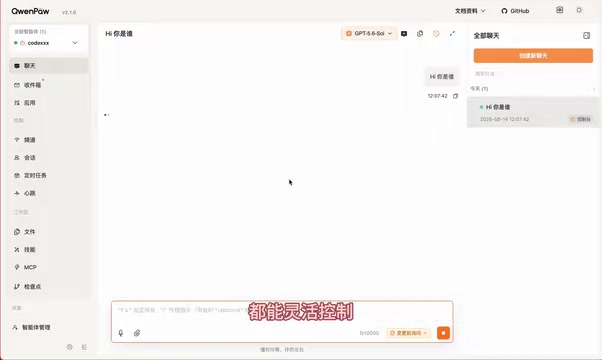
Processing results return directly to the current session — developers don't need to switch back and forth between multiple standalone tools, and context remains continuous. This is precisely the core experience improvement that a "unified entry point" delivers.
Qoder Integration: Same Workflow, Native Capabilities Fully Preserved
The process for integrating Qoder (Coder) is highly consistent with Codex: select Third-party Agent → choose Coder → the system automatically detects the environment and login status → name and save to complete creation. After a one-click switch, you can start sending questions in a new conversation.
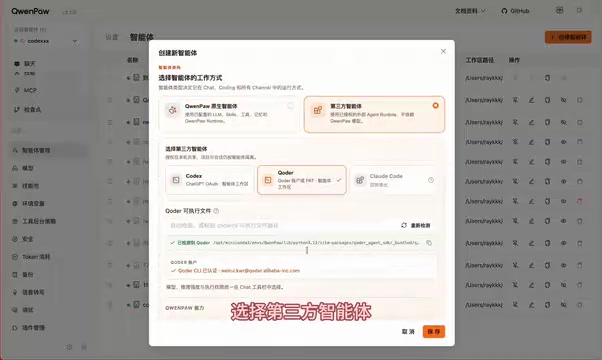
More importantly, Qoder's native modes and model selections are fully preserved. This reflects QwenPaw's design restraint — the aggregation layer doesn't override or strip down each Agent's native features. Instead, it passes them through as much as possible, letting users access each Agent's most authentic capabilities from within the unified entry point.
Conclusion: From Single-Point Competition to Aggregated Orchestration
QwenPaw 2.1.0's update represents a clear trend in AI coding tool development: moving from single-point Agent competition to competition at the aggregation and orchestration layer. As more excellent coding Agents appear on the market, whoever can provide a unified, low-friction, governable integration experience may become the hub of developers' daily workflows.
This trend closely mirrors the evolutionary logic in cloud computing. When containerization technology first emerged, Docker was the focus of single-point competition. But as the number of containers exploded, the real value shifted to orchestration layers like Kubernetes — it doesn't produce containers, but it manages, schedules, and governs all of them. Similarly, in the AI coding tools space, individual Agent capabilities are rapidly converging, and the real differentiation is shifting toward "who can better connect and orchestrate multiple Agents." This also echoes the recurring "platformization" pattern in the tech industry: when underlying capabilities become sufficiently rich, the middle aggregation and governance layer often captures the greatest user stickiness and commercial value.
From the demo, several of QwenPaw's design choices are worth noting:
- Automated environment detection lowers the barrier to integration;
- Decoupling execution from authorization balances convenience with security;
- Native capability pass-through avoids feature loss from aggregation.
Of course, as a demo from a single source, its stability under real-world high-intensity development scenarios and resource scheduling performance during multi-Agent concurrency still require broader validation. But directionally, "one entry point connecting more Agents" undoubtedly addresses the real pain point of today's fragmented multi-tool landscape.
Related articles

Chain of Thought Isn't Just for AI: How Humans Can Use CoT to Improve Thinking Quality
Chain of Thought isn't just a prompt trick for large models. Starting from a Hacker News discussion, this article analyzes why CoT works for human thinking too, breaks down actionable ways to transfer it, and highlights the key differences between human CoT and machine CoT.
Cloudflare Teams Up with OpenAI: Closi…
Cloudflare Teams Up with OpenAI: Closing the Loop from Vulnerability Discovery to Defense with AI
Cloudflare uses OpenAI Daybreak to investigate security vulnerabilities and generate reviewable remediation plans, while developers use Codex to boost coding efficiency and quality.

Orca Multi-Agent Orchestration in Practice: A Guide to Parallel Collaboration with Claude and Codex
Orca is Stable AI's free open-source agent workbench supporting 34 agents like Claude Code and Codex in parallel. Learn its Git worktree isolation, multi-model orchestration, and mobile management.