Raah.dev: One-Stop Tracking for Revenue, Analytics, and Website Performance

Raah.dev unifies revenue data and real-user performance metrics in one dashboard, built for both humans and AI agents.
Raah.dev is an all-in-one dashboard launched on Product Hunt that combines payment conversion data with real-user observability metrics like page load speed, API latency, error rates, and ISP performance in a single view, helping teams quickly assess whether revenue fluctuations relate to performance issues. Positioned for both humans and AI agents, it targets indie developers, small SaaS teams, marketers, and DevOps engineers, differentiating through cross-analysis of revenue and performance.
In today's highly competitive digital product landscape, viewing revenue data and website performance metrics in isolation often leads to delayed decision-making. Raah.dev, newly launched on Product Hunt, aims to break down this divide. It bills itself as an all-in-one dashboard offering "revenue analytics and real-user observability for humans and AI agents."
Core Features: Connecting Payment Conversions with Performance Metrics
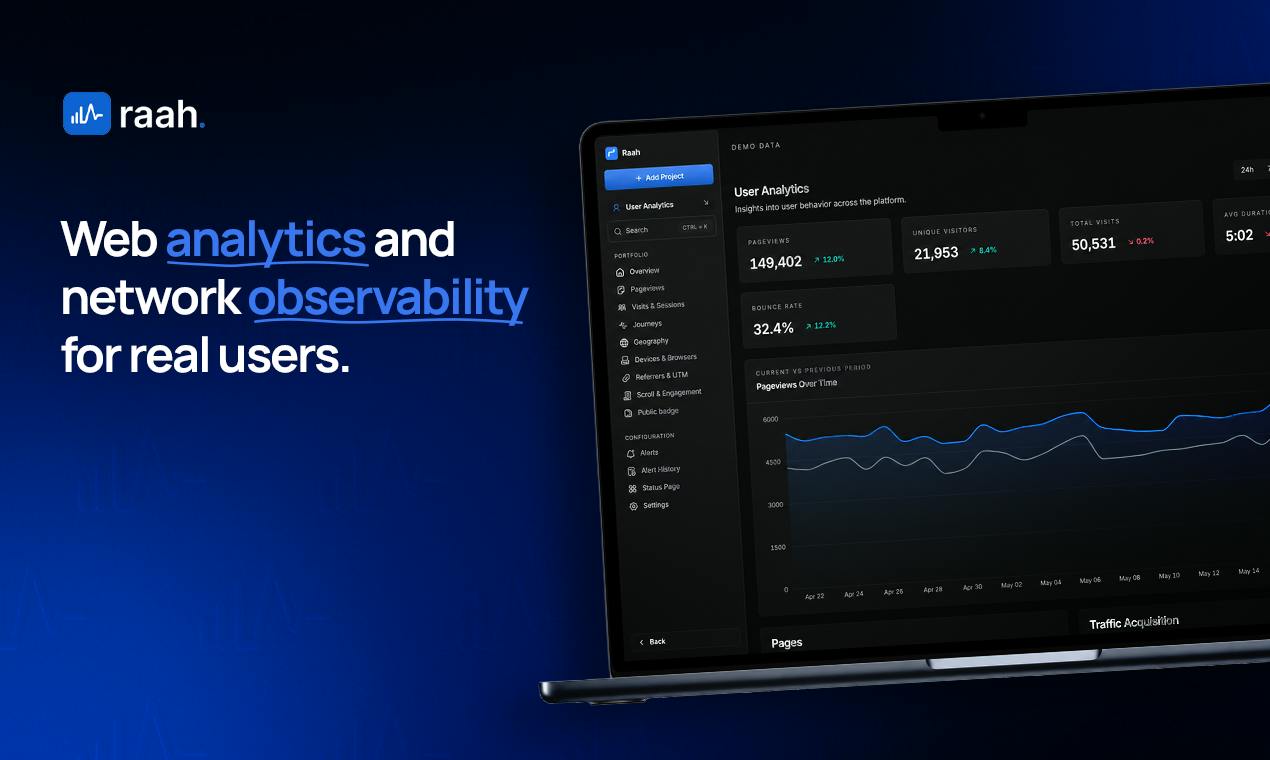
Raah.dev's core logic is straightforward: it brings payment and conversion data together with page load speed, API latency, error rates, and ISP performance in a single view. According to the official description, users can "connect payments and conversions with page speed, API latency, errors, and ISP performance in one dashboard."
This design targets a common operational pain point — when revenue drops, teams often need to log into analytics tools, payment platforms, and monitoring systems separately to investigate the cause. Raah.dev's value lies in reducing this context switching, enabling developers or product owners to quickly determine whether a revenue fluctuation is related to a spike in API latency or an access failure on a specific ISP.
The product received 71 upvotes and 7 comments on Product Hunt, ranking 13th for the day. Given that it sits at the intersection of developer tools and analytics, this level of attention is reasonable.
Observability for AI Agents
Notably, Raah.dev specifically emphasizes "for humans and AI agents" in its description. This suggests that its dashboard is not only designed for human viewing but may also provide structured data interfaces or more readable metric outputs for automated agents.
With AI coding and automated operations becoming increasingly widespread, this direction is forward-looking. If AI agents need to automatically adjust marketing strategies or trigger alerts based on performance data, a platform that unifies revenue and performance signals is clearly more efficient than multiple isolated data sources. However, the official materials do not detail exactly how AI agents connect to or consume this data, which may become a key point of interest in future iterations.
Observability originates from cybernetics and, in software engineering, refers to the ability to infer a system's internal state solely from its external outputs (logs, metrics, traces). Traditional monitoring can only answer "predefined questions," whereas observability emphasizes the ability to answer unforeseen questions. The "real-user observability" mentioned in the article typically refers to collecting browser-side load times, API call latency, errors, and network conditions through Real User Monitoring (RUM), rather than sampling only on the server side. Compared with synthetic monitoring, RUM better reflects the real experience of users in different regions and on different ISPs — which is also the prerequisite for Raah.dev to incorporate ISP performance into revenue analysis.
AI Agent refers to an LLM-driven program capable of autonomously perceiving its environment, invoking tools, and executing multi-step tasks — for example, an ops or marketing agent that automatically troubleshoots failures or adjusts campaign strategies. For agents to consume data, platforms typically need to provide structured APIs, machine-readable metric schemas, or standard interfaces like MCP (Model Context Protocol), enabling agents to query and operate on data via function calls. The article mentions that Raah.dev is "for humans and AI agents" but does not explain the integration method; if it only provides a visual interface without a stable API, it would be difficult for agents to use it directly — which is precisely the key to whether this positioning can be realized.
Target Users and Use Cases
Judging from its category tags (analytics, marketing, developer tools), Raah.dev covers multiple roles. For indie developers or small SaaS teams, it offers a lightweight combination of revenue and performance monitoring, avoiding the upfront cost of building complex data pipelines.
For marketers, linking conversion data with page speed helps validate the actual impact of performance optimization on revenue. For DevOps or full-stack engineers, juxtaposing API latency and error rates with the payment flow can accelerate fault attribution.
The market is not lacking in analytics tools or observability platforms, but products that deeply integrate revenue data with real-user performance metrics are relatively rare. Raah.dev's differentiation lies in cross-analysis of "revenue + performance" rather than being a sprawling, all-encompassing dashboard.
Challenges exist as well. On one hand, users need to authorize connections to payment systems and analytics accounts, making data security and privacy protection key to building trust. On the other hand, ensuring consistency in metric definitions across different data sources to avoid misleading correlations is a technical detail the product needs to validate.
Metric definition consistency is a core difficulty in cross-source correlation analysis. The "conversions" counted by payment platforms are usually based on successful payments and are affected by refunds, time zones, and attribution windows, whereas web analytics tools may count conversions based on form submissions or add-to-cart events — naturally producing discrepancies in counts. If revenue curves and performance curves are compared directly in the same view, inconsistencies in time granularity and attribution rules can easily produce spurious correlations. Common practices include unifying timestamps and time zones, clarifying the statistical definitions of each metric, and supplementing correlation judgments with A/B tests or segmented comparisons to avoid misreading coincidence as causation.
Summary
Raah.dev attempts to answer a specific question with a single dashboard: "Is revenue change related to website performance?" For teams that need to monitor both revenue and user experience, it offers a noteworthy new option. As AI agents play an increasingly important role in operational workflows, its "for AI agents" positioning may become a differentiating pillar for future growth.
One-line Summary
Raah.dev unifies revenue data and real-user performance metrics in a single dashboard, designed for both humans and AI agents.
Paragraph Summary
Raah.dev is an all-in-one dashboard launched on Product Hunt that advocates placing payment conversion data alongside real-user observability metrics such as page load speed, API latency, error rates, and ISP performance in a single view — helping teams quickly determine whether revenue fluctuations are related to performance issues and reducing the cost of switching between analytics, payment, and monitoring systems. The product is positioned for both human users and AI agents, targeting indie developers, small SaaS teams, marketers, and DevOps engineers. Its differentiation lies in cross-analysis of revenue and performance rather than being all-encompassing. The article also notes potential challenges such as data security authorization and cross-source metric definition consistency, and suggests that its "for AI agents" positioning may become a future growth pillar.
Related articles

9 AI Subscription Plans Compared: The Real Cost Per 100M Tokens Revealed
Bilibili creator tests 9 AI subscription plans from Volcano, Alibaba, Tencent, Baidu, Zhipu, Xiaomi, MiniMax and more, converting them all to real cost per 100M tokens, breaking down fixed-quota vs. three-tier coefficient billing and how caching, time-of-day discounts, and window limits affect actual quota.

Vibe Coding for Beginners: Expressing Intent Instead of Handwriting Code
What is Vibe Coding? A 137-episode Bilibili course defines it: the core is expressing intent, not writing code. This article analyzes Vibe Coding's productivity logic, target audience, and entry expectations to help beginners decide if it's worth learning.

LangChain Beginner's Guide: An Agent Development Roadmap from LangGraph to Deep Agents
Clarify the encapsulation relationship among LangChain, LangGraph, and Deep Agents, and master the learning path and selection logic for agent development frameworks—suitable for beginners in large model development.