Racing Manga Agent: One-Click Novel-to-Manga Conversion, Fully Offline and Free

Racing Manga Agent turns novels into manga pages fully offline using local Stable Diffusion.
Racing Manga Agent is an AI-powered tool that automatically converts novel text into complete manga pages. It handles storyboard breakdown, character consistency, dialogue bubble generation, and Japanese-style right-to-left layout — all running entirely offline on a local Stable Diffusion setup. Free and privacy-preserving, it compresses a multi-person manga production workflow into a one-click process for indie creators.
From Writing Novels to Drawing Manga — AI Takes Another Leap
Over the past two years, AI has made rapid progress on both the text creation and image generation fronts. Yet a complete workflow that truly converts "text" into "finished manga" has remained a tough nut to crack. The reason is simple: manga isn't just a single image. It involves storyboard breakdown, character consistency, camera direction, dialogue bubble layout, and a host of other complex steps. If any one of them falls short, the final product looks amateurish.
The concept of storyboarding originated in early animation industry, first systematically adopted by Disney Studios in the 1930s. In manga, storyboards not only determine the visual content of each panel but also control the reading rhythm through panel size, shape, and arrangement — large panels signal a pause at pivotal moments, while sequences of small panels create a sense of tension. Having AI automatically handle storyboard breakdown essentially requires the model to understand narrative temporality and spatiality, which falls under "Discourse Understanding" in NLP — a challenge far more demanding than single-sentence comprehension.
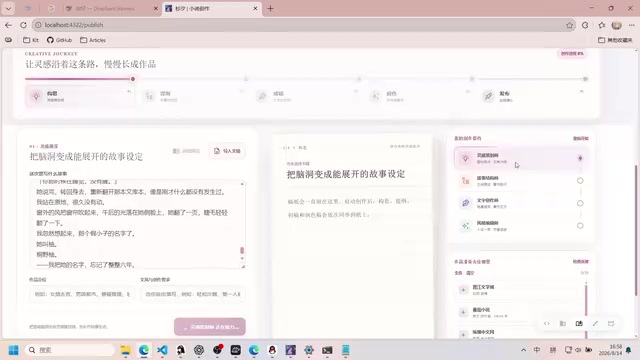
A manga Agent called Racing, demonstrated by Bilibili creator "AI神父" (AI Godfather), takes direct aim at this pain point. Its core logic is straightforward: paste in a passage of novel text, and the system automatically handles everything from script comprehension to finished manga pages — and it runs entirely offline, requires no internet connection, and works on an ordinary PC.
Core Features of Racing Manga Agent
Automatic Storyboarding and Camera Design
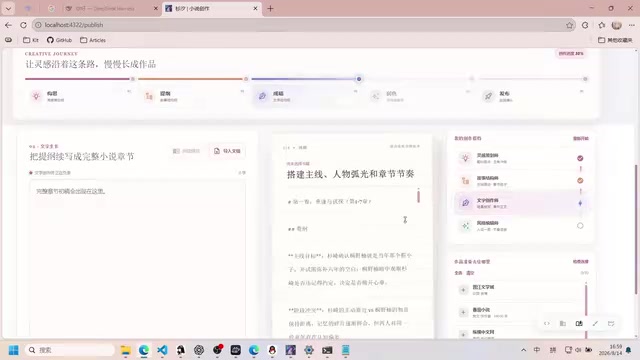
The most critical step in this manga Agent is automatically breaking a continuous block of novel text into four panels. Behind the scenes, the large language model acts as a "director" — it needs to understand narrative pacing, judge which content calls for a close-up versus a wide shot, and determine the scene, featured characters, and camera angle for each panel.
From a technical architecture standpoint, this is a textbook application of the AI Agent orchestration paradigm. AI Agent orchestration has been one of the most important architectural patterns in the LLM application layer during 2023–2024. Its core idea is to decompose complex tasks into multiple sub-steps, with the large language model serving as the "dispatch hub" that sequentially invokes different tools and models according to a preset or dynamically generated workflow. Representative frameworks include LangChain, AutoGen, and CrewAI. In the manga generation scenario, the Agent must coordinate a text comprehension model, storyboard planning logic, an image generation model, and a layout engine — this kind of multi-model collaborative orchestration is precisely the core advantage of the Agent architecture over single-model invocations.
The value of this step goes far beyond "generating an illustration." Storyboards are the skeleton of manga, determining reading rhythm and emotional tension. Feeding it "the most tear-jerking passage" is essentially a test of AI's ability to understand narrative emotion, not just whether the art looks good.
Local Stable Diffusion Image Generation
Once storyboards are set, the system sends each panel's description to a locally deployed Stable Diffusion instance for image generation. This is the technical foundation of the entire solution's "fully offline" capability — image generation doesn't rely on any cloud API; all computation happens on the user's own GPU.
Stable Diffusion is a Latent Diffusion Model open-sourced by Stability AI in 2022. Its core innovation is shifting image generation computation from pixel space to a compressed latent space, dramatically reducing VRAM requirements. A 512×512 image only needs a 64×64 tensor representation in latent space, making it possible to run inference on consumer-grade GPUs (8GB VRAM and above). Local deployment is typically achieved through open-source frontends like ComfyUI or AUTOMATIC1111, where users can load different checkpoint models and LoRA fine-tuning weights to control art style.
This brings two direct benefits:
- Zero cost: No per-image fees or subscriptions to online illustration services
- Data privacy guaranteed: Your novel manuscripts and creative content never get uploaded to any third-party server
For original creators, data privacy is especially significant. The rise of localized AI deployment is not only a result of technological evolution but also reflects the industry's growing concern for Data Sovereignty. Since 2023, multiple lawsuits have been triggered by copyright disputes over AI training data (such as Getty Images v. Stability AI), and creators' anxiety about their work being used for model training without authorization has intensified. A fully offline workflow fundamentally eliminates this risk: both input text and output images never leave the local device, protecting original content from third-party access while avoiding copyright ownership disputes over generated content. This trend aligns closely with the direction of regulatory frameworks like the EU AI Act and China's Interim Measures for the Management of Generative Artificial Intelligence Services.
Tackling the Three Persistent Problems in AI Manga Generation
Character Consistency
Anyone who's used AI image generation knows that making the same character "look the same" across different frames is notoriously difficult. A slight tweak to the prompt can completely change a character's hairstyle, face shape, or clothing. Racing's Agent claims to achieve unified character art style without repeated prompt adjustments, suggesting it performs some form of character feature locking at the underlying level — likely through reference images, LoRA, or a character asset library.
From a technical perspective, LoRA (Low-Rank Adaptation) is a parameter-efficient fine-tuning technique originally proposed by Microsoft Research for adapting large language models, later widely adopted for style and character customization in Stable Diffusion. Its principle is to inject low-rank decomposition matrices alongside the pretrained model's weight matrices, training only these newly added parameters (typically just 0.1%–1% of the original model's parameters) to teach the model to generate specific characters or styles. In manga generation scenarios, training a dedicated LoRA for each character and loading it across different panels is currently one of the mainstream technical approaches to solving character consistency. Additionally, technologies like IP-Adapter and Reference-Only can achieve cross-frame consistency through reference images — the former injects semantic information from reference images into the generation process via an image encoder, while the latter uses attention mechanisms to let generated images directly reference existing frames.
Dialogue Bubbles and Automatic Layout
Another long-overlooked detail is layout. Real manga requires dialogue bubbles and logical reading guide lines. This system can automatically generate dialogue bubbles and follows the traditional Japanese manga convention of right-to-left reading order. This step is what separates "a bunch of loose images" from "an actual manga page."
Iterative Editing Loop
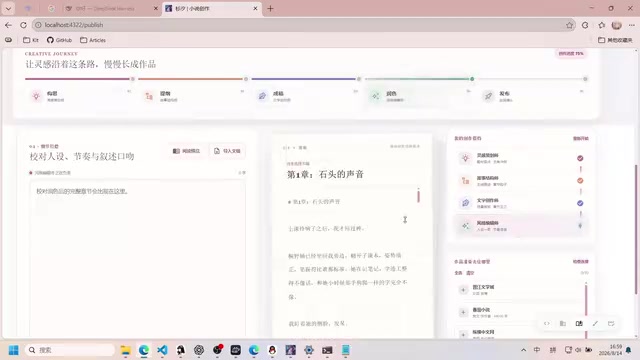
Creation is never a one-shot process. Racing's design emphasizes iterability: change the script, it redraws; change the storyboard, it reassembles. This "what-you-see-is-what-you-get" editing loop lets creators polish their work like editing a document, rather than starting from scratch every time.

Offline AI Workflow: One Computer Is Your Publishing Factory
The creator summarizes this solution's significance as: "One computer without internet is your publishing factory" — a statement that captures the true value of local AI workflows.
It compresses the manga production process — which traditionally requires collaboration among scriptwriters, illustrators, and layout designers — down to one person and one computer. For indie creators, web novel authors, and fan-work enthusiasts, this dramatically lowers the barrier to content format conversion — you can quickly visualize your written work for drafts, promotion, or pure creative expression.
That said, a realistic assessment shows these tools still have clear ceilings. The image quality and style stability of local SD, the adaptability of four-panel storyboards to complex long-form narratives, and the actual performance of character consistency across varied scenes all need to be validated through real-world use. "One-click manga generation" is better suited as a creative aid and rapid prototyping tool — it's still a considerable distance from replacing professional manga production.
Conclusion
The significance of Racing Manga Agent lies not in how stunning its artwork is, but in the fact that it runs the complete pipeline of "text → storyboard → image generation → layout" and does it completely free and fully offline. It represents a direction for localized AI workflows: packaging complex, multi-step creative tasks into one-click processes while keeping computing power and data in the user's own hands.
As open-source model capabilities continue to improve and local deployment barriers decrease, these kinds of "personal publishing factories" are likely to become increasingly common. For creators, what's worth watching isn't just any specific tool, but how the paradigm of "Agent orchestration + local generation" is reshaping the cost structure of content creation. From a broader perspective, as generative model capabilities improve by an order of magnitude every six months while hardware costs continue to decline, a "one-person studio" delivering creative output that once required an entire team will no longer be a privilege of tech enthusiasts — it will become an everyday reality for ordinary creators.
Related articles

Cursor AI Programming in Practice: Build a Student Management System from Scratch in 30 Minutes
A Bilibili creator demonstrates Cursor AI programming: generating a student management system in 30 minutes with natural language. Details on Agent mode, Claude selection, prompt techniques, and thresholds.

Top 20 AI Coding Tools Ranking: From Rock-Solid to Lackluster, a Scored Matrix
Bilibili creator releases top 20 AI coding tools ranking, tiered T0–T4 from rock-solid to lackluster, with Claude Code and Codex tied at T0. This article details the scoring dimensions (capability, reliability, robustness, durability, cost, domestic availability) and tool performances to help developers choose the right AI coding assistant.

Vibe Coding Systematic Tutorial: Master AI-Assisted Programming from Zero
A three-month Vibe Coding tutorial from a Bilibili creator covering Codex, ClaudeCode, and Cursor, from core logic to commercial project practice for beginners.