RAG Sync Monitor: An Incremental Embedding Tool That Updates Only Changed Chunks—No More Full Re-Embedding
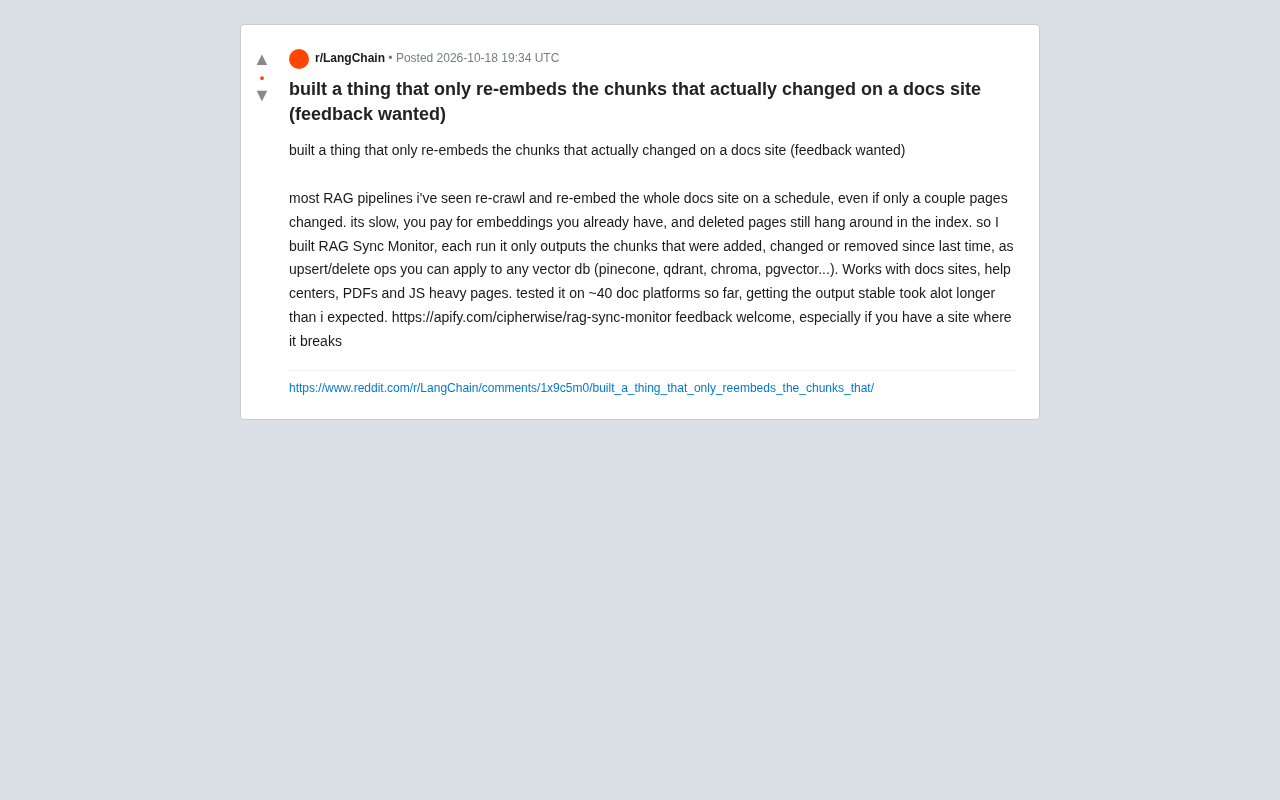
RAG Sync Monitor syncs at the chunk level, generating upsert/delete operations only for changed content.
This article introduces RAG Sync Monitor, a tool built by a developer to address the slowness, wasted embedding costs, and stale index entries caused by scheduled full crawls and re-embedding in RAG pipelines. Each run outputs only the chunks added, modified, or deleted since the last snapshot, generating upsert/delete operations applicable to Pinecone, Qdrant, Chroma, pgvector, and more. It supports documentation sites, help centers, PDFs, and JS-heavy pages, and has been tested on roughly 40 platforms. The author notes that stable output took longer than expected and is seeking feedback on failing sites. Overall, incremental updates yield clear gains in cost, efficiency, and index accuracy, though the tool is still early-stage.
Why Does a RAG Pipeline Need "Incremental Updates"?
Most RAG (Retrieval-Augmented Generation) pipelines update their knowledge base through scheduled full crawls and re-embedding, even when only a handful of pages have changed. This approach is not only slow and wasteful of embedding costs, but also leaves deleted pages lingering in the index, hurting retrieval accuracy. To solve this, a developer (a Reddit user) built RAG Sync Monitor, which on each run outputs only the chunks that have been added, modified, or deleted since the last run, generating upsert/delete operations that can be applied directly to vector databases such as Pinecone, Qdrant, Chroma, and pgvector. The tool supports documentation sites, help centers, PDFs, and JS-heavy pages, and has been tested on roughly 40 documentation platforms.
Core Mechanics of RAG Sync Monitor
Change Detection and Diff Output
The core of RAG Sync Monitor is precise change identification. It compares currently crawled content against the previous snapshot, identifies added, modified, and deleted chunks, and generates operations only for those differences. This means you no longer pay for redundant embedding of unchanged pages, and you no longer worry about deleted content lingering in the index. The output format is generic upsert/delete operations compatible with mainstream vector databases, lowering the barrier to integration.
Chunks are the basic unit of embedding and retrieval in a RAG pipeline. Because embedding models have context-length limits, long documents must first be split into semantically coherent segments, each of which is embedded separately and stored in the vector database. The reason incremental updates operate at the chunk level rather than the page level is that a page change often affects only one or two paragraphs; re-embedding at the page level still produces a large number of redundant vectors and makes it hard to map precisely to records in the old index. Therefore, the tool needs to maintain a stable identifier for each chunk (e.g., based on a content hash or heading path) so that between two snapshots it can determine which chunks are new, which were modified, and which disappeared due to page edits or deletions—and then generate the corresponding upsert and delete operations.
Upsert is the write semantic in vector databases that means "update if exists, insert if not," typically keyed on record ID. Combined with delete operations, it lets incremental sync express a change set atomically: modified chunks go through upsert to overwrite old vectors, and deleted chunks go through delete to be removed. This operation sequence is database-agnostic—Pinecone, Qdrant, Chroma, pgvector, and others all support the corresponding interfaces—so the tool only needs to output a generic operation list, which users execute via the target database's SDK. This avoids having to build separate sync logic for each vector store.
Broad Compatibility and Challenges
The developer notes that the tool supports documentation sites, help centers, PDFs, and JS-heavy pages, and has been tested on roughly 40 documentation platforms. Ensuring stable output took longer than expected, reflecting the complexity introduced by differing site structures, dynamic rendering, and PDF parsing. Nevertheless, the tool offers a promising solution to the incremental update problem in RAG pipelines.
JS-heavy pages refer to sites whose main content and links are rendered dynamically by client-side JavaScript; their initial HTML often contains only a skeleton, and the actual text appears only after scripts execute. Traditional static crawlers scraping such pages get empty or incomplete content, causing change detection to falsely report "mass deletions" or to miss real modifications. Incremental sync tools therefore typically need headless browser rendering, waiting for network idle before extracting the DOM, and fault tolerance for rendering timing and lazy loading. This is one of the main reasons the author emphasizes that "stable output took longer than expected": rendering behavior varies greatly across sites, making it hard to guarantee that every snapshot is comparable using uniform rules.
Impact and Takeaways for RAG Pipelines
Dual Optimization of Cost and Efficiency
Full re-embedding not only consumes embedding API call costs but also takes up compute resources. Incremental updates directly reduce both, with especially pronounced effects for large documentation sites. At the same time, promptly removing stale content helps keep the index accurate and improves the answer quality of the RAG system.
Community Feedback and Directions for Improvement
The developer is openly seeking feedback, particularly asking users to report sites where the tool fails. This openness helps the tool cover more edge cases. The tool is currently available as an Apify actor (link: https://apify.com/cipherwise/rag-sync-monitor); interested developers can try it out and contribute feedback.
Conclusion
RAG Sync Monitor targets an overlooked pain point in RAG pipelines: the waste of full re-embedding and index staleness. Through its incremental update mechanism, it promises to help developers save costs and improve efficiency. Although still in its early stages, its approach is worth watching—especially for teams maintaining large documentation sites.
One-line Summary
RAG Sync Monitor performs incremental sync at the chunk level, generating upsert/delete operations only for changed content.
Paragraph Summary
This article introduces RAG Sync Monitor, a tool built by a developer to address common problems in RAG pipelines: the slowness, wasted embedding costs, and stale index entries caused by scheduled full crawls and re-embedding. On each run, the tool outputs only the chunks added, modified, or deleted since the previous snapshot and generates upsert/delete operations that can be applied directly to vector databases such as Pinecone, Qdrant, Chroma, and pgvector. It supports documentation sites, help centers, PDFs, and JS-heavy pages, and has been tested on roughly 40 documentation platforms. The author notes that ensuring stable output across different site structures took longer than expected and is openly soliciting reports of failing sites to cover more edge cases. Overall, incremental updates deliver clear benefits in cost, efficiency, and index accuracy, though the tool is still in its early stages.
Related articles

Free Unlimited Claude Code Solution: Agnes AI + CC Switch Setup Guide
No paid subscription needed — pair the free AI platform Agnes AI with the open-source tool CC Switch to provide a backend for Claude Code, enabling unlimited free calls to text, image, and video models. This guide covers the full setup, test results, and usage boundaries.

A Complete Zero-Cost Guide to Getting Started with Claude Code for Beginners in China
A beginner's guide to Claude Code for users in China: two installation methods (command line and IDE plugin), full configuration steps for replacing the official API with the free domestic LongCat model, and a hands-on demo of building a small tool with natural language, plus tips.

When the NSA Gets Involved: The AI Supply Chain Crisis Behind Open-Source CVEs and API Key Hijacking
Multiple open-source projects disclosed severe CVEs in one day, PHP flaws alarmed the FBI, and Railway and OpenCode were breached with API keys stolen. This article breaks down the vulnerability window, AI-accelerated exploitation, and the AI supply chain crisis behind the API key black market, with a developer defense checklist.