RAGu: Using Retrieval Augmentation to Enable Zero-Shot Adaptation of VLA Models to New Scenarios
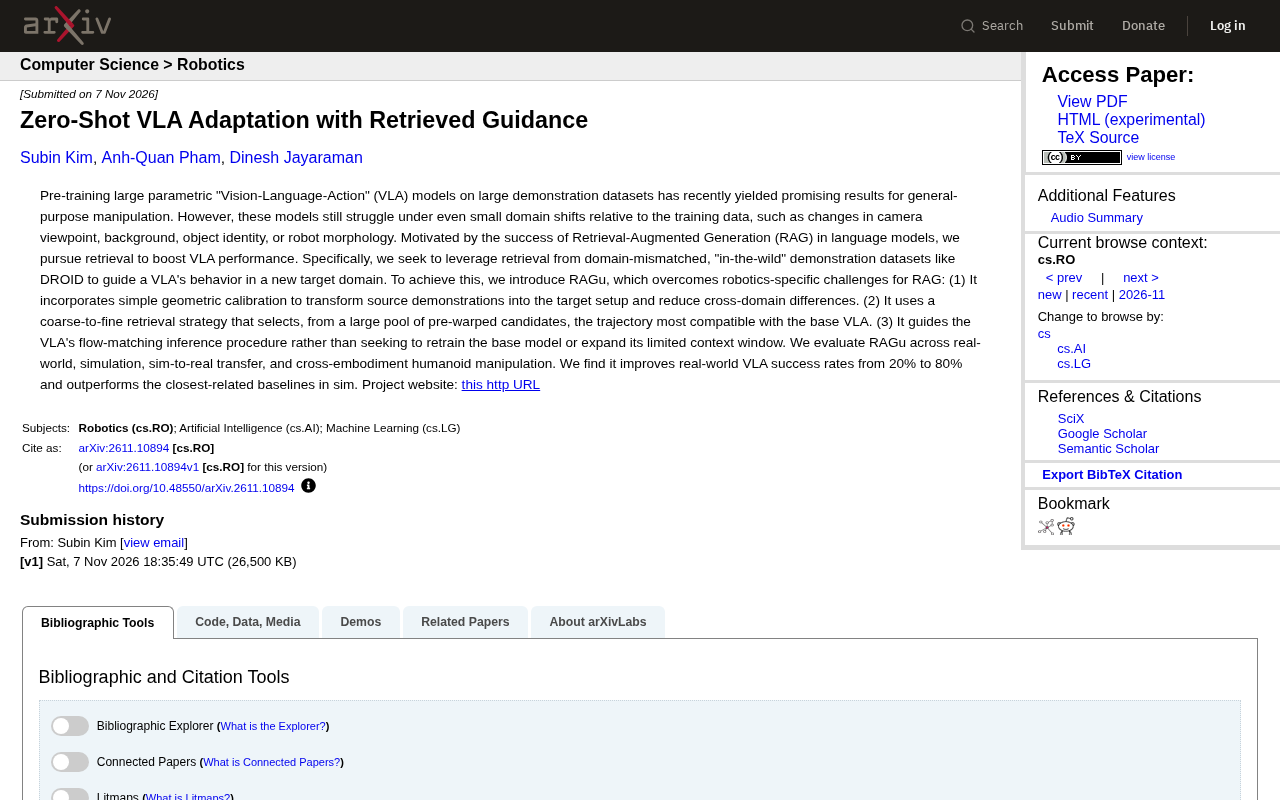
RAGu uses retrieval to guide VLA inference, achieving zero-shot adaptation to new scenarios and raising real-world task success from 20% to 80%.
This article introduces a work titled "Zero-Shot VLA Adaptation with Retrieved Guidance." VLA models pretrained on large-scale demonstration data have general manipulation potential, but slight changes in camera viewpoint, background, objects, or robot morphology cause sharp success rate drops. RAGu borrows the Retrieval-Augmented Generation (RAG) idea from large language models, retrieving reference trajectories from domain-mismatched in-the-wild demonstration datasets to guide VLA inference. Its three key designs are: geometric calibration transforms source demonstrations into the target robot configuration; a coarse-to-fine retrieval strategy efficiently selects the trajectory most compatible with the base model; and guidance is applied during flow matching inference rather than retraining or expanding the context window. Experiments cover real-world, simulation, sim-to-real, and cross-morphology humanoid manipulation, with real-world success rising from 20% to 80% and outperforming the closest baseline in simulation.
Vision-Language-Action (VLA) models, after pretraining on large-scale demonstration data, have shown potential for general manipulation tasks. However, when the deployment environment differs even slightly from the training data—camera viewpoint changes, different backgrounds, swapped objects, or even altered robot morphology—model performance drops sharply. This is an unavoidable hurdle for nearly all robot learning systems when deployed in the real world.
A recent work titled "Zero-Shot VLA Adaptation with Retrieved Guidance" proposes an intriguing idea: just as language models can use Retrieval-Augmented Generation (RAG) to compensate for knowledge gaps, why can't VLA models leverage retrieval to adapt to new scenarios?
Problem: Where Is the Generalization Bottleneck of VLA?
The core idea of VLA models is to unify visual perception, language understanding, and action output into a single end-to-end network, learning the mapping from observations to actions through large amounts of robot demonstration data. Such models perform well within the training distribution, but once test conditions deviate from the training data—for example, training used a certain robotic arm and a certain tabletop background, while testing uses a different setup or camera angle—the success rate drops noticeably.
Traditional remedies either involve collecting target-domain data for fine-tuning or expanding the model's context window to "stuff in" more examples; the former is costly and the latter is limited by architectural design. The authors of the paper chose a different path: retrieving reference trajectories from domain-mismatched "in-the-wild" demonstration datasets and using these trajectories to guide the VLA's inference process.
Three Key Designs of RAGu
Geometric Calibration: "Translating" Source Demonstrations to the Target Domain
The first challenge of cross-domain retrieval is that source and target data are not in the same coordinate system or spatial configuration. RAGu introduces a simple geometric calibration step that transforms trajectories from source demonstrations into the target robot's setup. This step does not require a complex domain adaptation network; instead, explicit geometric transformations reduce cross-domain discrepancies, making the retrieved demonstrations spatially meaningful for the target domain.
Coarse-to-Fine Retrieval Strategy
Faced with a large number of pre-transformed candidate trajectories, RAGu employs a coarse-to-fine filtering approach: first quickly narrowing down the candidate pool, then carefully selecting the trajectory most compatible with the base VLA model. This strategy ensures retrieval quality while controlling computational cost, avoiding expensive one-to-one matching within a huge candidate pool.
Guided Inference Rather Than Retraining
Most critically, RAGu does not retrain the base model, nor does it attempt to expand the VLA's limited context window. Instead, it applies guidance during the VLA's flow matching inference process, allowing the retrieved trajectories to influence action generation. This means the base model's capabilities are fully preserved, and retrieval merely provides an immediate, pluggable guidance signal.
Experimental Performance
The paper evaluates RAGu in various settings: real-world, simulation, sim-to-real transfer, and cross-morphology humanoid robot manipulation. The most striking result: in real-world tasks, VLA success rate improved from 20% to 80%. In simulation environments, RAGu also outperforms the closest baseline method.
This magnitude of improvement indicates that a substantial portion of the performance loss caused by domain shift can be compensated through retrieval guidance, without relying on target-domain data for model updates. For robot systems that need rapid deployment to new environments, this zero-shot adaptation capability has direct practical value.
Why It's Worth Attention
RAGu's significance lies in transferring the RAG idea to the field of robot manipulation and addressing robot-specific challenges—geometric alignment, trajectory compatibility filtering, and inference-time guidance. It does not pursue a larger VLA model but instead uses retrieval to "borrow strength" from existing in-the-wild data, offering a lightweight adaptation path for VLA deployment.
Of course, the method's effectiveness depends on the quality and coverage of retrievable source data, and the applicability scope of geometric calibration remains to be further examined. But the leap from 20% to 80% success rate is enough to bring this direction to the attention of more researchers.
Background Supplement
VLA models (Vision-Language-Action Models) are a class of models that unify visual perception, natural language instruction understanding, and robot action generation into a single end-to-end neural network. A typical approach uses a pretrained vision-language model as the backbone, then attaches an action decoding head (such as a diffusion policy head or flow matching head), and jointly trains on large amounts of robot demonstration data. Its advantage lies in leveraging internet-scale vision-language knowledge and responding to natural language instructions; its limitation is that action outputs highly depend on the robot embodiment, camera configuration, and scene distribution seen during training, so cross-domain generalization remains a major bottleneck.
Flow Matching is a class of generative modeling methods that generate samples by learning a continuous velocity field (vector field) from a noise distribution to the target data distribution; at inference, numerically integrating an ordinary differential equation yields an action sequence from noise. Compared to diffusion models, flow matching has a more direct training objective and smoother sampling paths, and is therefore widely adopted in robot action generation. RAGu injects retrieved trajectories as guidance signals precisely during this inference process, without modifying model weights.
Domain Shift refers to the phenomenon where the test data distribution differs from the training data distribution. In robotics, it often manifests as differences in camera viewpoint, lighting background, object appearance, tabletop layout, or robot embodiment. Domain shift does not cause the model to error out, but it silently degrades its outputs and is the most common source of performance loss when deploying robot learning systems. Zero-Shot Adaptation refers to mitigating domain shift without collecting target-domain data or updating model parameters.
Related articles

Gemini 4 Neon Review: Benchmark Scores Rival Carbon, API Pricing and Quota Breakdown
Google Gemini 4 Neon is now live, benchmark scores closely tracking Carbon, API pricing 3/15 at twice Hydrogen's rate. This article compiles Bilibili creator testing: Neon can replace 90% of Carbon scenarios, AntiGravity quota consumption is only one-third of Carbon, plus subscription channel restrictions and 2API ban risks.

Gemini 4 Helium Coming Soon? Signals of Google Loosening Subscription Restrictions
Google team member hints releases will continue; community speculates Gemini 4 Helium (Flash Lite) may be next. Subscription ban controversy gets a response as product lead says "Soon," suggesting restrictions may be lifted. This article covers Gemini developments, OpenAI Coding Agent and risk management, Doubao real-time audio-video API, and compute business dynamics.

AI-Assisted React Development in Practice: Optimizing a Video App and Handling Errors
A 14-year veteran developer demonstrates AI-assisted React video app optimization: compressing video from 80MB to 5MB (~94%) via ImageKit, plus reliable error handling and retry mechanisms. Includes planning, code understanding, and verification methods for working with AI.