Ranking Math Problems with LLMs: A New Attempt at AI-Assessed Importance

LLMs attempt to rank open math problems, showing potential but exposing inherent limits of subjective judgment.
The article discusses an experimental project on Hacker News that uses large language models to assess and rank the importance of open problems in mathematics. It analyzes the mechanism: LLM judgments rely on discussions of math problem importance in training data, essentially reproducing mainstream narratives rather than offering independent insight. Methodologically, prompt design significantly affects results, different definitions lead to different rankings, and LLMs may have systematic biases toward commonly discussed problems. The article concludes that this direction can serve as a preliminary reference for science communication and interdisciplinary research but cannot replace mathematicians' professional judgment, while revealing both the potential and limitations of LLMs in subjective judgment tasks.
When AI Starts Judging the Importance of Math Problems
Mathematics has too many unsolved problems, but which ones truly matter? This question has long been answered by the mathematical community through intuition, tradition, and peer review. Recently, a project discussed on Hacker News tried to answer it another way: letting large language models (LLMs) evaluate and rank open problems in mathematics.
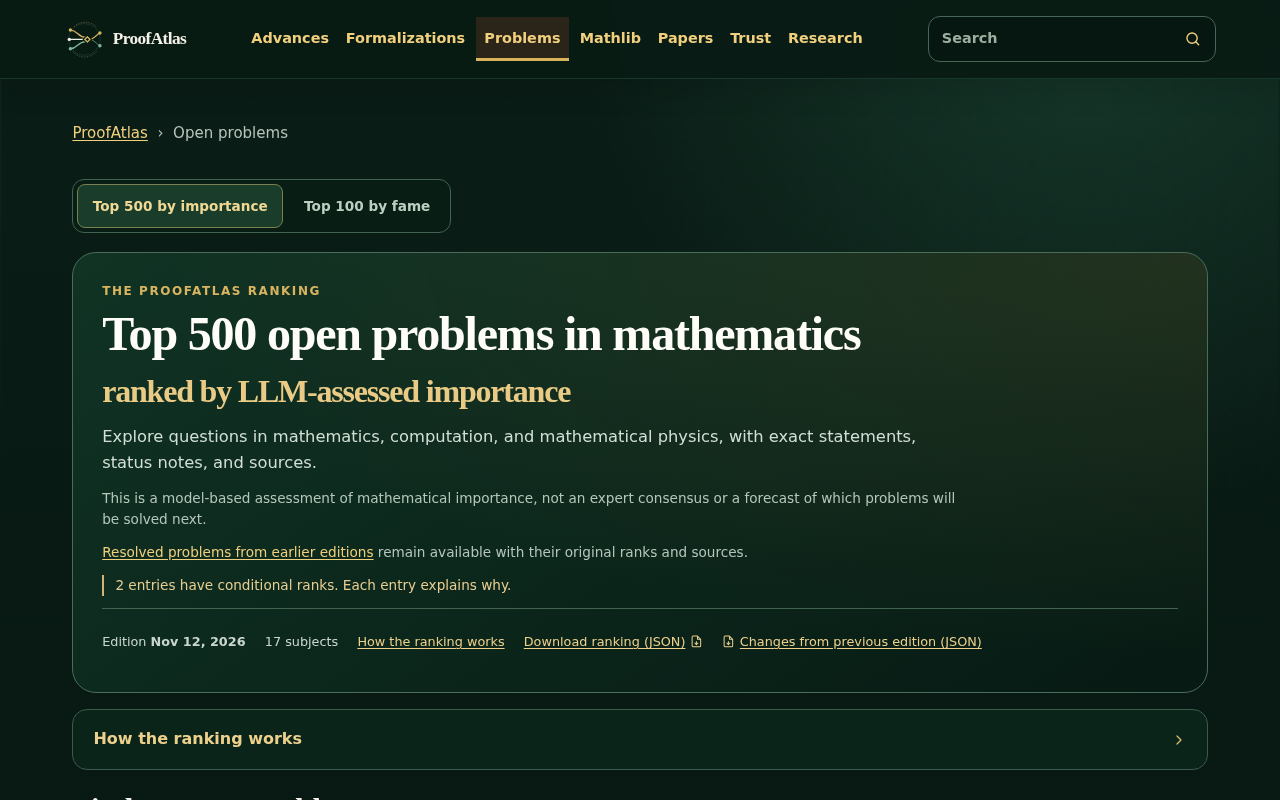
The core idea is not complicated: feed well-known open problems in mathematics into an LLM, have the model assign scores based on some criterion of importance, and then rank them accordingly. The Hacker News post title states the theme directly—"Top open problems in mathematics ranked by LLM-assessed importance." However, the post did not attract much attention, with only 7 points and no comments yet, suggesting that this attempt has not yet sparked broad debate in the tech community.
How LLMs Are Used to Make "Importance Judgments"
Having an LLM evaluate the importance of math problems is essentially a task of delegating subjective judgment to a language model. The model needs two capabilities: first, a basic understanding of mathematics—knowing roughly which branch each problem belongs to and which theories it relates to; second, some capacity for "value judgment"—being able to distinguish whether solving a problem would bring about a paradigm shift or merely constitute a technical completion.
According to the project's approach (based on the Hacker News post title and project description), the LLM is asked to score or rank the open problems. This approach contrasts with the traditional academic method: the importance of math problems is usually determined by community consensus—lists like Hilbert's problems or the Millennium Prize Problems were formed after extensive discussion among mathematicians. The involvement of LLMs amounts to an attempt to approximate this consensus using statistically learned language patterns.
Potential Differences from Human Ranking
Whether the LLM's evaluation results are reliable depends on how much discussion about the importance of math problems is included in its training data. If the model was heavily exposed to math popularizations, survey articles, and academic discussions during training, it may tend to reproduce the mainstream "importance narrative." But this also means the LLM's ranking may lack originality—it produces a weighted average of views already present in the training data, rather than independent mathematical insight.
A large language model (LLM) is fundamentally a statistical language model trained on massive amounts of text, generating content by predicting the next word. It does not possess genuine mathematical reasoning or value judgment capabilities; instead, it approximates human expression by learning co-occurrence patterns in text. In importance assessment tasks, the LLM is in effect reproducing statistical patterns in the training corpus about "which math problems are discussed more and rated more highly." Therefore, its output is essentially a weighted average of existing consensus, not independent insight. Understanding this helps assess the reliability and boundaries of LLM ranking results.
Hilbert's problems (proposed in 1900) and the Millennium Prize Problems (proposed in 2000) are two famous lists of open problems in the history of mathematics, both selected by authoritative groups of mathematicians after long discussion and representing community consensus. Hilbert's problems comprise 23 problems that profoundly influenced the development of 20th-century mathematics; the Millennium Prize Problems were selected by the Clay Mathematics Institute as 7 problems, each carrying a $1 million prize. The formation of these lists involved extensive peer review and academic debate, in sharp contrast to the LLM's mechanism of statistical ranking based on training data.
Why This Direction Is Worth Watching
Although it is currently only a small-scale experimental attempt, using LLMs to assess the importance of math problems still has value.
First, it provides a way to quickly generate a "candidate list." For researchers outside mathematics, science writers, or interdisciplinary researchers, an LLM can serve as a starting point for quickly learning which important open problems exist in mathematics. Second, this attempt reveals an application pattern for LLMs in subjective judgment tasks: when a question has no objective answer, let the model provide a grounded ranking based on training data.
Methodological Challenges
This approach also faces obvious methodological problems. The LLM's evaluation depends heavily on prompt design—how "importance" is defined directly determines the ranking results. Is it historical influence, theoretical value upon resolution, or potential contribution to applied mathematics? Different definitions lead to completely different rankings. In addition, the LLM may have systematic biases toward certain problems—for example, problems more commonly found in the literature may be given higher weight, while obscure but profound problems may be undervalued.
Prompt engineering refers to the technique of designing the wording, structure, and context of input text to guide an LLM toward desired outputs. In importance assessment tasks, prompt design directly determines the model's understanding of "importance." For example, if the prompt emphasizes "historical influence," the model may favor classic problems; if it emphasizes "application potential," it may favor engineering-related problems. This sensitivity means that LLM ranking results depend heavily on the evaluator's preset framework rather than objective criteria.
Consensus and Divergence from Multiple Perspectives
Based on the basic information about the Hacker News post, the project itself did not include detailed methodology or result data, and community discussion has not yet developed. However, drawing on the current general discussion in the AI community about LLM capabilities, some consensus and divergence can be observed.
A fairly common view is that LLMs perform unstably on tasks requiring intuition and domain judgment, especially in mathematics, a field that relies heavily on formal reasoning and domain knowledge. According to general observations in the AI research community, LLMs are better at restating and summarizing existing views than at making independent value judgments. Therefore, an LLM's ranking of the importance of math problems is more likely to reflect "importance narratives common in training data" rather than genuine mathematical insight.
At the same time, some argue that involving LLMs in such judgments is itself a valuable exploration—even if the results are imperfect, it can help humans think about whether the concept of "importance" itself can be operationalized.
Formal reasoning refers to translating mathematical arguments into a rigorous symbolic logical system so that machines can verify or derive them. Mathematics relies heavily on formal reasoning, whereas LLMs work mainly on statistical patterns in natural language and lack strict adherence to formal rules. This causes LLMs to perform unstably on tasks requiring precise logical deduction, being better at restating and summarizing existing views. Therefore, when assessing the importance of math problems, the limitations of LLMs lie not only in the subjectivity of value judgment but also in their lack of formal reasoning ability within the domain.
Practical Application Scenarios and Limitations
The most realistic application scenario for this LLM ranking method is currently to assist in generating overview materials on open problems in mathematics. For teaching, science writing, or quick orientation for interdisciplinary researchers, an LLM-generated ranked list can serve as a preliminary reference.
But its limitations must be made clear: LLM assessments cannot replace the professional judgment of mathematicians. The true importance of a problem often can only be accurately understood within a specific research context. Treating LLM rankings as authoritative conclusions carries a risk of misleading.
Conclusion
Using LLMs to rank the importance of open problems in mathematics is an interesting but still immature direction. It demonstrates one possible application of language models in subjective judgment tasks, while also exposing the inherent difficulty of such tasks: importance itself is a concept that needs to be defined. This low-profile post on Hacker News may be just a starting point for this line of thinking. If more systematic methodology descriptions and more transparent evaluation processes emerge in the future, such attempts will deserve more serious consideration.
Related articles

Pure-Code Video Generation Tested: Which AI Model Actually Follows Instructions?
A Bilibili creator tested three AI models' pure-code video generation with unified prompts and three revisions each: Xiaonaomao has a high ceiling but lacks stability, GPT 6.2 Extra models well but only follows half the instructions, and OPAS 5.5 remains the benchmark.

GPT-6 Six-Tier Hands-On Test: Astra Ultra Dominates but Bills Double
GPT-6 six-tier test: Astra Ultra sweeps 3:0 in 3D tasks thanks to sub-agents and runs 14% faster, but hidden backend bills make its real cost 2.6x single-threaded.

GPT-6.2 Astra vs Fable 5.2: Huge Cost-Efficiency Gap Across 12 Real-World Tests
Bilibili creator tests GPT-6.2 Astra vs Fable 5.2 across 12 real tasks: Fable wins 7-5 but costs 7.2x more and takes nearly 5x longer. Token efficiency emerges as the key selection metric.