REA Goes Viral on GitHub: One MCP Command Lets AI Reverse Engineer Any Software
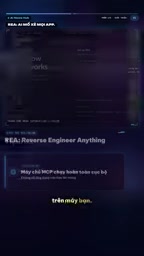
Open-source REA wraps reverse engineering into a local MCP server, letting AI assistants analyze 30+ closed-source formats with one command.
REA (Reverse Engineer Anything) is a fully local MCP server with over 470K GitHub stars. It consolidates tools like Ghidra, IDA, and JADX into a unified entry point, letting AI assistants such as Claude Code and Cursor analyze closed-source software with a single install command. It supports 30+ formats including Electron, Android APK, .NET, Unity, Cocos, native binaries, AI models, and firmware, providing pseudocode, call graphs, and execution traces with evidence chains and marked boundaries. Demos include DxBall audio reconstruction passing 3,200+ tests, Notion clipboard IPC analysis, and auto-generating Dockerized AI Agent training environments. MIT-licensed, with warnings to install only from official channels.
Title
REA Goes Viral on GitHub: One MCP Command Lets AI Reverse Engineer Any Software
Meta Description
REA (Reverse Engineer Anything) has surpassed 470K stars on GitHub. Through the MCP protocol, it lets AI assistants like Claude Code and Cursor reverse engineer 30+ file formats—including Electron, Android, .NET, and Unity—with a single command, running locally with evidence chains attached to every result and support for auto-generating AI Agent training environments.
Article Content
Reverse engineering has always been a skill reserved for a small circle of security researchers and crackers: opening a pile of tools like Ghidra, IDA, and JADX, manually reading assembly, capturing network packets, and digging through data files—taking days just to sketch out the outline of a closed-source feature. An open-source project called REA (Reverse Engineer Anything) is changing that. It has already racked up over 470,000 stars on GitHub, and its core idea is to package the entire reverse engineering workflow into an MCP server, letting AI coding assistants like Claude Code and Cursor "see inside" applications directly.
What Is REA: Turning Reverse Engineering Into a Single Command
According to the project's intro video, REA is an MCP (Model Context Protocol) server that runs entirely on the local machine. Users only need to run a single install command, and the AI assistant gains deep analysis capabilities for the target software—no data is uploaded to the cloud.
The project's positioning isn't "yet another reverse engineering tool" but a "single entry point." In the past, to understand a closed-source feature, engineers had to switch back and forth between Ghidra, IDA, JADX, and similar tools, manually disassembling machine code, capturing network traffic, and checking data files one by one—a process measured in days. REA attempts to replace this fragmented pipeline with a unified interface, letting AI be the executor while humans just ask the questions.
MCP (Model Context Protocol) is an open protocol launched by Anthropic at the end of 2024 to standardize how AI assistants connect to external tools and data sources. Think of it as "the USB interface of the AI world": the model itself doesn't directly execute tools; instead, it calls local capabilities through interfaces exposed by MCP servers. An MCP server declares which tools, resources, and prompt templates it provides to AI clients, and clients (such as Claude Code and Cursor) invoke them on demand during conversations. Because the protocol is decoupled from any specific model, the same MCP server can be reused by different AI clients. REA leverages exactly this mechanism, packaging capabilities like disassembly, decompilation, and traffic capture into standard tool interfaces, so the AI assistant can autonomously decide which tool to call and which code to analyze during its reasoning process.
30+ File Formats, One MCP Entry Point
REA covers a remarkably wide range of targets: more than 30 file formats, including Electron apps, Android APKs, .NET programs, Unity games, Cocos engine builds, as well as native binaries, AI model files, and firmware.
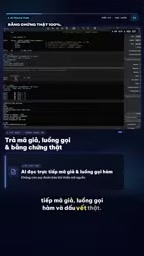
For AI assistants, the key change lies in the quality of information. Previously, when asked to analyze a binary, a large model could only guess; REA instead directly provides the model with pseudocode, function call relationships, and real execution traces. More importantly, every conclusion comes with concrete evidence and clearly marked analysis boundaries—what the AI gives isn't a vague "it might be like this" judgment, but a traceable chain of inference.
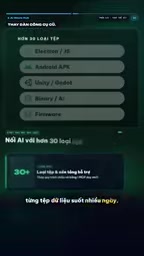
All analysis is completed on the user's own machine, which is especially important in scenarios involving commercial software or sensitive code.
Pseudocode is the core output format of decompilation tools. It reconstructs machine code or bytecode into a structure close to a high-level language, preserving variables, branches, loops, and function call relationships, though it isn't guaranteed to compile directly. Compared with reading assembly instructions line by line, pseudocode greatly reduces the cost of understanding, and it's also the prerequisite for large models to "read" binaries—assembly is too low-level and lacks semantics, while pseudocode's level of abstraction is closer to the source code distribution the model is familiar with. Function call relationships, meanwhile, describe the internal dependency graph of a program, helping analysts trace key logic from entry points. It's worth noting that decompilation is inherently an undecidable problem: pseudocode may lose type information or exhibit control flow that's hard to reconstruct. That's precisely why REA emphasizes attaching evidence and boundary annotations to conclusions—to remind both the model and the user that decompilation results are approximations, not exact equivalents.
Three Verified Real-World Cases
The project team has released three demos covering different types of reverse engineering tasks:
Game audio function reconstruction. REA reverse engineered and reconstructed the audio function of the classic game DxBall. The result matched the original implementation exactly and passed over 3,200 test verifications. This proves it's not just "roughly understanding"—it can reconstruct a working equivalent implementation.
Notion clipboard mechanism analysis. In the second case, REA traced Notion's clipboard mechanism implemented via an IPC bridge, all without source code. This kind of analysis is highly valuable for understanding the internal communication of modern Electron applications.
Automatic generation of AI Agent training environments. The third case is the most imaginative: previously, building simulation environments for AI agents required writing lots of code by hand. REA's approach is to record a session of web or app interactions, then convert the captured APIs into runnable Docker tools. The AI thereby gains an isolated training ground for reinforcement learning and testing, completely without touching the real system.
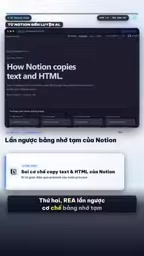
IPC (Inter-Process Communication) refers to the mechanisms by which different processes on the same machine exchange data, with common methods including pipes, shared memory, sockets, and platform-specific message buses. Modern Electron applications typically consist of a main process (Node.js environment with full system privileges) and multiple renderer processes (Chromium environment running the UI), and communication between them must go through an IPC bridge. System-level operations like the clipboard are often executed by the main process and triggered by requests from renderer processes. When analyzing such mechanisms, reverse engineers need to locate the bridge APIs exposed by preload scripts and trace message channel names and serialization formats to reconstruct the complete call chain. This is why the Notion case is representative: it demonstrates how, without source code, UI actions can be mapped to underlying system calls along IPC channels.
What It Means for Developers
What really strikes a chord with developers is that REA turns "understanding someone else's software" from a specialized skill into an act of asking a question. Seeing a competitor nail a particular interaction and wanting to know how it works, wanting to understand the internal logic of a closed-source library, or needing to write technical documentation for a legacy system—tasks that used to require outsourcing or days of work can now be advanced through conversation.
It also changes how AI agents are trained. Recording becomes the environment, meaning any software with a UI or API can quickly become a training ground for agents—a real efficiency boost for teams working on automated testing and reinforcement learning research.
Usage Boundaries and Security Reminders
The project is open-sourced under the MIT license and is explicitly intended for legitimate research purposes and software that users have the right to inspect. In other words, its legality depends on the scope of the user's authorization; the tool itself offers no exemptions.
Another real risk is impersonation. The project team specifically warns users to install only from the official repository or official NPM package, and to avoid third-party channels—a tool with deep local analysis privileges, once replaced with a malicious version, would have consequences far more serious than ordinary dependency poisoning.
Reverse engineering used to be the craft of a few experts; now it's compressed into a single command. As the barrier drops, so does the responsibility fall on each user: which application are you planning to crack open first?
The MIT license is a permissive open-source license that allows users to freely use, modify, and distribute the code, even in commercial closed-source products, as long as copyright and license notices are retained. But a license only governs how the code is used; it does not grant authorization to reverse engineer target software. In most jurisdictions, the legality of reverse engineering depends on the purpose and the target: interoperability research, security vulnerability analysis, and malware analysis are generally afforded some protection, while circumventing technical protection measures, infringing trade secrets, or violating end-user license agreements may be illegal. REA positions itself as a tool for legitimate research and inspection of one's own software, with actual compliance responsibility resting on the user. Moreover, while local execution avoids data exfiltration, it also means analysis privileges reside entirely on the local machine—so the trustworthiness of the installation source directly determines the security boundary.
One-line Summary
Open-source project REA packages reverse engineering into a local MCP server, letting AI assistants directly analyze 30+ closed-source software formats with a single command.
Paragraph Summary
REA (Reverse Engineer Anything) is a fully local MCP server that has surpassed 470,000 stars on GitHub. It consolidates scattered reverse engineering toolchains like Ghidra, IDA, and JADX into a unified entry point, enabling AI coding assistants such as Claude Code and Cursor to analyze the internals of closed-source software with a single install command. It supports 30+ formats including Electron, Android APK, .NET, Unity, Cocos, native binaries, AI models, and firmware. REA provides the model with pseudocode, function call relationships, and real execution traces, with conclusions backed by evidence chains and marked analysis boundaries. Demos include DxBall audio function reconstruction passing over 3,200 tests, Notion clipboard IPC mechanism analysis, and automatic generation of Dockerized AI Agent training environments from recorded interaction sessions. The project is MIT-licensed, emphasizes legitimate use, and warns users to install from official channels to prevent impersonation.
Related articles

VP ≠ VNP: A Major Breakthrough in Computational Complexity Theory
A study claiming to prove VP ≠ VNP over every field sparks heated discussion on Hacker News. This article analyzes the algebraic complexity background of VP and VNP, the proof approach, community controversy, and its potential impact on computational complexity theory.

Developer Naming Woes: The Technical Names That Drive Us Crazy
Why is technical naming so maddening? From Nginx and Vite to Qt and Sudo, a YouTube creator rants about the chaos of developer naming and pronunciation, revealing the tug-of-war between creators' intentions and community habits, and the cultural roots behind spelling traps like PyPI and GNOME.

Figma Workplace Scandal: Employee Sues CEO for Forcing Confrontation with Harasser
Figma and its CEO are sued by a current employee alleging sexual harassment and discrimination, and forcing the victim to confront her harasser. This article outlines the background, potential impact, and industry reflection.