rea: Reverse Engineering Any Software with AI Agents — From App Behavior to Native Binaries

rea is an open-source AI agent tool for reverse engineering, gaining nearly 3,000 GitHub stars in a single day.
morluto/rea is an open-source reverse engineering project written in TypeScript that brings AI agents into an analysis workflow traditionally dominated by deep expert knowledge — covering everything from runtime app behavior to native binary analysis. It gained nearly 3,000 stars in a single day on GitHub (over 6,700 total), reflecting strong community excitement at the intersection of AI agents and a notoriously high-barrier technical field. That said, public information remains mostly at the tagline level; actual platform support, analysis accuracy, and capability limits are still unclear, and legal compliance should be considered before use.
A New Reverse Engineering Project Gaining Nearly 3,000 Stars in a Single Day
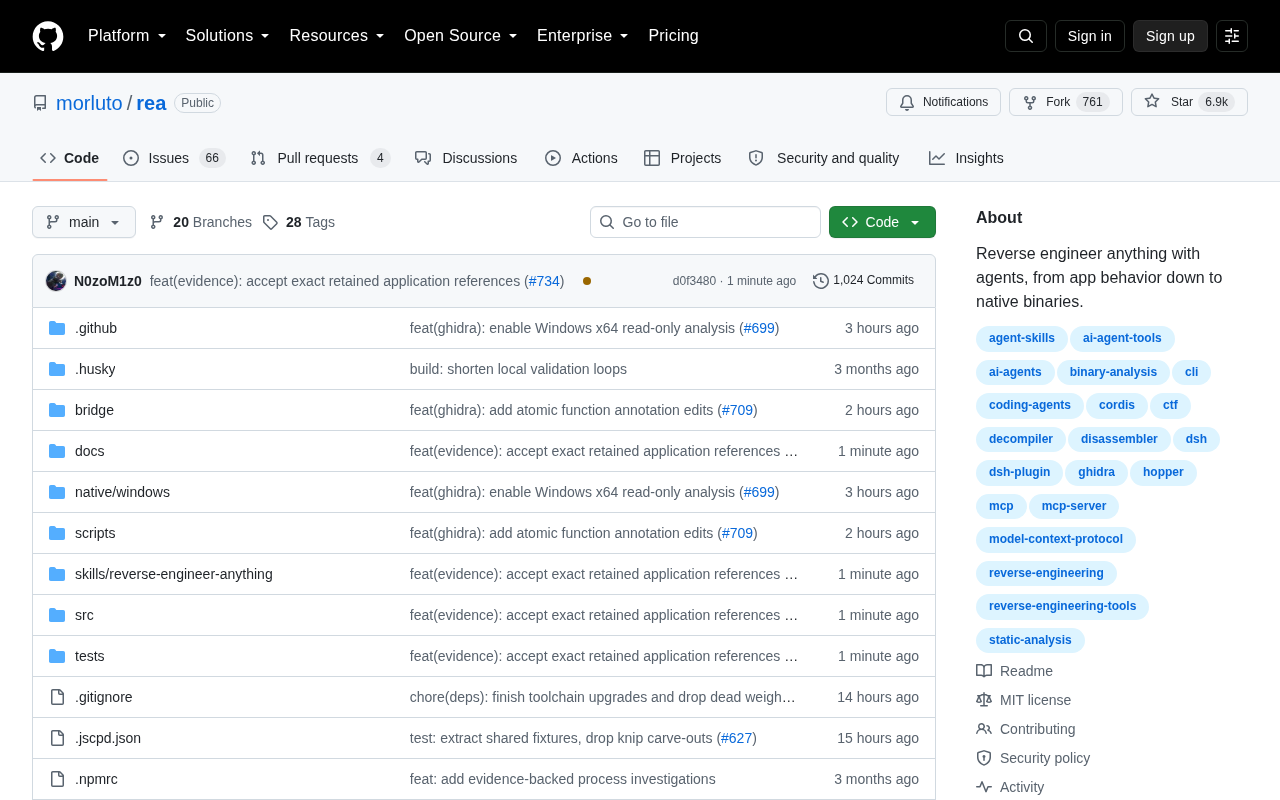
A noteworthy new project has emerged in the open-source reverse engineering space — morluto/rea. Its GitHub tagline is straightforward: "Reverse engineer anything with agents, from app behavior down to native binaries."
The growth numbers are striking: 6,765 total stars, 743 forks, with a single-day gain of 2,963 stars. That kind of velocity signals a project hitting a genuine pain point — only tools that resonate deeply with real needs tend to get this kind of explosive exposure. The project is written in TypeScript, a choice that makes it especially accessible to developers in the modern frontend and Node.js ecosystems.
What Problem Does rea Aim to Solve?
Traditional reverse engineering carries a steep learning curve. Whether you're analyzing an application's runtime behavior or diving into native binaries to disassemble code and reconstruct control flow, engineers need solid low-level knowledge and fluency with professional tools like IDA Pro, Ghidra, and Frida. The whole process is often time-consuming, painstaking, and heavily dependent on accumulated experience.
rea's core idea is to bring agents into this workflow. According to its tagline, it aims to cover the full analysis chain — from high-level app behavior all the way down to native binaries. In other words, it wants AI agents to take on portions of the analysis work that currently require manual, iterative exploration, lowering both the skill barrier and the time cost of reverse engineering.
Two-Layer Coverage: Behavior and Binary
The phrase "from app behavior down to native binaries" is worth unpacking. It implies two distinct levels of analysis:
- App behavior layer: Focuses on what software does at runtime — network requests, API calls, data flows, and other dynamic characteristics.
- Native binary layer: Dives into compiled machine code to analyze function structures, logic, and low-level implementation details.
Tools that genuinely bridge both layers are rare, and rea making this its core value proposition is a key reason it has quickly attracted attention from reverse engineers, security researchers, and software analysts.

For context: IDA Pro is the industry's most mature commercial disassembly and decompilation platform, with licensing costs in the thousands of dollars — a staple for professional security researchers. Ghidra is NSA's open-source alternative, offering decompilation and scripting capabilities that have gained rapid community adoption in recent years. Frida is a dynamic instrumentation framework that lets researchers inject JavaScript into live processes to intercept and modify function calls in real time — the go-to tool for dynamic analysis.
These tools represent two distinct approaches: static analysis (IDA/Ghidra) and dynamic analysis (Frida). Their shared barrier is that users need to understand assembly instructions, calling conventions, memory layouts, and be able to map tool output to business logic — skills that typically take years to develop. rea aims to use AI agents as a "collaborative analysis layer" that automates reasoning on top of these tools, reducing the need for manual intervention.
The distinction between dynamic and static analysis is fundamental in reverse engineering. Dynamic analysis (corresponding to the "app behavior layer") collects data while a program runs — it can capture the true logic of obfuscated code after deobfuscation, but is limited to the specific execution paths triggered. Static analysis (the "native binary layer") parses executable instruction sequences without running the program, covering all code paths, but becomes exponentially harder when dealing with packers or virtualization-based protections. Real-world security research often requires alternating between both approaches — using dynamic analysis to pinpoint key functions, then static analysis to deeply reconstruct logic. rea's claim to cover both layers means it needs to coordinate and schedule different analysis strategies at the agent level, which is where both the technical challenge and the value proposition lie.
Why Did It Go Viral So Quickly?
AI agents are one of the hottest topics in the developer community right now. Applying agents to a domain that has traditionally been almost entirely dependent on deep expert knowledge — reverse engineering — carries both strong novelty appeal and a compelling vision.
Several factors contributed to its rapid rise:
- Hits a real pain point: Reverse engineering has always had high labor costs and a brutal learning curve. Any tool that automates the process and lowers the barrier will attract attention.
- Rides the agent wave: Agents are evolving from chat assistants into capable executors. Reverse engineering is a hardcore testbed for demonstrating what agents can actually do.
- Developer-friendly tech stack: The TypeScript choice significantly lowers the barrier for Web and Node.js developers to contribute and build on top of it.
The core distinction between AI agents and traditional AI assistants lies in the ability to act: agents don't just generate text — they can call external tools, execute multi-step plans, and adjust strategies based on intermediate results, forming a closed loop of perception → reasoning → action. In a reverse engineering context, this means an agent can autonomously call a disassembly API to retrieve a function list, identify patterns and decide which module to analyze next, and compare results across multiple runs to infer patterns — all without a human issuing instructions at each step. This "self-directed progression" makes agents particularly well-suited for reverse engineering tasks that require extensive iterative exploration. It's also the key narrative that sets rea apart from ordinary "AI-assisted" tooling — though its actual degree of autonomy remains to be verified in practice.
A Measured Take: Reserving Judgment Beyond the Hype
It's worth noting that most of the currently available public information is limited to the project tagline and basic statistics. There's little disclosure about actual capability boundaries, supported platforms and architectures, or analysis accuracy. Reverse engineering is a domain where precision requirements are extremely high, and the reliability of AI agents in complex binary analysis still needs real-world validation.
For developers and security researchers who genuinely want to use it, the recommendation is to review the full documentation, examples, and usage limitations in the project repository, and evaluate actual performance in a controlled environment before integrating it into your workflow. Additionally, reverse engineering involves legal and compliance boundaries — any use of such tools should be within authorized and lawful scope.
Summary
rea represents a compelling attempt to bring AI agents into a hardcore technical domain: automating the reverse engineering process that has long relied on seasoned experts, covering the full chain from app behavior to native binaries. A single-day gain of nearly 3,000 stars signals extremely high community expectations for this direction. Its true capability boundaries still need to be tested in practice — but as a bellwether, it clearly points toward the vast potential of agents in specialized vertical domains.
Related articles

Uber Deploys ChatGPT Work Company-Wide: AI in the Workplace Enters the Scaled Implementation Phase
Uber deploys ChatGPT Work to 30,000+ employees, extending it from engineering to all roles. We analyze its expert-engineer pairing, end-to-end automation, and questions of AI control and power concentration—insights for scaling AI in the workplace.

Shift at Midnight Hands-On: When "ID Verification" Becomes Alien Hunting
Shift at Midnight blends ID verification with horror survival in a four-player co-op game. We break down its inspection mechanics and chaotic humor.

Zelensky Recounts the Outbreak of War: I Need Ammunition, Not a Ride
Zelensky recalls the first day of war in a YouTube interview: farewell to family, rejecting Biden's evacuation offer with "I need ammunition, not a ride," and how Bucha shaped his stance on compromise and peace talks.