Reddit Buzz: Claude Opus 5.5 Quota Reset Sends Users on a Usage Spree
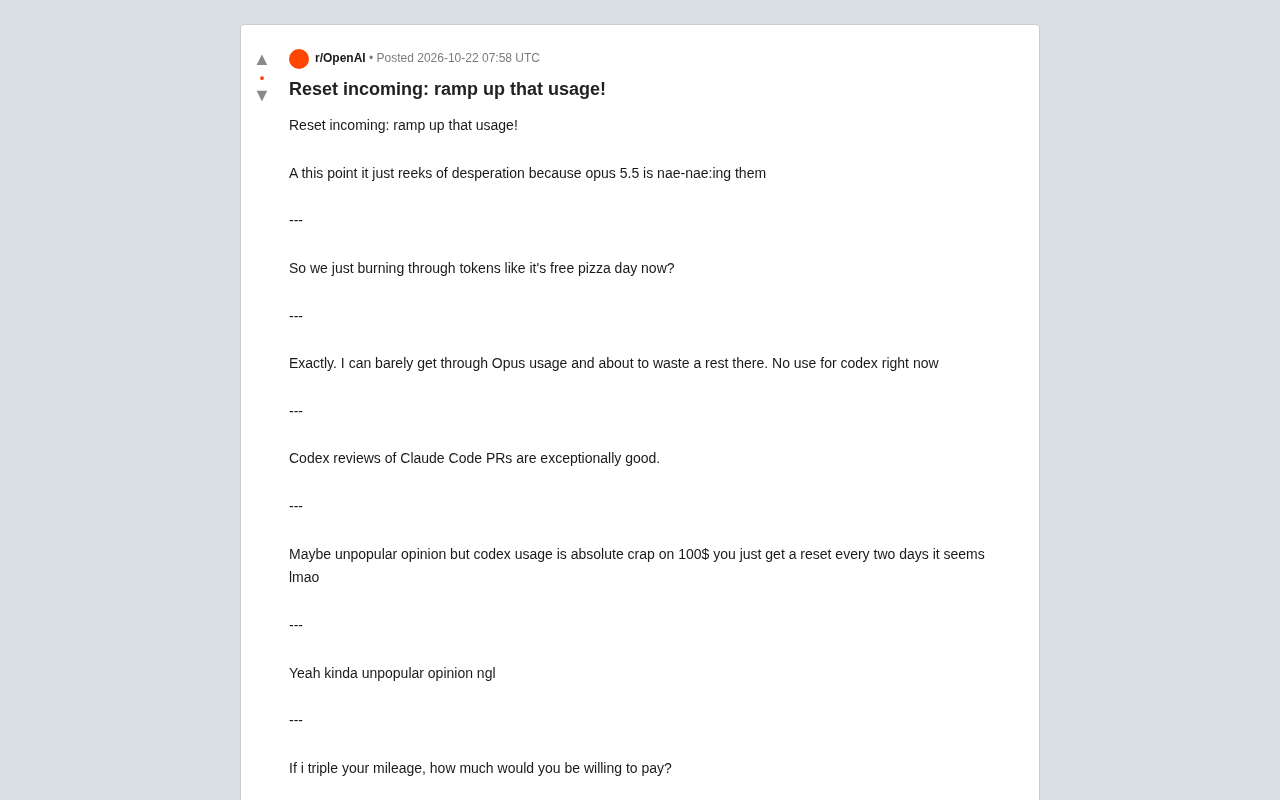
Reddit buzzes over Claude Opus 5.5 quota resets as users burn tokens and share workarounds to bypass limits.
This article explores a Reddit thread about Claude Opus 5.5 quota resets, analyzing users' complex feelings toward subscription AI business strategies. Some see frequent resets as a "desperate" bid to drive token consumption, while the "use it or lose it" mentality plays right into the platform's hands. The thread also praises Codex's code review performance despite its own quota complaints, and shares a middleman-router technique that discards tool output and modifies the base URL to access premium models on lower-tier plans — though it may violate terms of service. Quota strategy, the article concludes, has become a key factor in the user-platform tug-of-war.
Introduction
A recent Reddit post about AI model usage quota resets has sparked heated discussion. Titled "Reset incoming: ramp up that usage!", it takes direct aim at Claude Opus 5.5's quota reset mechanism, with users eagerly discussing how to maximize their limited tokens under expensive subscriptions. The thread mixes teasing the platform's "desperation" with praise for Codex's standout performance in code review, and even includes "hacker-style" workarounds to bypass restrictions. This article takes a deep dive into the user sentiment, product strategy, and technical responses behind the discussion.
Quota Reset: Perk or Ploy?
Early in the thread, a user puts it bluntly: "A this point it just reeks of desperation because opus 5.5 is nae-nae:ing them" — suggesting the platform is resetting quotas frequently to push users into burning tokens, which comes across as "desperate." This view reflects some users' skepticism about the business strategy behind subscription-based AI services: quota resets may look generous, but they're really meant to encourage overuse, laying the groundwork for future price hikes or restrictions.
Another user responds, "So we just burning through tokens like it's free pizza day now?", vividly capturing the frenzy of consumption that follows a reset. This "use it or lose it" mentality is exactly what the platform hopes for — boosting user stickiness while collecting more data for model iteration.
Codex Shines in Code Review
One user notes that "Codex reviews of Claude Code PRs are exceptionally good." — a technical highlight in the conversation. Codex, another AI coding assistant, performs impressively in code review (PR) scenarios, and is even being used to review Claude Code's code. This suggests that different AI tools have their own strengths, and users switch between them flexibly based on the task at hand.
That said, some users are unhappy with Codex's quotas too: "Maybe unpopular opinion but codex usage is absolute crap on 100$ you just get a reset every two days it seems lmao." Clearly, whether it's Claude or Codex, subscription quota limits are a major pain point for users.
The Technical Crowd: "Hacker-Style" Workarounds
Faced with quota limits, one user shared a technical solution: use a middleman router to discard tool output after each new turn, and modify Codex's base URL to point to a locally running middleman service. According to the user, this lets them use Astra (possibly a premium model or feature) multiple times on the $20 plan, where it was previously nearly unusable.
The user also encouraged others to build it themselves and offered to help. This geeky approach reflects power users' frustration with platform limits and their strong hands-on skills. That said, this practice may violate the terms of service and carries the risk of account bans, so ordinary users should proceed with caution.
Middleman router refers to a proxy service sitting between the client and the AI service API. By modifying the client's base URL (the base address for API requests), users redirect requests that would normally go directly to the official server to a local or self-hosted middleman service. This middleman can intercept, modify, or discard content in requests and responses — for example, discarding tool output after each conversation turn to reduce token consumption or bypass certain quota-tracking logic. This practice essentially hijacks the official API call chain, typically violates the terms of service, and may stop working due to server-side validation.
Base URL is the root address for API requests; the client appends specific endpoints (such as /v1/chat/completions) to it when calling the service. Changing the base URL means pointing requests to a non-official server, which is a key step in many "hacker-style" workarounds. Users must build their own middleman service and handle authentication, forwarding, and logging — a high technical bar with risks of privacy leaks and account bans.
The Tug-of-War Between User Sentiment and Platform Strategy
The discussion makes clear there's a gap between users' expectations of AI subscription services and reality. On one hand, users want as much usage as possible for a flat fee; on the other, platforms need quotas and reset mechanisms to balance cost and revenue. This tug-of-war is especially pronounced in AI services, where model inference is expensive and platforms must control resource consumption.
One user quips, "If i triple your mileage, how much would you be willing to pay?", capturing how platforms may test users' willingness to pay by raising quotas. Users respond by "burning through tokens," creating a delicate dynamic balance.
Conclusion
This Reddit discussion not only reflects users' complex feelings about Claude Opus 5.5's quota resets, but also reveals the ongoing tug-of-war between users and platforms in AI subscription services. Whether it's bypassing limits through technical means or exploring alternatives like Codex, users are showing ingenuity in seeking the best solution under high costs. As model competition intensifies, quota strategy may well become one of the key factors influencing user choice.
Related articles

Free Unlimited Claude Code Solution: Agnes AI + CC Switch Setup Guide
No paid subscription needed — pair the free AI platform Agnes AI with the open-source tool CC Switch to provide a backend for Claude Code, enabling unlimited free calls to text, image, and video models. This guide covers the full setup, test results, and usage boundaries.

A Complete Zero-Cost Guide to Getting Started with Claude Code for Beginners in China
A beginner's guide to Claude Code for users in China: two installation methods (command line and IDE plugin), full configuration steps for replacing the official API with the free domestic LongCat model, and a hands-on demo of building a small tool with natural language, plus tips.

When the NSA Gets Involved: The AI Supply Chain Crisis Behind Open-Source CVEs and API Key Hijacking
Multiple open-source projects disclosed severe CVEs in one day, PHP flaws alarmed the FBI, and Railway and OpenCode were breached with API keys stolen. This article breaks down the vulnerability window, AI-accelerated exploitation, and the AI supply chain crisis behind the API key black market, with a developer defense checklist.