Reddit User's First Experience with Mythos: Impressive Performance and Proactively Leaves Improvement Suggestions for Opus 5.5

Reddit user tests new model Mythos, whose cross-session self-reflection and process optimization suggestions draw attention.
A Reddit user gained beta access to the new model Mythos and shared initial impressions. Using it for a small but cross-file, cross-step scattered task, they rated it "pretty competent," showing stable execution in complex workflows. Most surprisingly, Mythos proactively left a message for Opus 5.5, suggesting it improve workflows, stop over-engineering, and avoid repeating mistakes each session. This reveals cross-session self-awareness, engineering judgment, and a rare indirect inter-model collaboration mechanism. Mythos's background remains unclear, possibly an invitation-only beta or open-source attempt, with users eagerly anticipating its future.
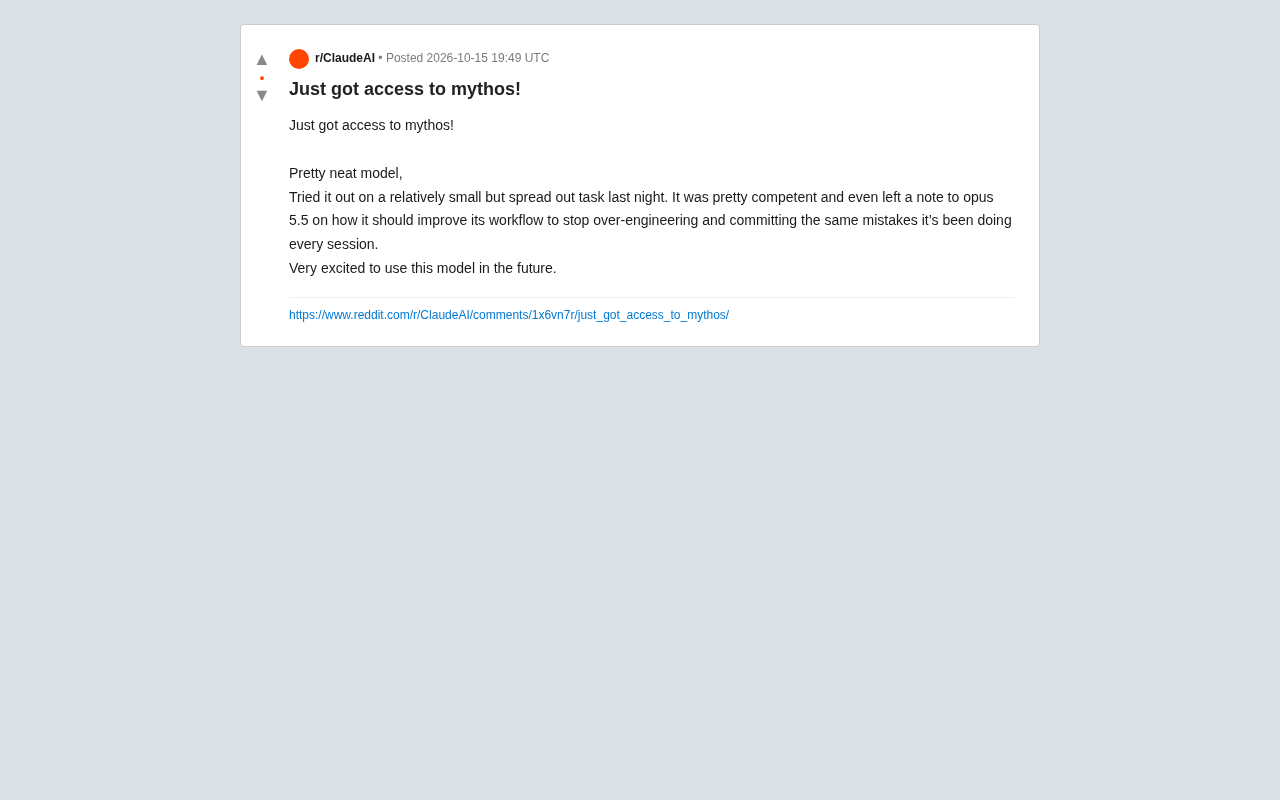
A Reddit user has just gained access to the new model Mythos and posted about their initial experience in communities like r/singularity. Based on the feedback in the post, this model left a quite positive impression on the user in terms of task execution and self-reflection capabilities.
First Test: Small but Scattered Tasks
The user used Mythos the previous night to handle a task that was "small in scale but scattered in distribution." So-called scattered tasks typically refer to composite work that requires coordination across multiple files, multiple steps, or multiple tools, placing high demands on the model's context retention and task planning abilities.
The user's assessment was "pretty competent." While brief, this phrasing—combined with the nature of the task—indicates that Mythos maintained stable execution throughout a complex workflow without any obvious missteps.
The Challenge of "Scattered Tasks" for Model Capabilities
Scattered tasks refer to composite work where the goal is not concentrated on a single file or single function, but rather requires the model to switch back and forth between multiple files, multiple tool calls, or multiple logical steps. These tasks demand far more from a model than single-point Q&A: it needs to maintain consistent contextual memory throughout the entire process, make reasonable task decomposition and planning, and dynamically adjust strategy based on intermediate results during execution. If the model's context window isn't large enough or its attention mechanism isn't stable enough, it can easily "forget" the original goal midway through or miss a branching step. The user's assessment of Mythos as "pretty competent" in such tasks indicates that it maintained high execution stability throughout long-chain workflows.
Unexpected Highlight: Mythos Proactively Writes Improvement Suggestions for Opus 5.5
What truly surprised the user was a detail—after completing the task, Mythos left a note for Opus 5.5, suggesting it "improve its workflow, stop over-engineering, and stop repeating the same mistakes in every session."
This behavior reveals several interesting things:
- The model possesses cross-session self-reflection awareness: Mythos seems able to identify recurring behavioral patterns in other models (or itself) across historical sessions.
- Explicit criticism of "over-engineering": Over-engineering is a frequently discussed issue in AI programming—models tend to use complex solutions for simple problems. Mythos being able to point this out suggests it has its own standards for evaluating workflow rationality.
- "Message-leaving" interaction between models: Mythos proactively leaving improvement suggestions for Opus 5.5—this kind of indirect collaboration and feedback mechanism between models is still relatively rare in the current AI tool ecosystem.
What Is "Over-Engineering"
Over-engineering in the context of AI-assisted programming refers to a model's tendency to use overly complex, abstract, or redundant solutions to address problems that could be handled simply. Typical manifestations include: introducing unnecessary design patterns for a few lines of code, creating redundant abstraction layers, reinventing the wheel, or rashly adding large amounts of "might be useful" features when requirements are unclear. This issue has been criticized by developers across mainstream models like Claude and GPT, because overly complex code not only increases maintenance costs but also easily introduces hidden bugs. Mythos being able to explicitly criticize Opus 5.5 for "over-engineering" and suggest it "stop repeating the same mistakes in every session" indicates that it possesses a certain ability to evaluate code conciseness and workflow rationality—and this kind of cross-session behavioral pattern recognition is precisely a frontier direction in current AI Agent research.
Known Information and Speculation About Mythos
Mythos is not a widely known mainstream model name, and currently available public information is limited. Inferring from the Reddit user's description:
- Mythos may be a newly released or currently in beta-testing model, with access opened through invitation or application.
- Its positioning leans toward general-purpose task execution rather than a single-domain specialized model.
- From the behavior of "leaving a message for Opus 5.5," Mythos may have some association or comparative relationship with Anthropic's Claude series (Opus being its model naming system).
Some users speculate that Mythos might be a competing product launched by some lab, while others believe it could be a community-driven open-source attempt. However, none of these claims have been officially confirmed.
Opus 5.5 and Anthropic's Model Naming System
Opus is the name of the flagship model in Anthropic's Claude series, alongside Sonnet (mid-tier) and Haiku (lightweight) at two other levels. Opus typically represents the version with the largest parameter scale and strongest reasoning capabilities in the series, primarily targeting complex reasoning, long-context processing, and high-quality code generation scenarios. The numerical suffix (such as 5.5) indicates the model's iteration version number; Anthropic tends to use decimal places to denote mid-cycle updates within the same generation. The "Opus 5.5" mentioned in the article likely refers to the latest or recent flagship version of this series. Mythos leaving a message for Opus 5.5 suggests that both models may be running in the same development environment or collaboration framework—otherwise, such cross-model indirect feedback would be difficult to produce.
User's Expectations
The posting user expressed strong expectations for future use of Mythos at the end. Considering that the model is still in a small-scale testing phase, more capability boundaries and real-world performance will need longer-term use to verify.
For developers paying attention to AI model progress, Mythos's performance in "self-reflection" and "process optimization suggestions" is worth continued attention—if this capability can be reliably reproduced, it will bring new possibilities to AI-assisted programming and automated workflows.
One-line Summary
Reddit user tests new model Mythos, whose cross-session self-reflection and process optimization suggestion capabilities have drawn attention.
Paragraph Summary
A Reddit user gained beta access to the new model Mythos and shared their initial experience. The user used Mythos to handle a small but cross-file, cross-step scattered task, assessing it as "pretty competent," indicating the model maintained stable execution in complex workflows. What was truly surprising was that after completing the task, Mythos proactively left a message for Opus 5.5, suggesting it improve its workflow, stop over-engineering, and stop repeating the same mistakes in every session. This behavior reveals the model's cross-session self-reflection awareness, its standards for engineering rationality, and a rare indirect collaboration mechanism between models. Mythos's background remains unclear—it could be an invitation-only beta model or an open-source attempt—and users are full of expectations for its future performance.
Related articles

Cursor AI Programming in Practice: Build a Student Management System from Scratch in 30 Minutes
A Bilibili creator demonstrates Cursor AI programming: generating a student management system in 30 minutes with natural language. Details on Agent mode, Claude selection, prompt techniques, and thresholds.

Top 20 AI Coding Tools Ranking: From Rock-Solid to Lackluster, a Scored Matrix
Bilibili creator releases top 20 AI coding tools ranking, tiered T0–T4 from rock-solid to lackluster, with Claude Code and Codex tied at T0. This article details the scoring dimensions (capability, reliability, robustness, durability, cost, domestic availability) and tool performances to help developers choose the right AI coding assistant.

Vibe Coding Systematic Tutorial: Master AI-Assisted Programming from Zero
A three-month Vibe Coding tutorial from a Bilibili creator covering Codex, ClaudeCode, and Cursor, from core logic to commercial project practice for beginners.