Redefining Legal AI Hallucination: From Factual Errors to 'Failure of Legal Warrant'
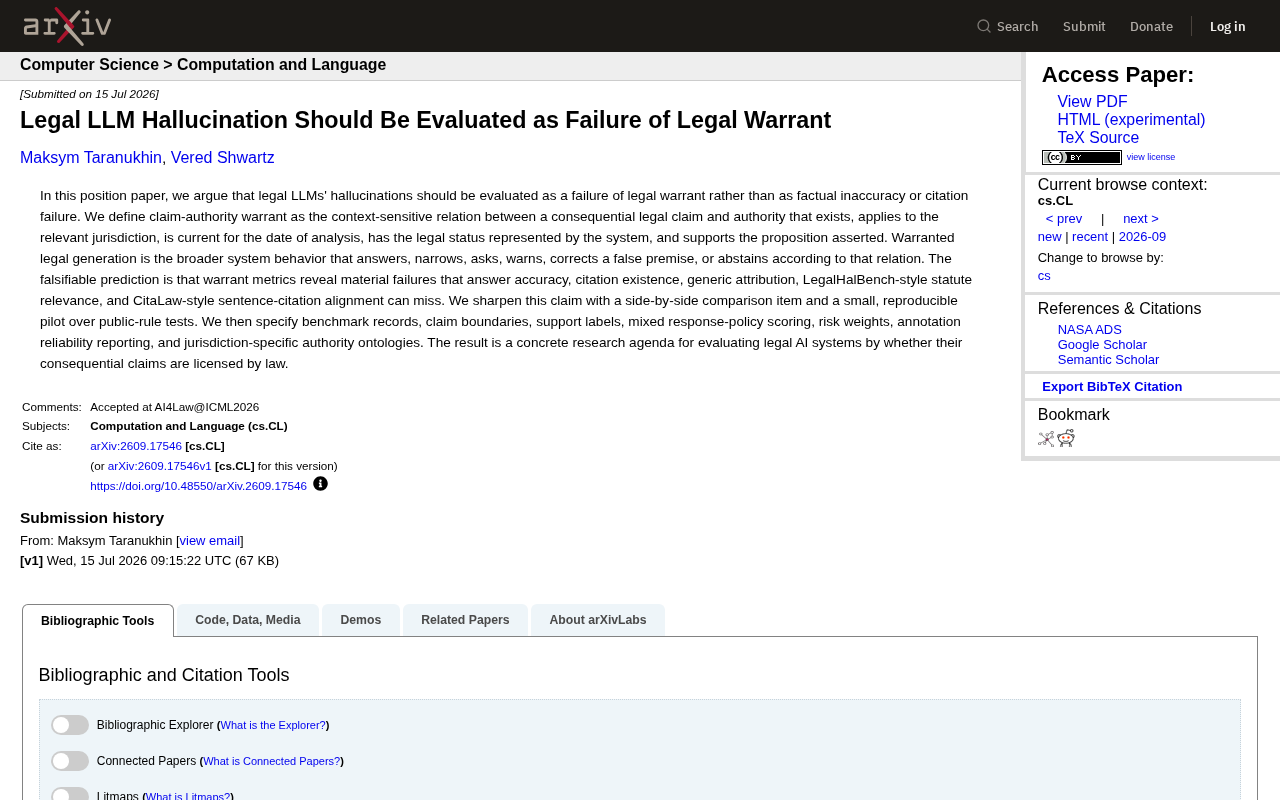
New paper reframes legal LLM hallucination as failure of legal warrant, not mere factual error.
An arXiv position paper argues that hallucinations in legal LLMs should be redefined as 'failures of legal warrant' — whether a model's legal claims are supported by authority that is real, jurisdictionally applicable, temporally valid, and of the correct legal standing. The paper introduces 'claim-authority warrant' and 'warranted legal generation,' calling for systems that can answer, narrow, warn, or abstain as appropriate. It critiques benchmarks like LegalHalBench and CitaLaw for structural blind spots and proposes a concrete evaluation agenda including risk weights and jurisdiction-specific authority ontologies.
A Blind Spot in Evaluation
When large language models (LLMs) are deployed in legal contexts, the "hallucination" problem is often reduced to factual errors or fabricated citations — for instance, inventing a non-existent case or citing an incorrect statute. However, a recent arXiv position paper (arXiv:2609.17546) advances a more fundamental perspective: hallucinations in legal LLMs should fundamentally be evaluated as failures of legal warrant, not merely as factual inaccuracies or missing citations.
The significance of this reframing lies in shifting the evaluative focus from "is this statement correct?" to "is this legal claim genuinely authorized by law?" In high-stakes legal applications, the latter is what determines whether a system can actually be trusted.
What Is "Claim-Authority Warrant"?
The paper's central concept is the claim-authority warrant — defined by the authors as a "context-sensitive" relationship between a legal claim with substantive consequences and the authoritative source it relies upon. For this relationship to hold, the authority must simultaneously satisfy multiple conditions:
- Actually exists — not a statute or case fabricated by the model;
- Applies to the relevant jurisdiction — rules from one state cannot support claims in another;
- Remains valid as of the analysis date — repealed or amended laws cannot serve as current authority;
- Holds the legal status the system claims — for example, distinguishing binding precedent from merely persuasive opinion;
- Actually supports the asserted proposition — a citation that exists but is substantively irrelevant still constitutes a failure.
In other words, a citation may "truly exist" yet still represent a defective warrant — because the jurisdiction is wrong, the authority is outdated, or it simply does not support the conclusion. Conventional detection of "whether a citation exists" cannot capture these deeper failures.
This framework has deep roots in legal practice. Common law systems (such as those in the US, UK, and Australia) rely heavily on stare decisis — the principle that courts must follow precedents set by higher courts. A citation drawn from a court without jurisdiction, or one representing obiter dictum rather than ratio decidendi, carries significantly diminished legal force. The same applies in statutory systems: legislation may be amended, repealed, or inapplicable because it was enacted after the facts in dispute. It is precisely this multi-dimensionality of legal warrant that makes "does the citation exist?" a wholly insufficient single-axis test — a citation can be simultaneously "real" and "invalid."
What Is "Warranted Legal Generation"?
The paper further introduces warranted legal generation as a broader behavioral standard for responsible legal AI systems. Rather than simply "providing an answer," such a system should flexibly select from a range of responses based on the warrant relationship between claims and authority:
- Directly answer (answer)
- Narrow the scope of the question (narrow)
- Ask clarifying questions (ask)
- Issue a risk warning (warn)
- Correct a false premise (correct a false premise)
- Decline to respond when there is insufficient grounding (abstain)
The value of this "mixed response policy" is that it acknowledges a fundamental truth of legal contexts: refusing to answer or flagging uncertainty is often more responsible than forcing out a seemingly complete response. This stands in sharp contrast to the tendency of current LLMs to "always provide an answer."
This response strategy aligns closely with two core duties in legal professional ethics: the duty of competence and the duty of candor. When a lawyer is uncertain about a legal question, professional norms require honest disclosure of that uncertainty rather than delivery of an unverified conclusion. The "overconfidence" problem in conventional LLMs — where models generate assertive-sounding answers even without reliable grounding — can directly cause clients to make erroneous decisions in legal contexts, producing real legal consequences. Abstaining and issuing warnings are not signs of system inadequacy; they are responsible behaviors consistent with professional legal standards.
Why Existing Benchmarks Fall Short
The paper advances a falsifiable prediction: warrant metrics will reveal substantive failures that existing evaluation methods miss. The authors identify limitations in several mainstream evaluation paradigms:
- Answer accuracy: evaluates only whether conclusions are correct, ignoring whether the reasoning is legally authorized;
- Citation existence: a real citation is not necessarily applicable or relevant;
- Generic attribution: lacks fine-grained verification of jurisdiction and temporal validity;
- LegalHalBench-style statutory relevance: struggles to capture the full chain of warrant relationships;
- CitaLaw-style sentence-citation alignment: alignment-level matching cannot verify legal standing.
To support the argument, the authors design controlled comparisons and conduct a small-scale, reproducible pilot experiment on publicly available rule test sets, demonstrating the divergence between warrant metrics and existing indicators.
LegalHalBench and CitaLaw are two of the more influential hallucination evaluation benchmarks in the legal domain. LegalHalBench primarily tests model recognition by constructing questions containing fictitious statutes, focusing on detecting "whether a non-existent rule was cited." CitaLaw focuses on semantic alignment between cited sentences in generated text and original legal documents. Their shared limitation is that both treat citation authenticity or semantic match as their core metric, without systematically incorporating jurisdictional applicability, temporal validity, or legal standing. The paper argues that this design creates a structural blind spot when confronted with real legal risk.
A Concrete Research Agenda
Rather than resting at conceptual critique, this paper offers specific components of an evaluation framework, including:
- Definitions of benchmark records and claim boundaries;
- Support labels to annotate whether an authority genuinely supports a proposition;
- Mixed response-policy scoring that assigns separate scores for answering, abstaining, warning, and other behaviors;
- Risk weights that apply higher penalties for failures involving high-consequence claims;
- Annotation reliability reporting to ensure the credibility of evaluations themselves;
- Jurisdiction-specific authority ontologies that systematically encode the jurisdictional dimension.
The ultimate goal is to build a legal AI evaluation system centered on the question: "Is each substantive claim genuinely authorized by law?"
Conclusion: A Paradigm Shift in Legal AI Evaluation
The value of this position paper lies in elevating the trustworthiness question for legal LLMs from "technical accuracy" to "legal legitimacy." For high-stakes contexts such as adjudication, compliance, and legal counsel, whether a model "fabricates" information is certainly important — but what matters more is whether every consequential recommendation it produces genuinely holds up and is supported by current, applicable law. If widely adopted, this framework could reshape testing standards and regulatory expectations for legal AI products.
Related articles
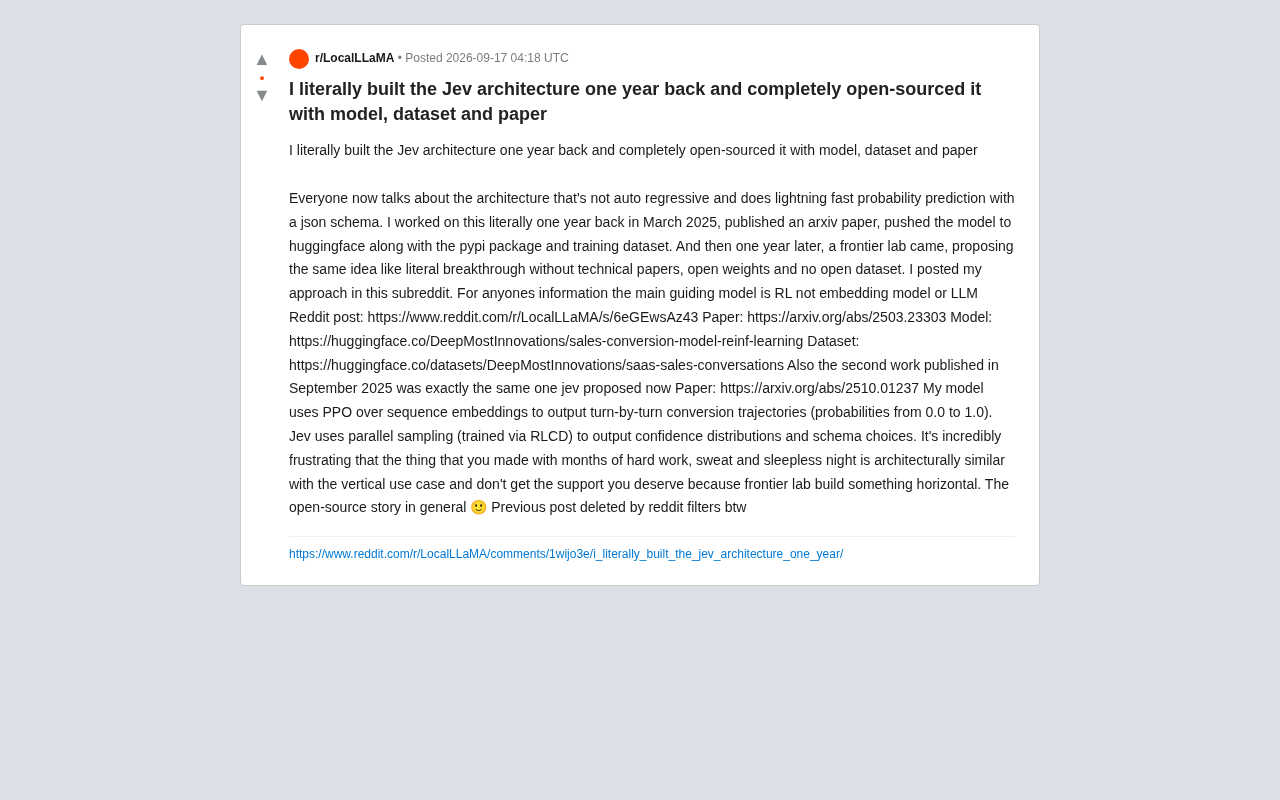
The Open Source Dilemma: A Non-Autoregressive Architecture Pioneer Overshadowed by Frontier Labs
An indie developer claims a frontier lab repackaged his year-old open-source non-autoregressive RL architecture as a breakthrough. We compare PPO sequence embeddings vs. RLCD parallel sampling and examine open source attribution gaps.
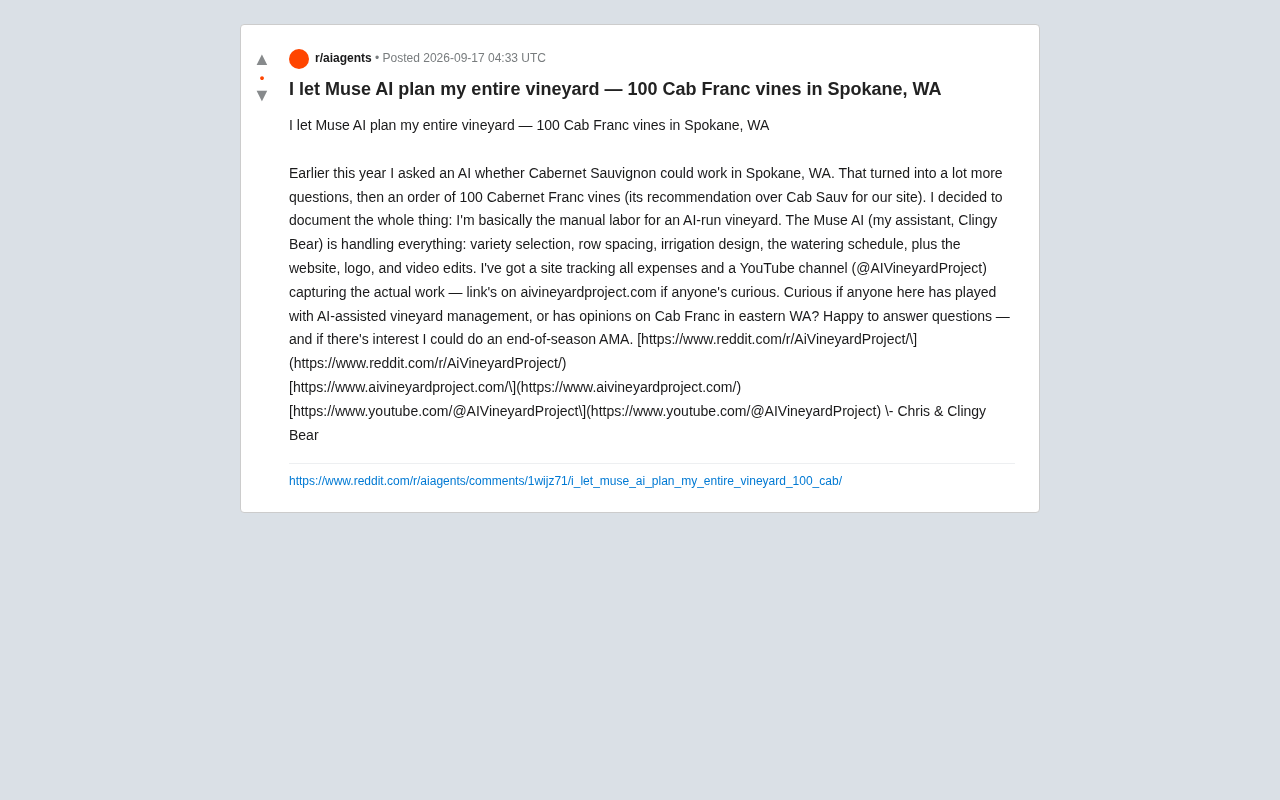
AI Plans an Entire Vineyard: A Real-World Experiment with 100 Grapevines
A Spokane hobbyist let Muse AI plan his entire vineyard — variety, spacing, irrigation, even the logo. He planted 100 Cabernet Franc vines and is documenting everything publicly.

Iceland's Treble Raises $18M to Bet on Voice Simulation Platform
Iceland-based voice simulation company Treble raises $18M. Its platform serves voice AI developers, AI wearables, and robotics firms. A deep dive into the technology and what the funding signals.