ReDiST: Student-Centric Reasoning Trace Construction for Better Distillation

ReDiST builds student-centric reasoning traces to boost the teaching effectiveness of reasoning distillation.
The article introduces ReDiST from the paper "Beyond the Answer: Student-Conditioned Trace Construction for Reasoning Distillation." It argues that teacher answers plus traces alone are insufficient because traces must match the student's cognitive state. ReDiST starts from student drafts offline, revises correct drafts with evidence and repairs wrong ones with answer guidance, ranks candidates with a frozen student-matched reader model, and balances trace and answer supervision during distillation. Experiments show gains on source and cross-benchmark tasks, while differing rankings underscore the need for cross-distribution evaluation.
In reasoning distillation, providing only the correct answer along with its reasoning trace is not enough for the student model to learn effectively. The paper "Beyond the Answer: Student-Conditioned Trace Construction for Reasoning Distillation" proposes the ReDiST framework, which constructs reasoning traces that genuinely improve learning outcomes by considering both the intermediate content of the trace and its acceptability to the target learner.
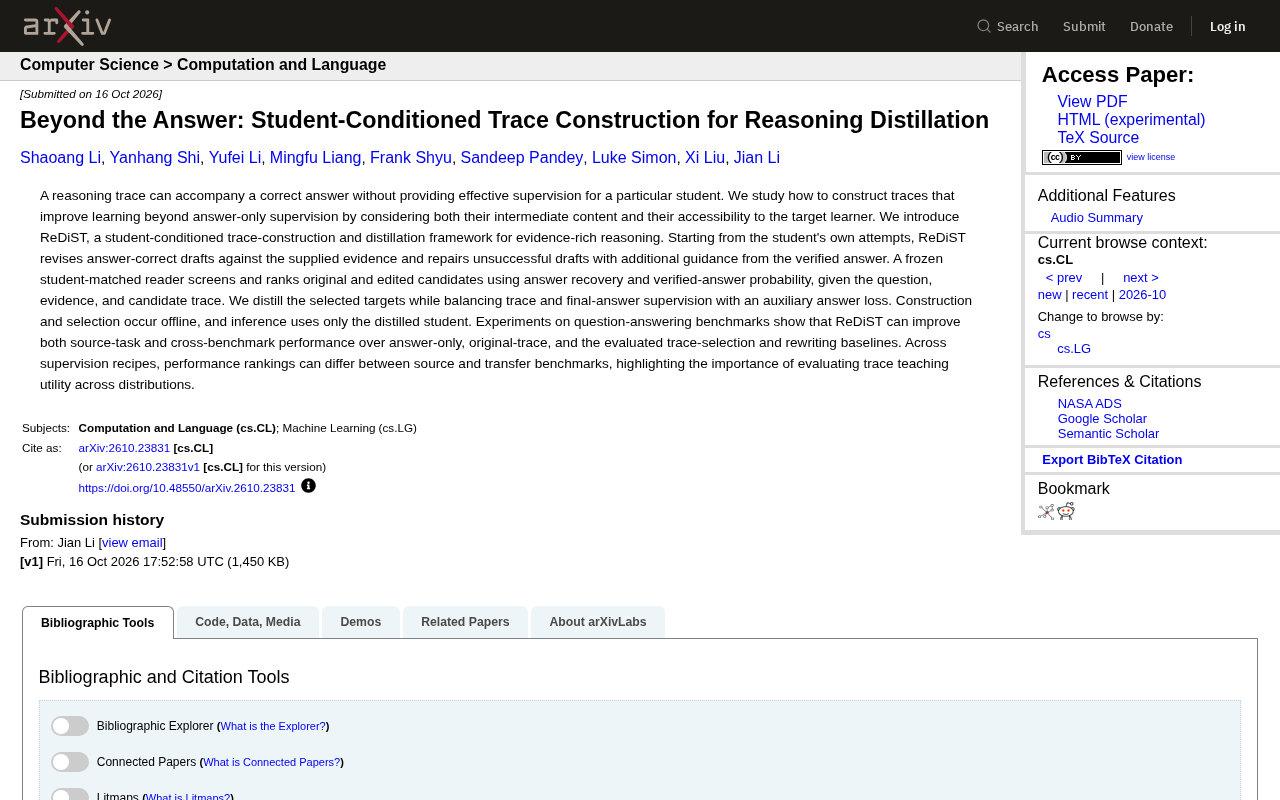
The Bottleneck of Reasoning Distillation: Why Answers and Traces Aren't Enough
Traditional reasoning distillation typically provides the teacher model's complete reasoning trace together with the correct answer to the student model. However, the paper points out that a reasoning trace, even when accompanied by the correct answer, may not provide an effective supervision signal for a particular student. The reason is that different student models have different levels of knowledge and comprehension ability; teacher-generated traces may exceed what the student can absorb or may contain information unnecessary for the student.
The core insight of ReDiST is that the "teaching quality" of a reasoning trace depends not only on whether its content is correct, but also on whether it matches the target student's cognitive state. Therefore, trace construction should be student-conditioned rather than simply copying the teacher's output.
Reasoning Distillation is a branch of knowledge distillation in which the reasoning processes generated by a large teacher model (rather than just the final answer) are used to train a smaller student model, enabling it to acquire step-by-step reasoning ability. Traditional knowledge distillation mainly transfers output distributions or soft labels, whereas reasoning distillation transfers explicit Chain-of-Thought text. Its effectiveness relies on an implicit assumption: that the teacher's trace is "learnable" for the student. But the student model's capacity and pretraining data distribution differ from the teacher's, and overly difficult or lengthy traces can exceed the student's out-of-distribution generalization ability, causing the supervision signal to fail. ReDiST addresses precisely the fragility of this assumption by treating traces as teaching materials that need to be "adapted" rather than teacher outputs to be copied directly.
The ReDiST Framework: From Student Attempts to Personalized Traces
The ReDiST workflow consists of three key steps, all completed offline, with only the distilled student model used at inference time.
1. Trace Revision Based on Student Drafts
ReDiST starts from the student model's own attempts (drafts). For drafts with correct answers, the provided evidence is used to revise them so that their reasoning process becomes more rigorous; for drafts with incorrect answers, the verified answer is used to provide additional guidance for repair. This approach ensures that the trace is both grounded in the student's existing cognition and appropriately corrected.
2. Student-Matched Filtering and Ranking
The revised candidate traces then need to be filtered. ReDiST uses a frozen reader model matched to the student, which, given the question, evidence, and candidate trace, evaluates its answer-recovery ability and verified-answer probability, ranking the original trace and the edited candidates. This step simulates the likelihood that the target student will understand the trace and arrive at the correct answer, thereby selecting the traces with the greatest teaching value.
Reader Model here plays the role of a "simulated student," typically a frozen model of similar scale or capability to the target student. It does not participate in training and is used only to evaluate candidate traces: given the question, evidence, and trace, it computes the probability that the reader model recovers the correct answer (answer-recovery ability) as well as its likelihood of the verified answer (verified-answer probability). These two metrics together characterize the "teachability" of a trace—requiring both that the trace can guide the reader to the correct conclusion and that it is semantically consistent with the correct answer. Because the reader model is matched to the student, its scores can be approximately regarded as the target student's expected performance after learning the trace, thus avoiding the bias introduced by directly using teacher preferences or manual rules for filtering.
3. Balanced Distillation Loss
During the distillation stage, ReDiST not only has the student model learn the selected traces but also balances trace supervision and final-answer supervision through an auxiliary answer loss. This ensures that the student model attends to both the reasoning process and the correctness of the final result.
Experiments show that on question-answering benchmarks, ReDiST outperforms answer-only supervision, original traces, and the evaluated trace-selection and rewriting baselines on both source tasks and cross-benchmark tests. Interestingly, under different supervision recipes, the performance rankings on source benchmarks and transfer benchmarks may differ, highlighting the importance of evaluating the pedagogical utility of traces under distribution shift.
Distillation Loss in sequence generation tasks is typically the token-level cross-entropy on the selected trace, i.e., having the student model maximize the likelihood of the trace sequence given the input. Answer Loss, by contrast, directly supervises the correctness of the student model's final answer, typically the cross-entropy on the answer tokens. ReDiST combines the two in a weighted manner because optimizing only the trace loss may cause the student to overfit to the surface form of the reasoning text while ignoring the correctness of the conclusion, whereas optimizing only the answer loss degenerates into traditional answer distillation and loses the transfer of reasoning ability. The balancing term serves to make the model strike a compromise between "imitating the process" and "ensuring the result," and in the experiments this recipe proved particularly critical for cross-distribution generalization.
Experiments and Implications: The Need for Cross-Distribution Evaluation
The paper conducted experiments on question-answering benchmarks, and the results show that ReDiST can improve both source-task and cross-benchmark performance. However, a key finding is that the supervision method that performs best on the source benchmark is not necessarily optimal on the transfer benchmark. This means that when evaluating the pedagogical utility of reasoning traces, one cannot rely solely on in-distribution tests; cross-distribution generalization must also be considered.
This finding has practical implications for reasoning distillation: when constructing traces, one should be guided by the target student's actual learning outcomes and validate the method's effectiveness across diverse evaluation scenarios. Through student-conditioned construction and filtering, ReDiST offers a new approach to personalized reasoning distillation.
One-line Summary
ReDiST constructs reasoning traces in a student-centric way, improving the teaching effectiveness of reasoning distillation.
Paragraph Summary
The article introduces the ReDiST framework proposed in the paper "Beyond the Answer: Student-Conditioned Trace Construction for Reasoning Distillation." The framework points out that traditional reasoning distillation, which provides only teacher answers and traces, is not enough for the student model to learn effectively, because traces need to match the target student's cognitive state. ReDiST works offline starting from the student model's own drafts—revising correct drafts with evidence and repairing incorrect drafts with answer guidance—then uses a frozen student-matched reader model to rank candidate traces and select those with the greatest teaching value, and balances trace supervision with answer supervision during distillation. Experiments show that ReDiST outperforms baselines on source tasks and cross-benchmark tests, but the performance rankings on source and transfer benchmarks may differ, highlighting the need for cross-distribution evaluation.
Related articles

AI-Powered SRC Vulnerability Hunting: A Hands-On Guide to Building the Hermes Agent Workbench
Based on a hands-on Bilibili video: how to build an AI-powered SRC vulnerability hunting workbench—three-step method, four report elements, Agent mode vs web chat, and tool selection.

CLI-Anything Complete Beginner's Guide: How AI Operates Software — Principles and Practice
A complete beginner's guide to CLI-Anything: how AI Agents operate professional software via the command line, covering the three-layer architecture, CLI Hub installation, DrawIO practice, generator principles, and limits.

Carbon-X: A 14.8B Open-Source Model That Handles DNA and Text Simultaneously
Carbon-X is a 14.8B open-source multimodal model on Hugging Face where DNA and text share a token stream. 6-mer tokenization, 302B token mid-training, deployable on a single 80GB GPU, 66.7% average on five DNA benchmarks, Apache 2.0 license.