Reflective Cognitive Alignment: Making AI a Rule-Abiding Assistant for Elderly Cognitive Stimulation Therapy
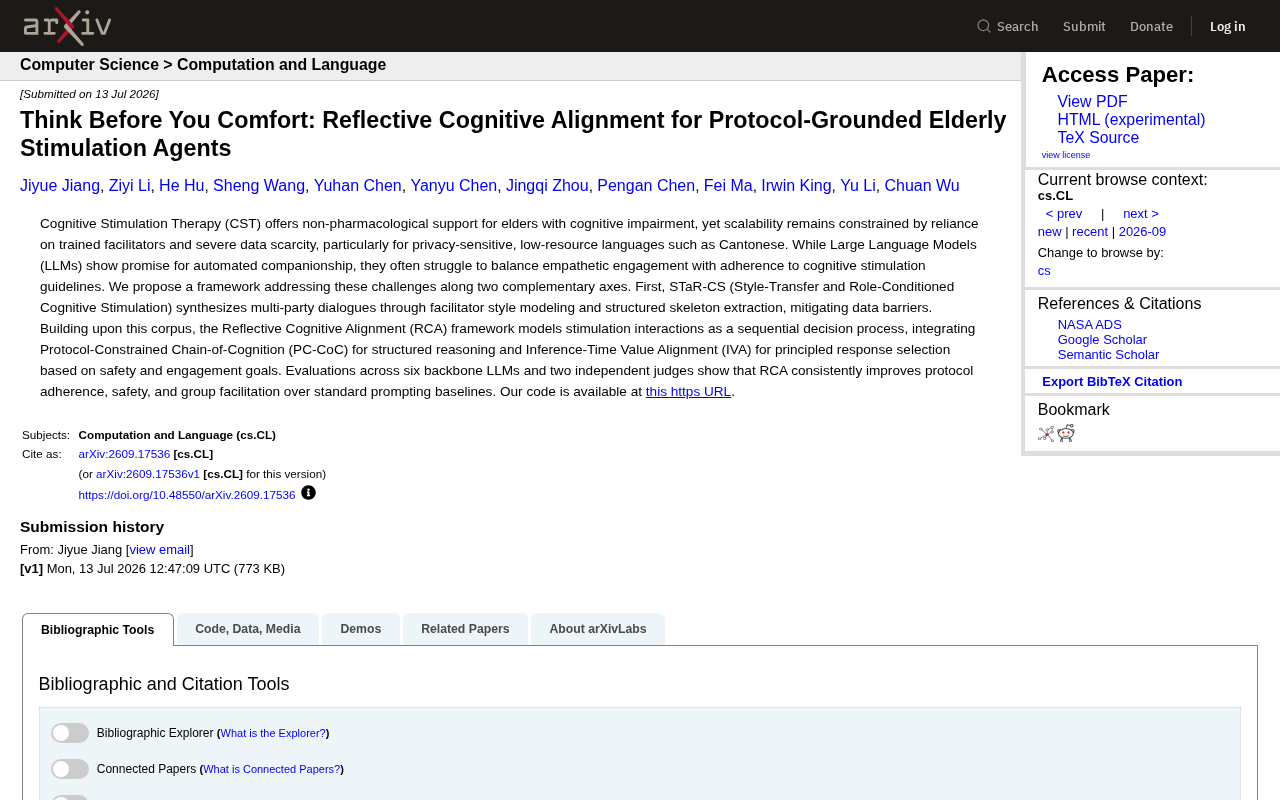
RCA framework uses synthetic data and reflective alignment to help LLMs balance empathy with CST protocols for elderly care.
This arXiv preprint (2609.17536) addresses the challenges of scaling Cognitive Stimulation Therapy (CST) and the severe lack of training data in low-resource languages like Cantonese. It proposes a two-stage framework: STaR-CS synthesizes multi-party therapeutic dialogues via facilitator style modeling and skeleton extraction, while the RCA framework models CST interactions as sequential decision-making — using Protocol-Constrained Chain-of-Cognition (PC-CoC) for structured reasoning and Inference-Time Value Alignment (IVA) to select responses optimizing both safety and engagement. Evaluated across six base LLMs and two independent evaluators, RCA consistently improves protocol adherence, safety, and group facilitation. Code is open-sourced, though real-world clinical validation remains pending.
Cognitive Stimulation Therapy (CST) is a non-pharmacological approach designed to help older adults with cognitive impairment maintain or improve cognitive function. However, it has long faced an uncomfortable reality: it relies heavily on professionally trained facilitators, making it difficult to scale — and in privacy-sensitive, low-resource language settings like Cantonese, usable training data is especially scarce. A recent paper published on arXiv (paper ID 2609.17536) proposes a framework that aims to fill this gap using large language models (LLMs).
The Core Tension: Empathy vs. Protocol Compliance
LLMs have shown considerable promise in automated companionship scenarios, but the researchers highlight a critical challenge: LLMs often struggle to strike a balance between empathetic interaction and adherence to CST therapeutic protocols.
This tension isn't hard to understand. A chatbot that focuses entirely on comforting an elderly user and saying the right things may feel warm, but it drifts away from the actual therapeutic goals of CST — which requires structured facilitation to encourage active thinking and discussion, not passive reassurance. Conversely, a model that mechanically enforces the treatment protocol may come across as cold and robotic, undermining participants' willingness to engage. The paper's title, Think Before You Comfort, is a concise encapsulation of exactly this dilemma.
CST was systematically formalized by Spector et al. in the UK in 2003. Its core principles include: being person-centered rather than disease-centered, stimulating multiple sensory and cognitive domains through discussion, and encouraging the expression of opinions rather than correcting wrong answers. Typical CST activities include current events discussions, word association, and categorization games, usually conducted in small groups (4–8 people) twice a week. This group dynamic is itself part of the therapeutic mechanism — the social support and mutual encouragement among group members sustains motivation to engage far better than cognitive exercises alone. This explains why "group facilitation" is one of the key dimensions the paper evaluates: in multi-party conversations, an AI facilitator must simultaneously advance cognitive tasks, draw out participation from each member, and avoid making anyone feel ignored or corrected — a far more demanding task than one-on-one dialogue.
Two Complementary Technical Approaches
The research team tackled the problem along two complementary directions.
Step One: Addressing Data Scarcity with STaR-CS
The first approach targets the data scarcity problem. The team proposes STaR-CS (Style-Transfer and Role-Conditioned Cognitive Stimulation), which synthesizes multi-party dialogue data by modeling facilitator style combined with structured "skeleton extraction."
The value of this approach lies in the nature of the problem: real CST dialogue data involves the privacy of elderly participants and is naturally scarce in languages like Cantonese, making direct collection prohibitively costly. By using style transfer and role conditioning to generate synthetic corpora, the team effectively "manufactures" multi-party dialogues that conform to therapeutic protocols in a controlled manner — bypassing the barrier of data acquisition.
Style transfer in NLP typically refers to converting the expressive style of text to a target style while preserving semantic content — for example, rewriting formal language as colloquial speech, or mimicking a specific author's writing habits. In the CST context, different facilitators have their own pacing of questions, phrasing of encouragement, and ways of transitioning between topics — details that are critical to maintaining the emotional engagement of elderly participants. "Skeleton extraction" refers to first extracting a structural framework from existing dialogues (such as topic nodes, turn relationships, and functional utterances), then generating complete corpora based on this framework, thereby reducing randomness and bias in the synthetic dialogues. Cantonese is specifically highlighted because its writing system heavily overlaps with Mandarin Chinese, but its spoken vocabulary, grammar, and tones differ significantly — causing existing LLMs to perform far worse on Cantonese tasks than on Mandarin. Meanwhile, elderly dementia patients in Hong Kong and Cantonese-speaking regions often rely on Cantonese far more than written Chinese.
Step Two: "Reflective" Decision-Making with the RCA Framework
Building on the synthetic corpora, the team constructs the Reflective Cognitive Alignment (RCA) framework. It models the CST interaction process as a sequential decision-making process and integrates two key components:
- PC-CoC (Protocol-Constrained Chain-of-Cognition): For structured reasoning, allowing the model to think through constrained steps aligned with the treatment protocol before generating a response.
- IVA (Inference-Time Value Alignment): During inference, principled selection among candidate responses based on safety and engagement objectives.
In other words, RCA doesn't let the model "say whatever comes to mind" — it first reasons within a protocol framework, then selects from multiple candidate responses the one that best satisfies safety and engagement goals. This directly embodies the "think before you comfort" design philosophy reflected in the paper's title.
Modeling dialogue as sequential decision-making is a classic paradigm at the intersection of reinforcement learning and dialogue systems: each conversational turn is treated as a state, the model's choice of response is an action, and the overall outcome of the dialogue corresponds to cumulative reward. The advantage of this framework is that it can explicitly incorporate long-term goals — such as sustaining elderly participants' engagement and completing the therapeutic protocol — rather than merely optimizing the fluency of individual responses. Inference-Time Value Alignment (IVA) is distinct from training-time RLHF (Reinforcement Learning from Human Feedback): it does not modify model weights, but instead scores and filters multiple candidate outputs at inference time. This makes it cheaper to deploy and easier to flexibly adjust scoring criteria for specific scenarios (such as safety or protocol compliance) — offering greater practical feasibility for resource-constrained healthcare settings.
Results: Consistent Improvements Across Models and Evaluators
To validate the generalizability of the framework, the research team evaluated it across six different base LLMs and incorporated two independent evaluators to render judgments.
The results show that compared to standard prompting baselines, RCA delivers consistent improvements across three dimensions:
- Protocol adherence — better alignment with CST therapeutic protocols;
- Safety — responses that better meet safety requirements;
- Group facilitation — improved facilitation performance in multi-party dialogue scenarios.
The fact that improvements are consistent across six backbone models and two independent evaluators is particularly noteworthy, as it suggests the gains are not dependent on the characteristics of any specific model, but represent framework-level universal improvements. The team has also open-sourced the code on GitHub (github.com/jiangjyjy/RCA_Agent) for reproducibility and follow-on research.
Significance and Limitations
The practical significance of this work lies in applying LLMs to a scenario with genuine real-world need but extremely limited resources — elderly cognitive care — while specifically addressing both the "data" and "alignment" pain points. For low-resource language communities like Cantonese speakers, the combination of synthetic data generation and protocol-constrained inference provides a replicable path toward deployment.
Of course, as a newly released preprint, its conclusions should be interpreted with caution. The study validates effectiveness primarily within a framework of synthetic corpora and model-based evaluation. Whether it remains equally effective in long-term real-world use with actual elderly populations — and whether synthetic data may introduce subtle biases — still awaits further clinical and empirical validation. But as a directional exploration, the "think before you comfort" design philosophy offers a valuable reference point for how medically assistive AI agents can balance warmth with protocol compliance.
Related articles
The Open Source Dilemma: A Non-Autoregressive Architecture Pioneer Overshadowed by Frontier Labs
An indie developer claims a frontier lab repackaged his year-old open-source non-autoregressive RL architecture as a breakthrough. We compare PPO sequence embeddings vs. RLCD parallel sampling and examine open source attribution gaps.
AI Plans an Entire Vineyard: A Real-World Experiment with 100 Grapevines
A Spokane hobbyist let Muse AI plan his entire vineyard — variety, spacing, irrigation, even the logo. He planted 100 Cabernet Franc vines and is documenting everything publicly.
Iceland's Treble Raises $18M to Bet on Voice Simulation Platform
Iceland-based voice simulation company Treble raises $18M. Its platform serves voice AI developers, AI wearables, and robotics firms. A deep dive into the technology and what the funding signals.