Reinforcement Learning in Practice: Building an Unbeatable Game AI Bot from Scratch

A developer built an RL-powered game Bot that beats them every time — and it's a perfect RL learning blueprint.
A Reddit developer applied reinforcement learning to a beloved childhood game and trained an AI Bot that wins 100% of the time. The article uses this as a lens to explain why games are ideal RL environments, traces how institutions like DeepMind and OpenAI used games as a launchpad for landmark results, and clarifies that a perfect win rate reflects strategy convergence and AI's inherent speed advantages — not true game comprehension. It closes by connecting this recreational experiment to serious applications like robot control and RLHF, arguing that interest-driven, problem-first exploration builds deeper engineering intuition than chasing the latest papers.
A Childhood Game That Sparked a Reinforcement Learning Experiment
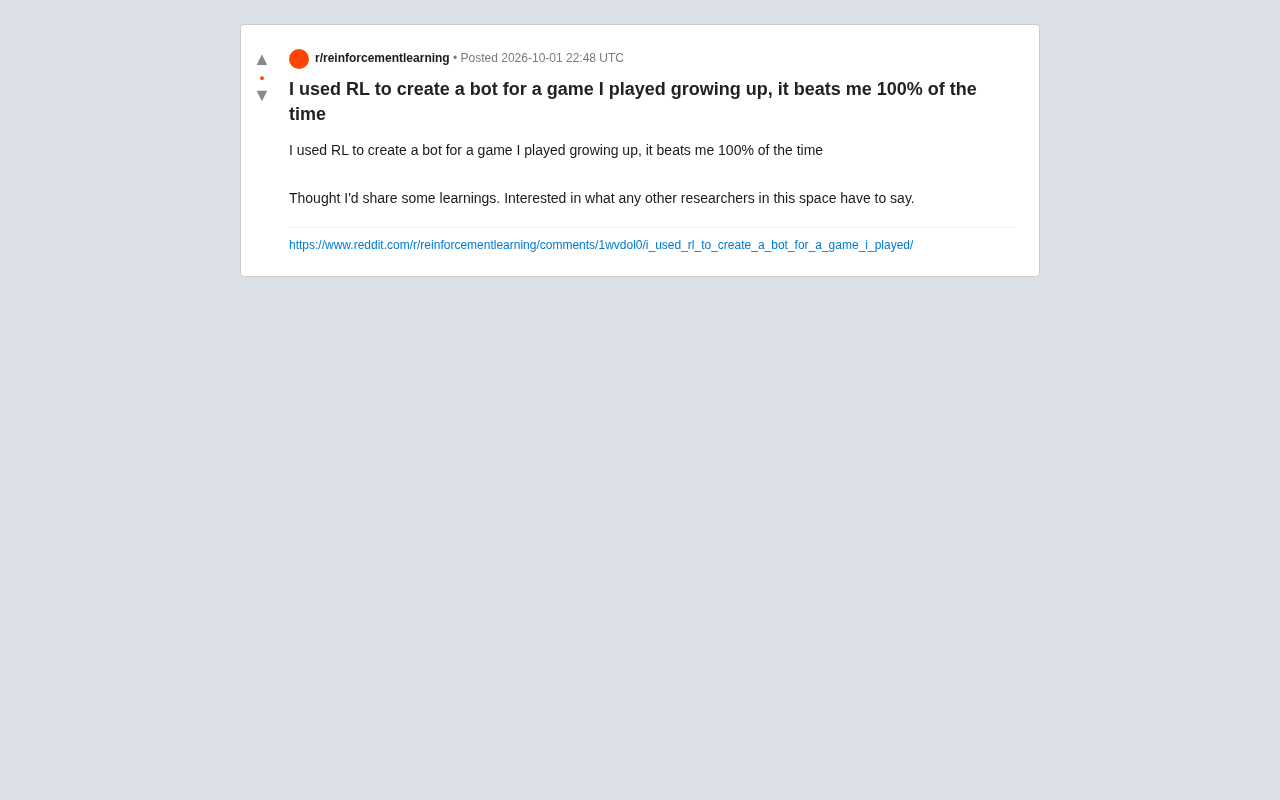
A developer recently shared a side project on Reddit: using reinforcement learning (RL) to train an AI Bot for a game they'd played since childhood. The result was striking — the Bot wins 100% of the time against its own creator.
Projects like "conquering a childhood game with AI" have always been popular in the tech community, and not just for nostalgia. They take abstract machine learning theory and ground it in a concrete scenario with clear boundaries and explicit rules. Games are often the ideal testing ground for reinforcement learning: the state space is enumerable, reward signals are well-defined, and you can run unlimited trial-and-error iterations.
Why Games Are a Natural Training Ground for Reinforcement Learning
The core logic of reinforcement learning is this: an Agent interacts with an environment, continuously refines its strategy based on received rewards, and ultimately learns to make optimal decisions toward a specific goal. Games provide exactly the ingredients this mechanism requires.
Compared to real-world tasks, game environments offer several key advantages. A fully simulatable environment means an Agent can accumulate in hours the kind of experience that would take a human years of play. Reward functions are relatively easy to define — score, win/loss, survival time are all ready-made feedback signals. State and action spaces are typically discrete or low-dimensional, which significantly reduces training complexity.
From DeepMind's Atari experiments to AlphaGo and OpenAI Five, nearly every landmark reinforcement learning achievement has emerged from a game environment. This Reddit developer's personal project is essentially walking a well-validated technical path — just with a personally meaningful childhood game as the stage.
Two classic algorithmic paradigms in RL are clearly illustrated in game settings. Value-based methods (such as DQN, Deep Q-Network) use neural networks to estimate the long-term value of each state-action pair, guiding the Agent to favor actions with the highest expected return. Policy gradient methods (such as PPO, Proximal Policy Optimization) directly optimize the policy function itself, making them more suitable for continuous action spaces or scenarios requiring stochastic policies. PPO has become one of the most widely used algorithms in game Bots and RLHF thanks to its training stability and low sensitivity to hyperparameters. Additionally, Self-Play is the key technique for pushing Agents beyond human-level performance — the Agent repeatedly competes against earlier versions of itself, creating a progressively stronger opponent and breaking through the ceiling imposed by human demonstration data. AlphaGo Zero, which relied entirely on self-play to surpass all human Go players from scratch, is the most compelling proof of this paradigm.
What a 100% Win Rate Actually Means Technically
"Beating a human 100% of the time" sounds remarkable, but within a rule-bound game it's far from unusual. Once an Agent has gone through enough rounds of self-play or environment interaction, it can discover optimal strategies that humans would never notice — and execute them with millisecond-level precision.
A few technical points are worth noting here. First, training sufficiency — a consistent perfect win rate indicates the model has converged to a near-optimal strategy, not a lucky streak. Second, game complexity — if the game has a limited branching factor, the Bot may even approach the theoretical optimal solution. Third, human-machine asymmetry — AI doesn't fatigue, isn't affected by emotions, and has extremely low reaction latency. These "non-intellectual" advantages are often decisive in real-time competition.
That said, a Bot beating humans doesn't mean it "understands" the game. A strategy trained via reinforcement learning is fundamentally an optimized mapping from states to actions. It excels at high-quality decision-making within the training distribution, but generalization to rule changes or unseen situations remains a widespread challenge.
The Exploration vs. Exploitation tradeoff is the central challenge in whether training converges to a truly optimal strategy. Early in training, the Agent needs extensive exploration — trying random actions to discover potentially high-reward paths. As training progresses, it should gradually shift toward exploiting known good strategies. Common approaches include the ε-greedy policy (explore randomly with probability ε, otherwise execute the current best action) and entropy regularization (encouraging action diversity in policy gradient methods). Stopping exploration too early can trap the Agent in a local optimum — learning a strategy that's "good enough but not perfect." Excessive exploration, on the other hand, leads to poor training efficiency. A Bot that stably achieves a 100% win rate suggests the developer struck the right balance in this tradeoff, with sufficient coverage of the game's critical state space during training.
The Value of Side Projects and Community Discussion
The developer specifically mentioned wanting feedback from others in the field — which speaks directly to the value of open-source communities and technical forums. Personal projects, though limited in scale, often surface engineering details that textbooks never mention: how to design a reward function that prevents the Agent from gaming it, how to tune hyperparameters for stable convergence, and how to balance exploration with exploitation.
For anyone looking to get started with reinforcement learning, building a "Bot that beats yourself" is an excellent first project. It has a clear success criterion (can it beat you?), and takes you through the full pipeline — from environment modeling and algorithm selection to training and tuning. Compared to jumping straight into large benchmark tasks, this kind of small but complete project is far better at building intuitive understanding of RL's core concepts.
The Bridge from Recreational Experiment to Serious Applications
Game Bots might look like pure entertainment, but the methodology refined through game-based RL is migrating to much broader domains. Robot control, autonomous driving decision-making, recommendation systems, resource scheduling, and the recently prominent field of large language model alignment (RLHF) all have reinforcement learning at their core.
What makes this developer's post worth paying attention to isn't how cutting-edge the technology is — it's how vividly it illustrates a clear path for learning and practice: pick a problem you know well and care about, then use rigorous methods to solve it thoroughly. In the AI field, interest-driven exploration that starts from concrete problems often cultivates more genuine engineering skill and research intuition than chasing the latest papers.
It's worth noting that since the original post didn't disclose the specific algorithm used (DQN, PPO, or otherwise), the game's name, or training details, this article is largely an interpretation based on general RL principles. If the author later releases code and training logs, it would likely spark deeper technical discussion in the community.
RLHF (Reinforcement Learning from Human Feedback) is the core alignment training technique behind today's large language models, including ChatGPT and Claude. The basic pipeline works like this: human annotators score model outputs by preference, which is used to train a reward model that approximates human preferences; that reward model then serves as the feedback signal to fine-tune the language model using algorithms like PPO, steering its outputs toward what humans expect. This framework directly reuses the core idea from game RL — "reward signal drives policy optimization" — and applies it to language generation tasks, demonstrating how strongly the methodology developed in game settings transfers to new domains. Understanding how a game Bot is trained is an important foundation for understanding modern AI alignment techniques.
Related articles

Bilibili's Hit Dify Tutorial: A Practical Guide to Building 20+ AI Apps from Scratch
A distilled guide to Bilibili's top-rated Dify tutorial: Windows + Docker deployment, MySQL connection, five app types, model integration strategy, and publishing.

Agent Skills Beginner's Guide: From Concepts to Multi-Agent Collaboration in Practice
A comprehensive guide to Agent Skills: core concepts, components, the importance of Description, standardization, beginner learning paths, and multi-agent collaboration.

One Neuron Detects Both Cats and Cars? We Reproduced It and Found a New Explanation
The cat-car neuron reinterpreted: researcher Cammarata argues it distinguishes pointy from round, not cats from cars. We reproduced the experiment and found the new explanation holds on most inputs—but cars are the exception. The interpretability debate continues on language models.