Reinforcement Learning Lets AI Write Its Own Retrieval Programs, 4B Model Outperforms 8B Baselines

RPL lets models write programmable retrieval programs via RL, with small models beating large ones on multi-hop tasks.
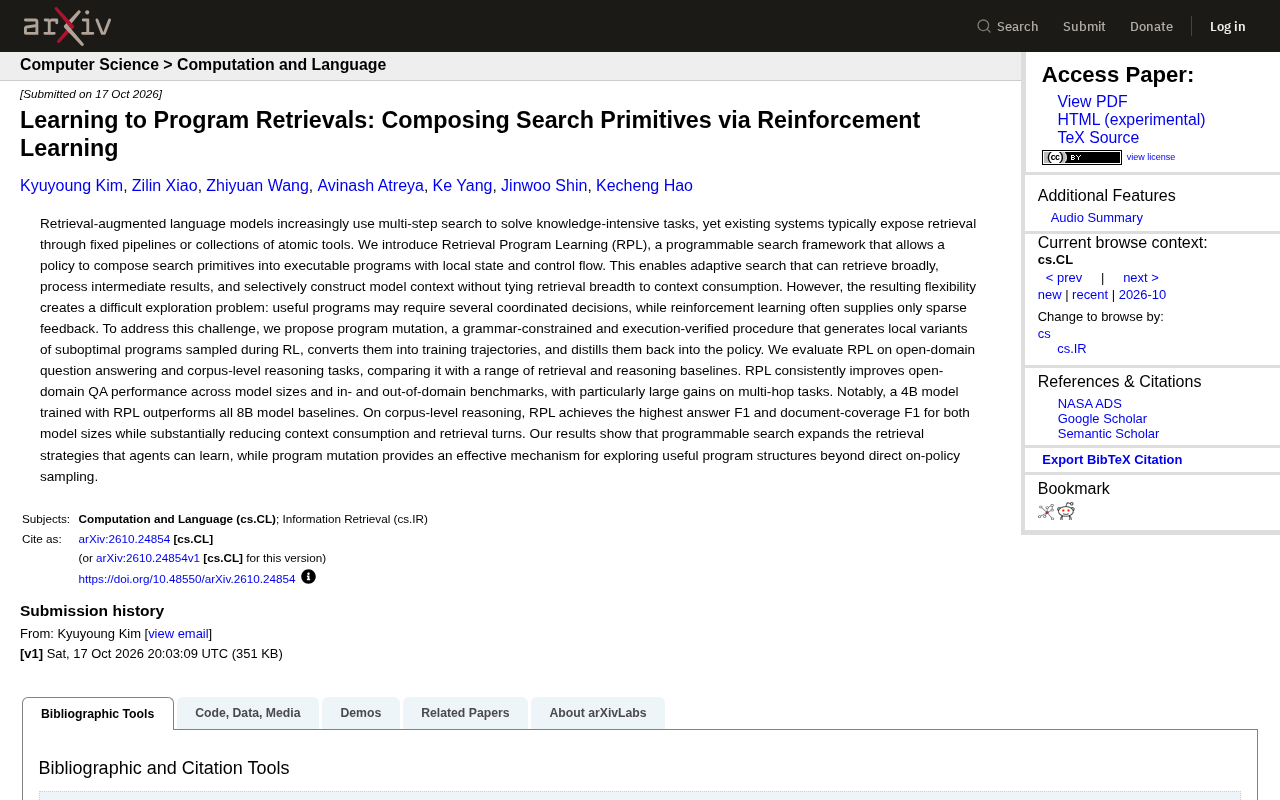
This article introduces the Retrieval Program Learning (RPL) framework, which turns retrieval from fixed pipelines or atomic tool calls into compositions of programmable primitives. The policy model writes retrieval programs with loops, conditionals, and local variables, optimized via RL to decouple exploration scope from context usage. A program mutation mechanism—sampling suboptimal programs, mutating within grammar constraints, and distilling after execution verification—turns blind exploration into guided local search. A 4B model trained with RPL outperforms all 8B baselines on open-domain QA, with significant multi-hop gains and top answer/document coverage F1 on corpus-level reasoning while reducing context and retrieval rounds.
Retrieval-augmented generation (RAG) has become the mainstream approach for knowledge-intensive tasks, but most systems still treat retrieval as a fixed pipeline or a set of atomic tools—the model can only "call" retrieval, not "design" it. A new paper proposes the Retrieval Program Learning (RPL) framework that changes this: it lets a policy model compose retrieval primitives into executable programs with local state and control flow, and optimizes these programs via reinforcement learning. More critically, the authors design a "program mutation" mechanism to alleviate the sparse feedback problem in reinforcement learning, enabling even small models to learn complex multi-step search strategies.
From "Calling Tools" to "Writing Programs": The Core Idea of Programmable Retrieval
Traditional RAG systems typically expose a fixed set of retrieval tools (e.g., keyword search, vector retrieval, document reading) that the model calls in a preset order. This design couples retrieval breadth with context consumption: to search broadly, you must stuff many results into the context; to save context, you can only search narrowly.
The core breakthrough of RPL is abstracting retrieval into programmable primitives. The policy model can write retrieval programs containing loops, conditional branches, and local variables—first retrieving broadly, then processing intermediate results (e.g., filtering, aggregation, reranking), and finally constructing only the curated content into the model context. This decouples the "exploration scope" of retrieval from "context usage"—the model can search boldly without paying a context cost for every search.
The paper notes that this flexibility introduces a thorny exploration problem: a useful retrieval program often requires multiple coordinated decisions to be correct simultaneously, while reinforcement learning typically provides only sparse final feedback signals. Direct on-policy sampling struggles to hit structurally correct programs.
Retrieval primitive is the smallest composable unit in the RPL framework, analogous to basic functions in a programming language. Each primitive encapsulates a deterministic retrieval behavior, such as keyword querying, vector nearest-neighbor search, reading by document ID, result filtering, or reranking. Unlike traditional "tool calling," primitives are not directly returned to the language model; instead, they serve as instructions within a program orchestrated and executed by the policy model, with intermediate results stored in local variables for subsequent steps. This design gives retrieval behavior composability, reusability, and verifiability—whether a program is legal and whether execution succeeds can be automatically checked, providing a structured search space for subsequent mutation and reinforcement learning.
Program Mutation: Cracking the Exploration Problem with Grammar Constraints and Executable Verification
To address the exploration dilemma under sparse feedback, the authors propose a program mutation mechanism. Its workflow can be summarized in three steps:
- Sample suboptimal programs: Collect programs that perform poorly but show structural potential during reinforcement learning.
- Grammar-constrained mutation: Make local modifications to programs within predefined grammar rules (e.g., replacing a primitive, adjusting loop bounds, adding a filtering step), ensuring mutated programs remain legal and executable.
- Execution verification and distillation: Actually run the mutated programs, verify their execution results, convert valid mutations into training trajectories, and distill them back into the policy model.
The essence of this mechanism is turning "blind exploration" into "guided local search." Grammar constraints prevent the search space from exploding, execution verification filters out invalid mutations, and the remaining high-quality trajectories become additional signals for policy improvement. Compared to pure on-policy sampling, program mutation can discover useful program structures more efficiently.
Sparse feedback is a classic challenge in reinforcement learning: the agent receives only a single reward signal at the end of a long sequence of decisions, with no immediate feedback on intermediate steps, leading to difficult credit assignment and inefficient exploration. In the context of RPL, a retrieval program may contain a dozen primitive compositions and loop branches, and positive reward is only obtained when the final answer is correct—random sampling is nearly impossible to hit a structurally correct program. The program mutation mechanism targets this pain point: by making local perturbations within the legal grammar space, it transforms "sampling from scratch" into "directed search around promising programs," and uses execution verification to provide intermediate filtering signals, thereby obtaining usable training trajectories even under sparse rewards. This approach resembles the mutation-selection paradigm in evolutionary algorithms, but is constrained within program grammar to guarantee executability.
Experimental Results: Major Gains on Multi-hop Tasks, Small Models Beat Large Ones
The authors evaluate RPL on two types of tasks—open-domain question answering and corpus-level reasoning—and compare it with various retrieval and reasoning baselines.
On open-domain QA, RPL consistently improves performance across different model scales and in-domain/out-of-domain benchmarks, with especially significant gains on multi-hop tasks. The most striking result: a 4B model trained with RPL outperforms all 8B model baselines. This shows that the policy improvements from programmable retrieval are sufficient to compensate for the gap in model parameter count.
On corpus-level reasoning tasks, RPL achieves the highest answer F1 and document coverage F1 at both model scales, while substantially reducing context consumption and retrieval rounds. In other words, it answers more accurately while searching more economically.
The paper concludes that programmable search expands the space of retrieval strategies that agents can learn, and program mutation provides an effective means to explore useful program structures beyond direct on-policy sampling.
Multi-hop QA refers to questions that require chained reasoning across multiple documents or passages to answer, such as "What is the population of the city where a certain writer was born?" Such tasks require the system to first locate entities, then trace related documents, and finally aggregate information—naturally demanding multi-step retrieval and intermediate result processing. Traditional RAG's fixed pipeline often loses context or introduces noise after the second hop, whereas RPL's programmable retrieval allows the model to explicitly write loops and conditional branches to advance hop by hop, hence the especially significant gains on this type of task. Corpus-level reasoning further requires the model to plan retrieval paths across the entire corpus and cover enough relevant documents; document coverage F1 is precisely the metric measuring whether retrieval "searches comprehensively," and together with answer F1 reflects the ability to "search accurately and comprehensively."
Implications for RAG System Design
The value of RPL goes beyond numeric improvements on an academic benchmark. It points to an evolutionary direction for RAG architecture: retrieval is no longer a fixed external module, but a computational process the model can actively orchestrate. For practical systems, this means less context waste, more flexible multi-step reasoning capabilities, and the possibility of small models replacing large ones in cost-sensitive scenarios.
Of course, programmable retrieval also brings new engineering challenges—program grammar design, execution sandbox security, and the computational overhead of the mutation process are all issues to weigh during deployment. But at least from the research results, letting models "learn to program retrieval" goes further than letting them "learn to call retrieval."
One-line Summary
RPL lets models write programmable retrieval programs via reinforcement learning, with small models outperforming large ones on multi-hop tasks.
Paragraph Summary
This article introduces the Retrieval Program Learning (RPL) framework, which transforms retrieval from fixed pipelines or atomic tool calls into compositions of programmable primitives. The policy model can write retrieval programs containing loops, conditional branches, and local variables, and optimize them via reinforcement learning, thereby decoupling retrieval exploration scope from context usage. To address the exploration challenge caused by sparse feedback in reinforcement learning, the authors propose a program mutation mechanism: sampling suboptimal programs, making local mutations within grammar constraints, and distilling back into the policy model after execution verification—turning blind exploration into guided local search. Experiments show that a 4B model trained with RPL outperforms all 8B baselines on open-domain QA, with significant gains on multi-hop tasks; on corpus-level reasoning it achieves the highest answer F1 and document coverage F1 while reducing context consumption and retrieval rounds. The article concludes by discussing the implications of programmable retrieval for RAG architecture evolution and engineering challenges.
Related articles

Altman Declares: The Cybersecurity Crisis Is Unsolvable and There Are Too Many Vulnerabilities to Patch
OpenAI CEO Sam Altman publicly admits he can't fix all security vulnerabilities and that the cybersecurity crisis will keep worsening. This article analyzes the industry reality behind this statement: exploding software complexity, the double-edged sword of AI, and the need to shift security paradigms from "zero vulnerabilities" to resilient defense.

Product Hunt Launches Visual Launch Editor, Saying Goodbye to Tedious Form Filling
Product Hunt launches a Visual Launch Editor with in-place editing for name, tagline, gallery, and maker info, auto-saved drafts, and a checklist to guide creators.

Zelensky Speaks: How We Held Kyiv Against 200,000 Russian Troops
Zelensky recalls the early Russia-Ukraine war: 200,000 Russian troops drove on Kyiv while Ukraine's main forces were in the east. He explains how mobilization grew the army from 200,000 to 800,000 and how Kyiv and Chernihiv oblasts were recaptured.