Replicating Manus with Native Python: A Complete Guide to Multi-Agent Application Development
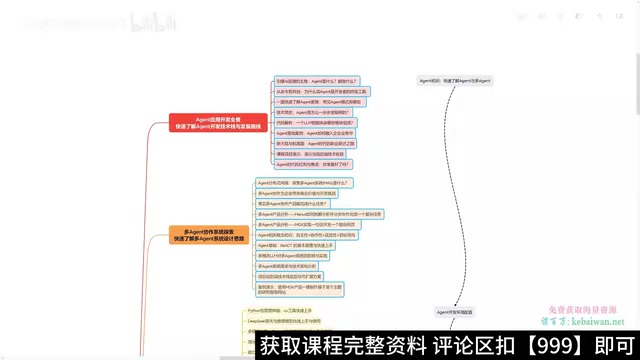
A full-stack Agent development course replicating Manus with native Python, MCP, and A2A protocols.
This article introduces a full-stack AI Agent development course centered on building MoreManus, a Manus replica. It opens with the market frenzy around Manus invitation codes, maps out the three-layer AI economy, and explains why developers should focus on the opportunity-rich application layer. The seven-stage curriculum covers Python setup, MCP tooling, A2A multi-Agent communication, prompt engineering, and full project deployment — spanning roughly 300 knowledge points across Next.js, FastAPI, Docker sandboxes, and CDP browser control. The course's defining feature is its rejection of LangChain and similar frameworks in favor of native code, helping learners truly understand Agent internals.
Why Agent Development Is the New Frontier for Developers
Manus, billed as the world's first general-purpose AI Agent, triggered a massive market response upon launch — invitation codes were reportedly resold on secondhand platforms for up to 60,000 or even 100,000 RMB, with demand far outstripping supply. This phenomenon reflects the intense market interest in AI Agents. Combined with the rise of domestic models like DeepSeekAd and the accelerating adoption of AI across industries — from brain-computer interfaces and robotics to content creation — Agent development has become one of the most talked-about technical frontiers in recent years.
For developers, this trend represents a very real opportunity. Job posting data shows that Agent-related roles commonly offer salaries of 30K–50K+ per month, often with 14–16 month compensation packages, putting them 50% to 150% above traditional front-end and back-end positions. Meanwhile, AI/Agent-focused startups are attracting enormous funding rounds. The field is characterized by high salaries, strong returns, and excellent long-term prospects. Whether you're chasing the next wave, pursuing higher pay, switching careers, or starting a company, Agent development is a direction worth investing in.
The Three-Layer Structure of the AI Economy — and Why the Application Layer Makes Sense
To understand why Agent development is the right focus rather than deeper AI infrastructure, it helps to look at the three-layer structure of the AI economy.
The Infrastructure Layer is the foundation, providing compute, data, and framework support — GPUs, TPUs, and training frameworks like TensorFlow and PyTorch. The number of companies that can meaningfully operate at this layer is tiny. GPU/TPU manufacturers can be counted on one hand, mature AI frameworks are scarce, and the cost, time, and ecosystem barriers to building a new framework from scratch are prohibitive.
The Foundation Model Layer sits in the middle — the large language models (LLMs) that provide core cognitive capabilities. Training a foundation model is extraordinarily expensive. Even DeepSeek, which pushed training costs to remarkable lows, still required tens of millions of dollars per model run. This layer, too, is accessible only to a handful of well-capitalized organizations.
The Application Layer (Agent Layer) sits at the top, facing users directly. It includes AI Agents, content creation tools, coding assistants, data analysis platforms, and more. This layer has the broadest audience — large companies and startups alike all have needs here, and the number of opportunities and job openings is orders of magnitude larger than the other two layers combined. Crucially, the stronger the foundation, the more the application layer flourishes. Choosing Agent development means positioning yourself at the layer closest to users, closest to real business problems, and richest in opportunity.
The Seven-Stage Course Breakdown: From Single Agent to Distributed Collaboration
This course is built around MoreManus, a product that replicates Manus. It spans over a dozen chapters organized into seven stages, each building logically on the last.
Stage 1 · Introduction to Agents: Quickly clarify the conceptual differences between single-agent and multi-agent systems, and explore how Agents are deployed in enterprise settings — establishing the theoretical foundation for the code development ahead.
Stage 2 · Environment Setup: Build a Python environment from scratch, connect to a large model using the OpenAI SDK, implement a basic Agent, and initialize the project structure.
Stage 3 · MCP Protocol: This is the core of the course, spanning three chapters. It covers the MCP (Model Context Protocol) and how to use it, writing MCP tools such as a Python interpreter, text writer, and web search module, and demonstrates how to convert existing tools into MCP tools for use with local models. This stage also introduces the Browser-Use framework and its underlying Playwright automation layer, enabling programmatic browser control by Agents.
Stage 4 · A2A Protocol: Covers the A2A (Agent-to-Agent) protocol standard, implements A2A servers and clients using Google's standard library, and lays the groundwork for distributed Agent development. The final product's multi-Agent communication layer is built on A2A.
Stage 5 · Prompt Engineering: Learn techniques for writing targeted prompts for different Agents, along with standards for evaluating prompt quality and methods for optimization.
Stage 6 · Full Project Development: Integrate distributed Agents, multi-Agent orchestration, a back-end API, and a Next.js front end; style the UI with Tailwind CSS; and enable one-command deployment using Dockerfile and Docker Compose.
Stage 7 · Wrap-Up and Outlook: Attempt to use the system to "bootstrap" itself — migrating the project from native Python to Java, Go, Node.js, and other languages — and explore the multi-Agent development roadmap along with career tips for AI roles.
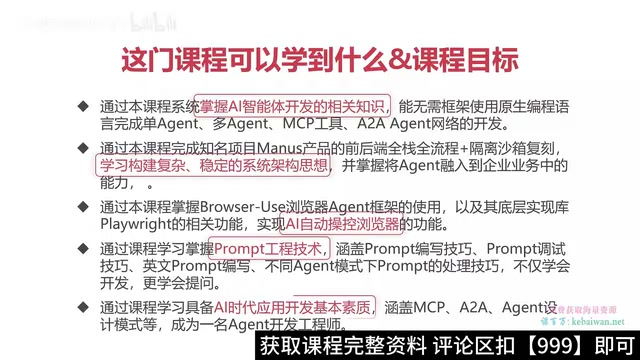
MoreManus Product Capabilities: Visual Configuration Beyond Manus
From hands-on demos, MoreManus's interface closely mirrors Manus, featuring a task list, conversation window, and file upload functionality. When a user submits a request, the underlying orchestration Agent automatically breaks the task into subtasks, distributes them to different Agents for execution, and each Agent further decomposes its subtask into clickable, inspectable steps.
Each task is assigned an isolated sandbox environment where the Agent automatically executes commands, controls a built-in browser to visit web pages, enter credentials, and automate complex workflows. Generated files are uniformly uploaded to the application and remain downloadable even after the virtual machine is shut down; text-based files support click-to-preview with syntax highlighting.
Several capabilities stand out that Manus itself lacks: model parameters can be dynamically configured from the front end (e.g., whether to allow automatic plan execution, iteration count, step count); you can dynamically switch between any OpenAI-compatible model, including GPT, DeepSeek, Gemini, and Claude; the front end can connect to an A2A Network to access distributed Agents on the internet; MCP servers can be dynamically added to extend the toolset; and you can remotely take over the browser inside the virtual machine — handling steps like CAPTCHA entry that Agents struggle with — before handing control back to the Agent.
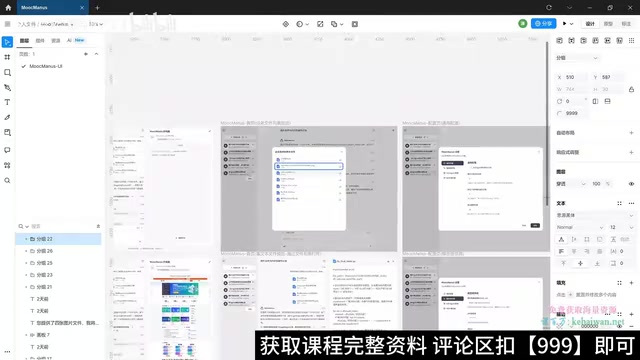
Several demo scenarios are particularly illustrative: merging images into a PDF, automatically converting an entire codebase from Python to Go, and scraping course information from a specified web page. All tasks are autonomously broken down, executed, debugged, and iterated by Agents — the code self-conversion task alone took tens of minutes, demonstrating the system's capacity to handle genuinely complex work.
Technical Architecture and Stack: No Framework Black Boxes
MoreManus's system architecture consists of three major components and two secondary modules. The front end is built with Next.js, includes a built-in VNC client for controlling the virtual machine's browser, and provides interfaces for model configuration and tool visualization. The back-end orchestrator is based on FastAPI, implements an API gateway internally, uses the OpenAI SDK with DeepSeek models to build the core brain, configures MCP tools and the A2A Agent network, and integrates Playwright browser tooling, sandbox management, and a ReAct Agent workflow. The sandbox also runs a FastAPI service internally, has Chrome installed for remote control via CDP, uses Supervisor for process management, and handles file operations, desktop sharing, and command/file transfer.
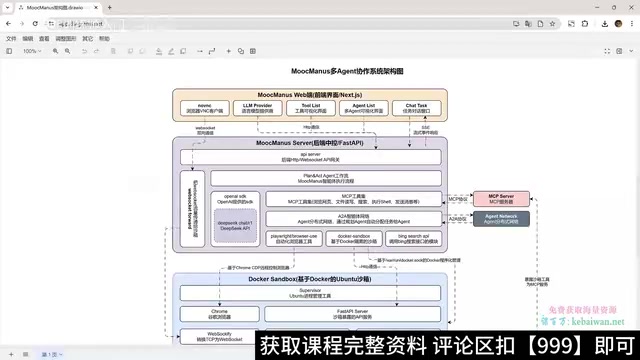
The tech stack spans roughly 300 knowledge points across six core areas: Front End (Next.js, React.js, Tailwind CSS, SSE, Monaco Editor); Back-End Orchestrator (FastAPI, Uvicorn, PostgreSQL, Redis, Pydantic, COS object storage); Sandbox Visualization and Remote Control (CDP, socket port forwarding, desktop sharing, programmatic process management); Core LLM Capabilities (OpenAI SDK, DeepSeek API, CoT chain-of-thought, ReAct design pattern, A2A protocol, MCP protocol, prompt engineering); Docker Sandbox (Ubuntu image, Dockerfile authoring, Supervisor process management, environment isolation); and Sandbox MCP Toolset.
The course's most distinctive feature is its rejection of frameworks like LangChain and LangGraph in favor of orchestrating multi-Agent systems using native Python with the MCP and A2A base libraries. This lower-level approach helps learners genuinely understand how Agents work under the hood, avoiding the blind spots that come with framework abstraction. When the time comes to switch to Java, Go, or another language, developers with a solid grasp of the fundamentals will adapt with ease.
ReAct (Reasoning + Acting) is an Agent workflow design pattern that combines reasoning with action, jointly proposed by Princeton University and Google Research in 2022. Its core idea is to have the model output a "Thought" before each step, then decide on an "Action" and observe the result — repeating this loop until the task is complete, forming an iterative "Think → Act → Observe" cycle. Compared to directly outputting answers, ReAct significantly improves accuracy and interpretability on complex multi-step tasks, because each reasoning step can be logged and audited. CDP (Chrome DevTools Protocol) is the low-level debugging and automation protocol exposed by Google Chrome. Browser automation frameworks like Playwright use CDP to programmatically control page DOM interactions, intercept network requests, capture screenshots, and more — allowing sandbox Agents to interact with a real browser exactly as a human would.
Target Audience and Learning Outcomes
The course is designed for six types of learners: junior-to-mid-level front-end and back-end developers looking to transition into Agent development; mid-to-senior developers seeking to level up; developers interested in AI Agent development (including power users of tools like Dify and Coze); entrepreneurs; and practitioners looking to leverage Agent skills to boost their competitiveness. As for prerequisites — familiarity with Python, Agent development, Docker orchestration, and AI algorithms is helpful but not required. The course starts from environment setup and walks through every line of front-end, back-end, and sandbox code, making it accessible to complete beginners.
Learning outcomes include a complete project with at least 7,000 lines of front-end, back-end, and sandbox code; 50+ examples of Agent business logic in production-style scenarios; demos of 30+ MCP tools; and one enterprise-grade project that runs throughout the entire curriculum. Beyond programming, the course covers engineering system architecture, Agent design thinking, career planning, and LLM integration — emphasizing that "the ability to build complex, stable systems matters more than knowing how to write code." This is the core differentiator from most AI courses on the market.
Background: MCP and A2A Explained
MCP (Model Context Protocol) is a standardized protocol proposed and open-sourced by Anthropic in late 2024, designed to solve the fragmented integration problem between large models and external tools and data sources. Before MCP, every AI application had to write custom adapter code for each tool it used, making maintenance extremely costly. MCP defines a unified server-client communication specification so that models can call file systems, databases, search engines, code executors, and other tools through a single consistent interface — analogous to the USB standard in the hardware world. An MCP server is essentially a lightweight process that exposes a set of "Tools," "Resources," and "Prompts" for the model to invoke; the MCP client (typically the Agent's host) is responsible for discovering and calling these capabilities. Leading AI development tools such as Claude Desktop and Cursor now support MCP, the ecosystem is growing rapidly, and learning MCP has become one of the core essential skills in Agent development.
A2A (Agent-to-Agent) is an open protocol released by Google in April 2025, designed specifically for cross-system communication and task collaboration between multiple AI Agents. While MCP addresses the problem of "models calling tools," A2A addresses "how an Agent discovers and delegates subtasks to another Agent." Each A2A-compatible Agent publishes an "Agent Card" — essentially a service description — that describes its capabilities, supported input/output formats, and authentication methods, allowing other Agents or orchestrators to dynamically discover and invoke it. A2A uses standard HTTP for transport, supports streaming responses via SSE, and includes built-in task state management so that long-running asynchronous tasks can be reliably tracked. This protocol makes distributed Agent networks possible — Agents deployed by different developers across the internet can collaborate with one another, forming an "Agent ecosystem" analogous to a microservices architecture. This is also the technical foundation that enables MoreManus to connect to an external A2A Network.
Related articles
Claude Code Adds Mods and AGENTS.md Support: A Deep Dive
Anthropic adds Mods plugin system and AGENTS.md support to Claude Code, alongside Projects redesign, background computer use, Diff panel, and Skills evaluation tools.
DeepSeek Harness Goes Open Source: An AI Agent Foundation Where Everything Is a Plugin
DeepSeek Harness is now open source. Built on an "everything is a plugin" philosophy, it supports 20+ LLM providers and launches a local Web UI with a single command.
AI Large Language Model Learning Roadmap: From Theoretical Foundations to Agent Development
A complete AI large model learning roadmap: from Transformer theory and PyTorch/Hugging Face frameworks to API calls, fine-tuning, Agents, and LangChain — a clear path from beginner to job-ready.