Replit Enters the Government Market: How AI Coding Is Reshaping Emergency Response and Public Governance
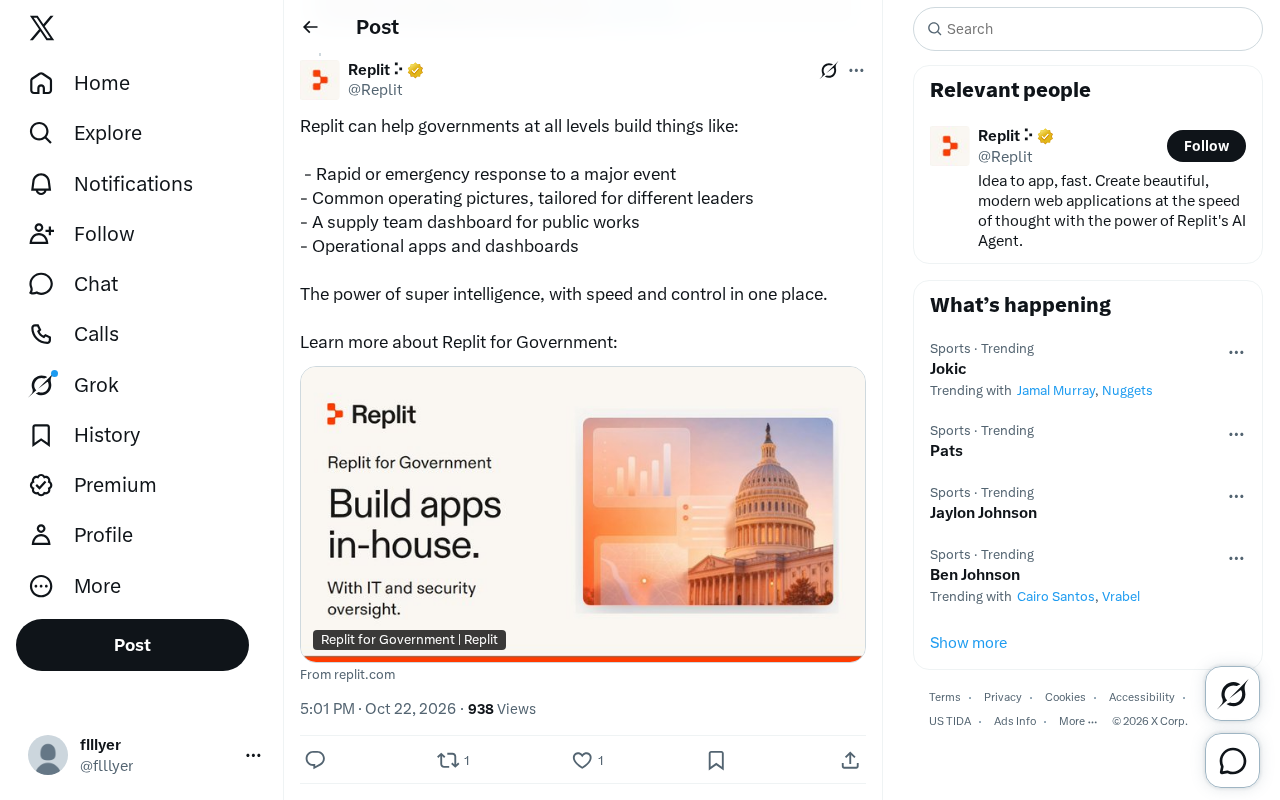
Replit promotes government solutions, entering emergency and public management scenarios at AI speed.
Replit announced its entry into the government market, listing emergency response, Common Operating Picture, public works supply chain dashboards, and operational applications as key scenarios. Its core proposition combines the speed of superintelligence with the control governments need, compressing traditional procurement and outsourced development cycles. However, Replit has not disclosed critical details such as data isolation, security compliance, or deployment models—exactly the barriers to entry in the government market. If successful, the strategy could disrupt traditional government IT outsourcers and shift developer skills toward requirements description and code review.
Replit recently sent a clear signal on social media: it is no longer just a toy for developers—it wants to become the technology infrastructure for governments at all levels. From emergency response to public works dashboards, Replit is packaging "superintelligence" as a productivity tool that governments can quickly deploy while retaining control.
From Developer Tool to Government Infrastructure
Replit's tweet lists four typical scenarios: rapid or emergency response to major incidents, a Common Operating Picture (COP) for leaders at different levels, supply chain team dashboards for public works, and various operational applications and dashboards. What these scenarios share is that they involve urgent needs, a high degree of customization, and strict requirements for data control.
Traditionally, government agencies acquiring such systems must go through lengthy procurement cycles and outsourced development processes. Replit is trying to compress exactly that cycle—describe requirements in natural language, rapidly generate a working application prototype, and then have internal teams iterate and adjust. This model is especially appealing for emergency scenarios: when an incident occurs, waiting months for a development schedule is clearly unrealistic.
Replit summarizes this value proposition as "the power of superintelligence, with speed and control in one place." The subtext is that the speed advantage of AI-generated code does not come at the expense of the control that governments care about most.
Common Operating Picture (COP) is a core concept in emergency management and military command, referring to the integration of real-time data from multiple sources (geolocation, resource status, incident progress, etc.) into a unified visual interface so that decision-makers share the same situational view. In government scenarios, a COP requires different levels (such as on-site command, regional coordination, and central decision-making) to see data granularity matched to their permissions while ensuring underlying data consistency. Replit's emphasis on "customizing for different leaders" essentially means generating different front-end interfaces by role under the same data model, which places high demands on permission management and data isolation.
The Product Logic Behind the Four Scenarios
The scenarios listed in the tweet are not randomly assembled; they correspond to different layers of government technology needs.
Emergency response is the most rigid requirement. Disasters, public safety incidents, health crises, and similar scenarios require systems to go live within hours or days, not months. The value of Replit's AI-assisted development capability here is shortening the path from requirements to a working system.
Common Operating Picture involves information integration and layered permissions. Leaders at different levels need to see data views at different levels of granularity. Replit's emphasis on "customizing for different leaders" points to the ability to generate multi-role interfaces from the same data source.
Public works supply chain dashboards and operational applications are routine management tools. Such needs are high in volume and change frequently; the traditional outsourcing model is costly and slow to respond, while low-code or AI-assisted development platforms are well suited to this "long-tail but high-frequency" government IT demand.
One detail worth noting: Replit did not elaborate in the tweet on data isolation, compliance certifications, or deployment models for government customers. These are precisely the most critical barriers to entry in the government market. The "Replit for Government" link at the end of the tweet indicates that an official page exists, but public information on security and compliance details remains limited.
Government IT procurement and compliance certification is the key context for understanding Replit's government strategy. Governments typically require vendors to pass specific security certifications (such as FedRAMP in the United States and China's Multi-Level Protection Scheme evaluations) and to meet requirements for data localization, audit logs, and access control. Under the traditional outsourcing model, these compliance tasks are handled by integrators. But if an AI-assisted development platform is to enable government staff to build applications directly, it must provide compliance guarantees at the platform level (such as isolated tenants, encrypted storage, and operational auditing). Replit's tweet did not mention these details, yet they are often hard prerequisites for government customers' decisions and the main obstacle to moving a platform from "demo" to "production."
Opportunities and Questions in the Government Market
The timing of Replit's entry into the government market makes sense. Governments around the world are exploring how to use AI to improve public service efficiency, and rigid procurement processes are a common pain point. A platform that enables internal staff to quickly build tools could, in theory, bypass part of the traditional outsourcing chain.
But government customers behave very differently from commercial customers. Government agencies have long vendor review cycles, high demands for data sovereignty, and low tolerance for system instability. Questions Replit needs to answer include: Can the generated applications pass security audits? Where is data stored? How is liability defined when failures occur?
Judging from the tweet itself, Replit's narrative focuses on "showcasing capabilities" rather than "arguing compliance." This fits the pace of early market education, but it also means that actual government adoption may be more cautious than the picture painted in the tweet.
What It Means for Developers and IT Service Providers
If Replit's government strategy progresses smoothly, the impact will not be limited to government procurement departments. Traditional outsourcers and systems integrators that take on government IT projects may come under pressure—when a customer's internal team can quickly build prototypes with AI, the power to define requirements and negotiate prices shifts upstream.
For developers, the spread of such platforms means that "being able to describe requirements" and "being able to review AI-generated code" will become as important as "being able to write code." The juxtaposition of "speed and control" in Replit's tweet actually hints at this division of labor: AI handles generation, while humans set direction and accept the results.
Replit has not yet announced specific customer cases or pricing models for its government business; this tweet is more of a declaration of direction. Whether the government market can become Replit's second growth curve depends on whether it can turn the ability to "build quickly" into "trustworthy government-grade systems." Speed has been demonstrated; the answer to the control half of the equation remains to be filled in.
One-line Summary
Replit promotes government solutions, entering emergency and public management scenarios at AI speed.
Paragraph Summary
Replit announced on social media that it is entering the government market, listing four scenarios: emergency response, Common Operating Picture, public works supply chain dashboards, and operational applications. Its core proposition is to combine "the speed of superintelligence" with "the control governments need," compressing traditional procurement and outsourced development cycles. The article argues that these scenarios correspond to different layers of government IT needs, but Replit has not disclosed key details such as data isolation, security compliance, and deployment models—exactly the barriers to entry in the government market. If the strategy progresses smoothly, it could disrupt the bargaining power of traditional government IT outsourcers and push developers' skill focus toward requirements description and code review. Customer cases and pricing information are currently lacking, so this remains a declaration of direction.
Related articles

LLaMA-Factory in Practice: A Complete No-Code Guide to Fine-Tuning Large Models
An introduction to LLaMA-Factory, the open-source fine-tuning tool: its 60.1K-star background, supported models and algorithms, local vs. cloud deployment, and CUDA setup steps.

Zeng Ming's Deep Retrospective: Why OpenAI May Not Be the Ultimate Winner — and Why the Corporate System Will Disappear
Zeng Ming's deep retrospective on the AI endgame: model companies are just infrastructure, OpenAI and Anthropic won't be the final winners; the next battle is the Agent entry point standard; the corporate system will disappear as AI restructures collaboration, and only mission-driven companies can survive the cycle.

OpenHands v1.28.0: OpenCode and PI Added as Built-in Agents, API Keys Requestable In-Conversation
OpenHands ships 5 releases in 21 days: v1.27.0 adds OpenCode and PI as built-in agents, v1.28.0 enables in-chat key requests. ACP integration, credential reuse, model list changes, and upgrade advice.