Replit Launches BYOC: Code Runs on Your Own Cloud

Replit launches BYOC, enabling enterprises to deploy dev and production environments in their own clouds, trading trust for isolation and control.
Replit has announced Bring Your Own Cloud (BYOC), allowing enterprises to run development and production workloads in their own cloud accounts on Azure, Google Cloud, and AWS. The solution aims to provide security and platform teams with stronger isolation and control while preserving the familiar Replit experience, directly addressing compliance pain points for regulated industries such as finance, healthcare, and government. BYOC supports separate deployment of development and production environments and covers the three major cloud platforms, avoiding single-vendor lock-in. The article argues that this marks the competition among AI coding platforms extending from model capability to infrastructure trust and deployment flexibility, but officials have not yet disclosed pricing, timelines, or technical implementation details; enterprises evaluating it should focus on functional differences, the division of operational responsibilities, and the depth of integration with existing SSO/audit systems.
Replit is changing how cloud development tools are deployed. The company has announced the launch of Bring Your Own Cloud (BYOC), allowing enterprises to run Replit's development and production workloads in their own cloud environments across Azure, Google Cloud, and AWS. The move sends a clear signal: AI coding platforms are shifting from "host everything" to "let enterprises control the infrastructure."
Why BYOC Is a Key Pivot for Replit
Replit's core selling point is its out-of-the-box online coding experience—open a browser and you can write code, run projects, and deploy applications with almost no server configuration. But that convenience rests on Replit-hosted infrastructure, and for regulated industries such as finance, healthcare, and government, running code and data on a third-party platform often fails compliance review.
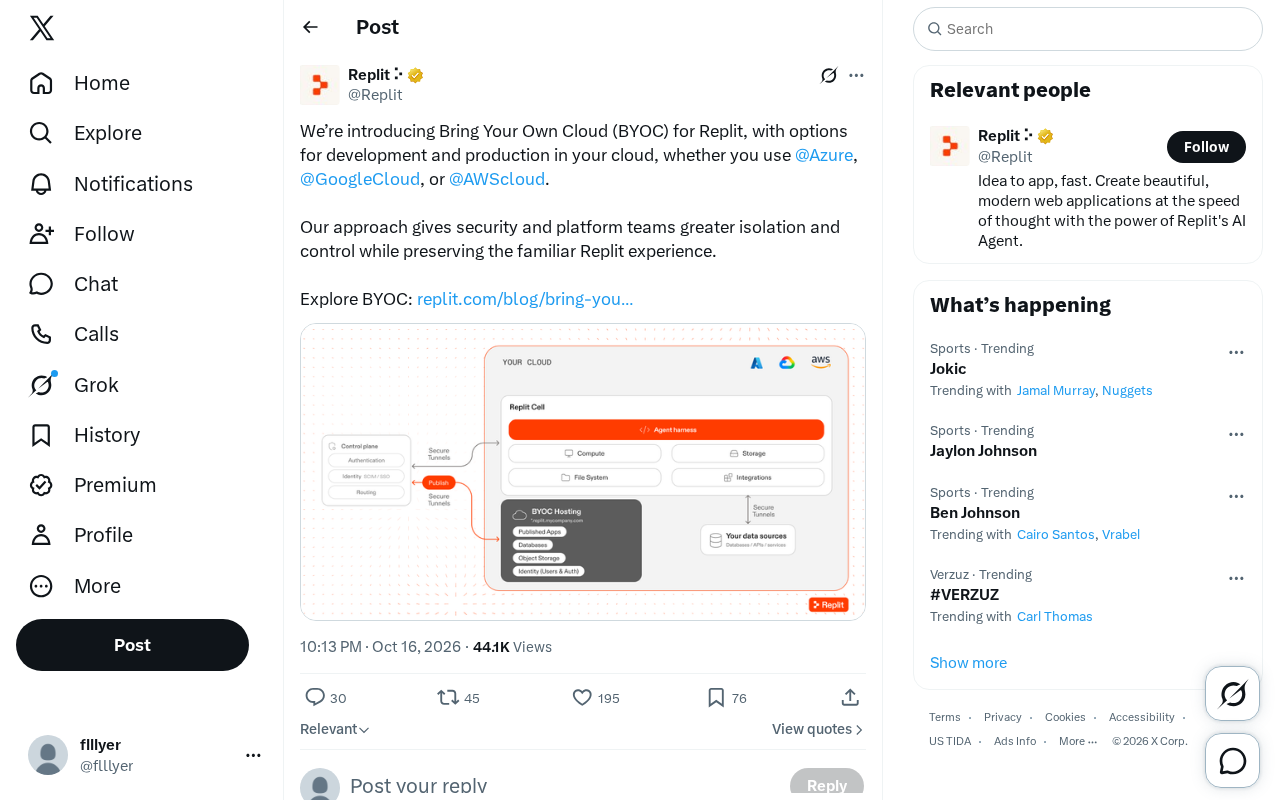
BYOC directly addresses this pain point. According to the official description, the solution "gives security and platform teams stronger isolation and control while preserving the familiar Replit experience." In other words, enterprises get Replit's product interface and collaboration capabilities, but compute and data stay in their own cloud accounts.
This model isn't new—infrastructure tools like GitLab and HashiCorp have long offered similar options. But for an AI coding platform that sells itself on "zero ops," launching BYOC means Replit has acknowledged a reality: to win enterprise customers, a good experience isn't enough—customers need to hold the keys themselves.
BYOC (Bring Your Own Cloud) is a deployment model in which a software vendor runs its product in the customer's own cloud account rather than in the vendor's hosted public cloud environment. The customer retains full ownership and control of the infrastructure, while the vendor provides the software layer, management interface, and updates and maintenance. This model offers inherent advantages in data sovereignty, compliance auditing, and network isolation, making it particularly suitable for regulated industries such as finance and healthcare. Compared with the SaaS multi-tenant model, BYOC typically adopts a control plane/data plane separation architecture: the vendor hosts the control plane responsible for coordination and updates, while the data plane is deployed within the customer's cloud to handle actual workloads. Tools like GitLab and HashiCorp already offer similar solutions, and Replit's entry marks that AI coding platforms are beginning to embrace this enterprise-grade deployment paradigm.
Dual Dev and Production Modes, Covering Three Major Cloud Platforms
The details of the BYOC launch are worth breaking down one by one:
- Dual-environment support: Enterprises can choose to deploy development and production environments separately in their own clouds, rather than having only one hosting option. This is a necessary design for teams that need strict dev/prod separation.
- Multi-cloud compatibility: Azure, Google Cloud, and AWS are all covered, with no lock-in to a single cloud vendor. Enterprises can continue using existing cloud contracts and architectures without migrating infrastructure just to use Replit.
- Isolation and control: The official announcement emphasizes isolation and control, which typically means network-level isolation, data residency guarantees, and integration with enterprises' existing IAM systems.
Officials have not yet disclosed finer technical implementation details, such as whether BYOC deploys proxy nodes in the customer's cloud account or adopts a full control plane/data plane separation architecture. These details will directly affect enterprises' operational burden and actual isolation effectiveness.
What It Means for Security and Platform Teams
From an enterprise architecture perspective, the value of BYOC isn't that there's "one more deployment option," but that it changes the boundaries of responsibility. The attack surface security teams need to worry about shifts from Replit's hosted environment to their own cloud accounts, and audit logs, network policies, and key management can all be incorporated into existing governance frameworks.
Platform teams, meanwhile, must assess a practical question: will BYOC throw operational complexity back at them? If Replit's BYOC solution requires enterprises to maintain clusters and upgrade components themselves, then its difference from self-built development environments becomes limited. The official emphasis on "preserving the familiar Replit experience" suggests the operational burden should be kept at a relatively low level, but the exact degree will need to be verified through actual documentation and customer cases.
Control plane/data plane separation is a typical technical architecture for BYOC. The control plane is usually hosted by the vendor and is responsible for the user interface, API scheduling, version updates, and monitoring; the data plane is deployed within the customer's cloud account and carries actual compute, storage, and network traffic. This separation keeps customer data within their cloud while still allowing the vendor to push feature updates uniformly. The isolation effectiveness depends on how the data plane communicates with the control plane—typically implemented through encrypted channels and least-privilege proxies. Enterprises need to assess whether the architecture supports integration with existing IAM, audit logs, and network policies, as well as who is responsible for operating and maintaining data plane components (e.g., automatic upgrades or manual maintenance). These details directly affect compliance and operational burden.
IAM (Identity and Access Management) is a core security framework in enterprise cloud environments, used to define who can access which resources and how. In a BYOC scenario, Replit's data plane needs to integrate with the enterprise's existing IAM system—for example, through role binding, service accounts, or federated identity authentication—to ensure developers and service components receive only the minimum necessary permissions. Audit logs record all API calls and resource operations and are key evidence for enterprises to meet compliance requirements (such as SOC 2 and ISO 27001). Key management services (such as AWS KMS and Azure Key Vault) handle the generation, rotation, and storage of encryption keys, and BYOC solutions need to clarify how they connect with these services. Security teams should focus on whether BYOC supports incorporating these capabilities into existing governance frameworks rather than introducing a separate management silo.
The Infrastructure Battle Among AI Coding Platforms
Replit's move is even more interesting in the broader industry context. Competition among AI coding assistants and cloud IDEs has expanded from "model capability" to "deployment flexibility." Products like GitHub Codespaces and Gitpod have long supported running on users' own infrastructure, while AI editors like Cursor prioritize local-first operation. Replit was previously a representative of the pure hosting route, and now that it has filled in the BYOC piece, it shows that the threshold for the enterprise market is shifting from features to trust.
Another dimension worth watching is the governance of AI-generated code. When Replit's Agent automatically generates and deploys applications, where the code ultimately runs, who can audit it, and whether data leaves the country are all questions enterprises will press on during procurement. BYOC at least makes it possible for "code and data to stay in your own cloud account," providing a basis for subsequent compliance conversations.
However, BYOC is not a panacea. It solves the infrastructure trust problem, not the reliability of the model itself or the quality of generated code. For individual developers and small teams already using Replit, this feature will have limited short-term impact—it is mainly aimed at enterprise customers with compliance and isolation needs.
Replit did not provide pricing, availability timelines, or specific technical documentation for BYOC in the announcement, and this information will determine whether the feature can truly land. When evaluating, enterprise customers can focus on three things: the functional differences between BYOC and hosted environments, how operational responsibilities are divided, and the depth of integration with existing SSO/audit systems.
Data residency refers to legal requirements that data must be stored within a specific geographic region or jurisdiction, commonly seen in regulations such as GDPR and China's Cybersecurity Law. For multinational enterprises, code, configurations, and runtime logs generated by AI coding platforms may contain sensitive information, and hosting them on overseas servers may violate data localization rules. BYOC makes data residency compliance possible by deploying the data plane in a cloud region specified by the customer. When procuring, enterprises need to confirm whether the BYOC solution supports region locking, cross-region replication controls, and data export auditing. In addition, temporary data and artifacts generated when AI Agents automatically deploy applications also need to be included in residency policies to avoid compliance blind spots.
One-line Summary
Replit launches BYOC, enabling enterprises to deploy development and production environments in their own clouds, trading trust for isolation and control.
Paragraph Summary
Replit has announced the launch of Bring Your Own Cloud (BYOC), allowing enterprises to run development and production workloads in their own cloud accounts on Azure, Google Cloud, and AWS. The solution aims to give security and platform teams stronger isolation and control while preserving the familiar Replit experience, directly addressing the compliance pain points of regulated industries such as finance, healthcare, and government. BYOC supports separate deployment of development and production environments and covers the three major cloud platforms, avoiding lock-in to a single vendor. The article argues that this marks the competition among AI coding platforms extending from model capability to infrastructure trust and deployment flexibility, but officials have not yet disclosed pricing, timelines, or technical implementation details; enterprises evaluating it should focus on functional differences, the division of operational responsibilities, and the depth of integration with existing SSO/audit systems.
Related articles

AI Digital Twin in Action: Using DOT to Automatically Track Bugs and User Feedback
DOTS engineers demonstrate how AI digital twin DOT collects cross-platform user feedback, categorizes issue themes, opens threads to investigate bug root causes, and submits PRs—showcasing a complete AI agent workflow for defect triage with auditable design.

Why Transistors Are No Longer Flat: The Evolution from Planar to Gate-All-Around
Transistor evolution from planar to FinFET to gate-all-around: why gates went from three-sided to four-sided wrapping to suppress short-channel effects and leakage current, extending Moore's Law.

Swarm Intelligence = a Single RL Agent? A Proof of Multi-Armed Bandit Equivalence
A paper proves that collective decision-making through local imitation in swarms is mathematically equivalent to single-agent reinforcement learning: N blind imitators act as N parallel environment samples, with an effective learning rate of 1/N. This article explains the derivation and implications of the Maynard-Cross Learning algorithm.