Replit's Context Skill in Practice: A Smart Project Deduplication Trick to Avoid Reinventing the Wheel

Replit's new deduplication skill auto-detects similar existing projects before you start building a new one.
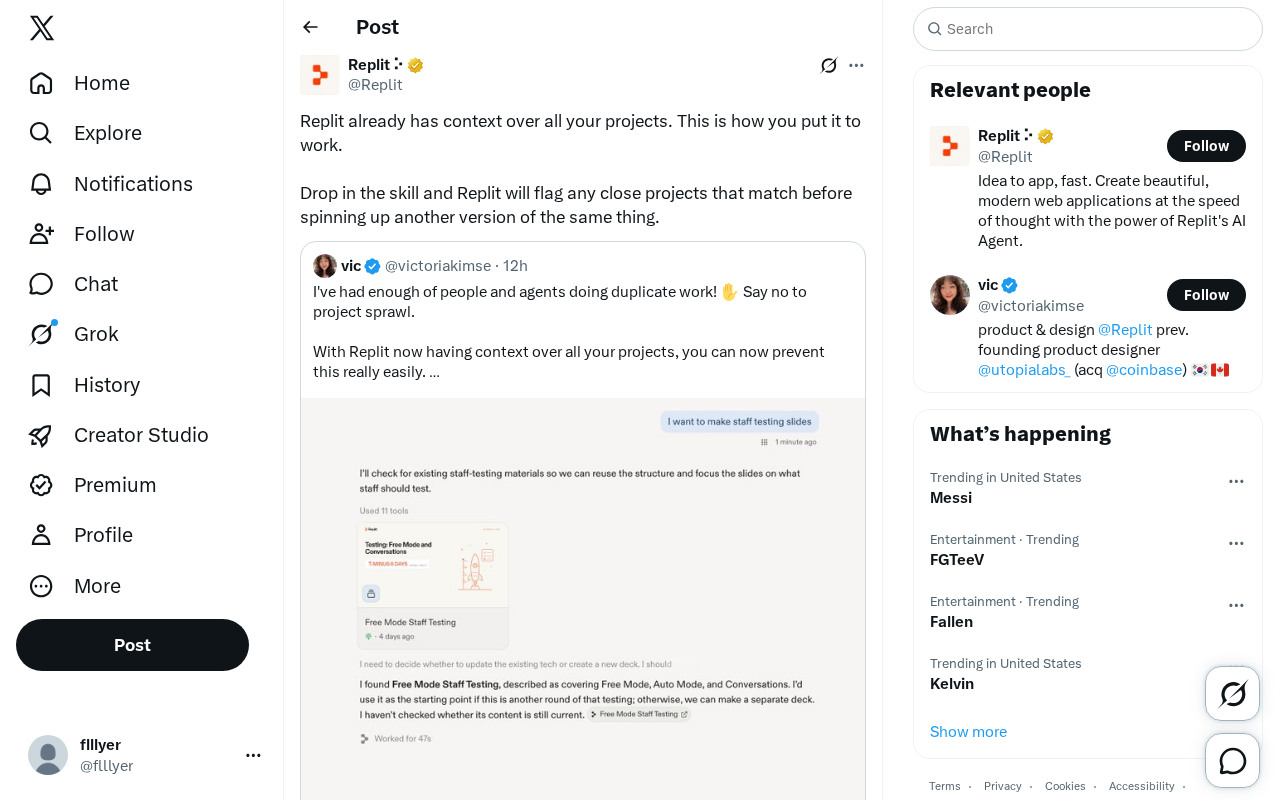
Replit, as a cloud-based AI dev platform, has full contextual awareness of all user projects — and now offers a deduplication Skill that automatically scans your existing project library when you create something new, flagging highly similar matches before you reinvent the wheel. The core value is intercepting redundant work upfront: as project counts grow, manual recall becomes unreliable, making AI-powered deduplication a more intuitive workflow improvement. The feature signals a shift from AI tools that passively execute instructions to ones that proactively advise based on historical context — though its real-world value will hinge on matching accuracy.
Replit's Cross-Project Context Awareness
Replit, as a cloud-based AI development platform, has a frequently underestimated capability: it maintains complete context (context) over all of a user's projects. This means that as you accumulate multiple projects on the platform, Replit doesn't treat them as isolated code repositories — it can understand and identify similarities across them.
The source material highlights a key scenario: when developers go to build something new, they often unknowingly recreate something they've already built before. This is exactly where Replit's context awareness can step in — reminding you that the wheel might already exist before you start "reinventing" it.
How the Skill Works
According to the official description, the usage is straightforward: once you drop in this "skill," Replit will automatically check your existing project library whenever you're about to create a new project. If it finds a highly similar match, it proactively flags it — rather than letting you start fresh on something functionally redundant.
The core logic here is intercepting duplicate work upfront. In traditional workflows, developers rely on memory or manual searching to recall whether they've built something similar before. As the number of projects grows, this kind of manual recall becomes increasingly unreliable. Delegating project deduplication to an AI that has full contextual awareness is a more intuitive improvement to the development workflow.
Why This Matters
For solo developers and small teams, project fragmentation is a genuine pain point. When similar features get reimplemented repeatedly, it wastes time, creates maintenance overhead, and fragments code assets. By leveraging its existing context advantage for deduplication alerts, Replit is essentially transforming a "passive code repository" into an "active development assistant."
What is a "Skill" in Replit? In the Replit ecosystem, a Skill is a plug-and-play functional module — similar to a plugin that equips an AI assistant with a specific capability. Replit's underlying AI Agent already handles general tasks like code generation, debugging, and deployment. A Skill builds on top of that foundation with incremental functionality tailored to a specific workflow scenario. Developers can drop a Skill into their workflow on demand, without changing their overall habits. This design philosophy aligns with the popular "Tool Use" pattern in today's AI tool ecosystem — combining specialized capabilities to make general-purpose AI more precise and useful in vertical scenarios.
Implications for the Development Workflow
Small as this skill may seem, it reflects a broader direction in the evolution of AI coding tools: tools that no longer just execute your current instruction, but make informed suggestions based on a full understanding of your work history. The shift from "build whatever you tell me" to "let me remind you this might already exist" is a real-world application of contextual memory.
For developers who habitually prototype quickly and spin up new projects frequently, this kind of feature can meaningfully reduce redundant effort — freeing up more energy for genuinely new requirements. Of course, its real value depends on matching accuracy. Too many false positives will disrupt your flow; too many misses renders it pointless. That's the area this type of context skill will need continuous refinement going forward.
A note on "Context Memory": Context Memory is one of the core competitive dimensions for AI coding assistants. Early tools like GitHub Copilot primarily relied on the current file or a limited workspace window to generate suggestions — a relatively narrow context window. Cloud platforms, by contrast, naturally hold a user's full historical data, enabling context to expand from "a single session" to "the entire project lifecycle." This is an architectural advantage that local tools struggle to replicate. Replit's cross-project matching capability leverages exactly this platform-level advantage — it doesn't require users to manually organize or tag their projects. Instead, the platform continuously maintains a searchable project knowledge base in the background, surfacing it as concrete suggestions at the right moment.
Conclusion
Replit's full contextual awareness of all user projects, combined with an opt-in deduplication skill, together form a practical workflow for reducing reinvention. It transforms what was once a manual, memory-dependent search process into an automatic, proactive prompt from the platform. For developers managing a large number of projects, this is a worthwhile efficiency optimization to explore.
Since this article is based on a brief official announcement, specific details about the matching algorithm, how to enable the feature, and real-world performance remain to be verified. Users interested in trying it out are encouraged to test it in their own environment before drawing conclusions.
Related articles

Bilibili's Hit Dify Tutorial: A Practical Guide to Building 20+ AI Apps from Scratch
A distilled guide to Bilibili's top-rated Dify tutorial: Windows + Docker deployment, MySQL connection, five app types, model integration strategy, and publishing.

Agent Skills Beginner's Guide: From Concepts to Multi-Agent Collaboration in Practice
A comprehensive guide to Agent Skills: core concepts, components, the importance of Description, standardization, beginner learning paths, and multi-agent collaboration.

One Neuron Detects Both Cats and Cars? We Reproduced It and Found a New Explanation
The cat-car neuron reinterpreted: researcher Cammarata argues it distinguishes pointy from round, not cats from cars. We reproduced the experiment and found the new explanation holds on most inputs—but cars are the exception. The interpretability debate continues on language models.