RETRACE: Using Memory Mechanisms to Correct Misread A/B Test Conclusions

RETRACE uses memory mechanisms to trace evidence chains and correct conclusions built on confounded A/B tests.
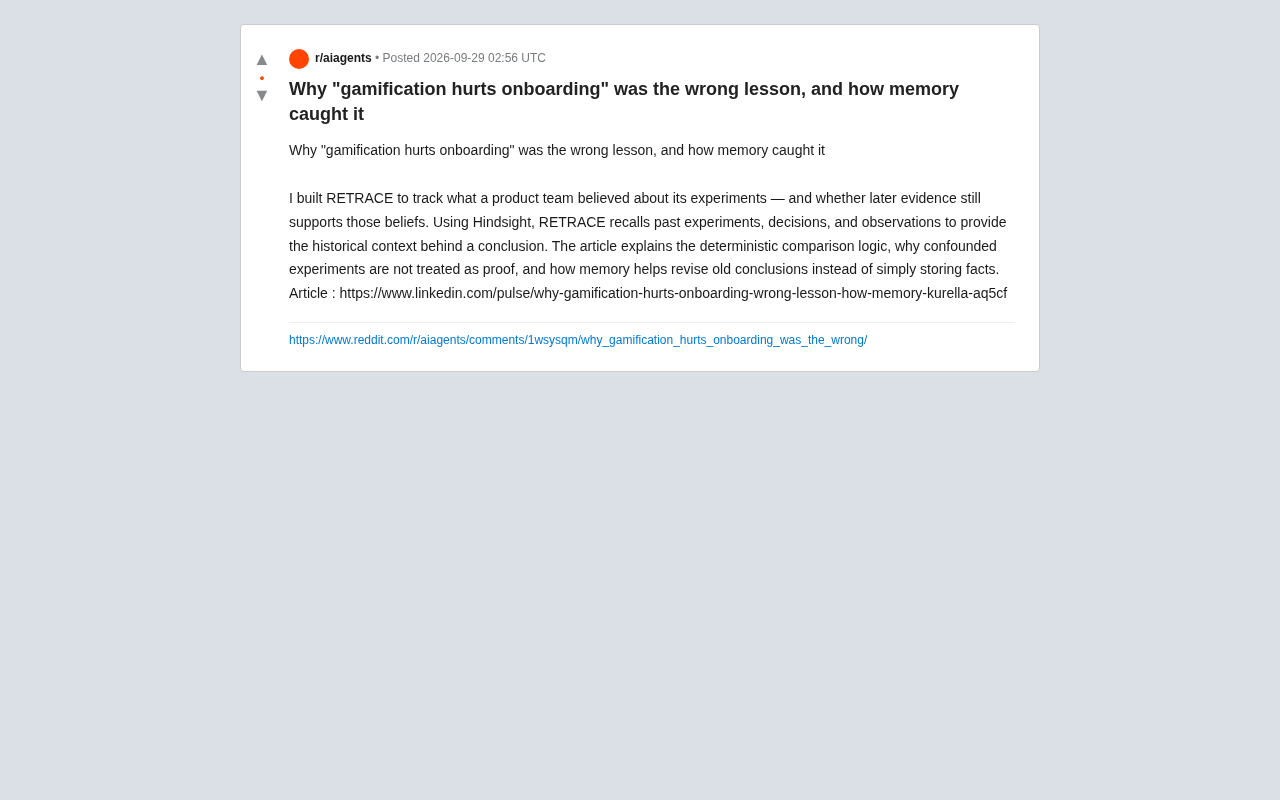
Product teams often canonize experimental conclusions without questioning whether the underlying experiments were sound. RETRACE tracks what teams believe and whether subsequent evidence still supports those beliefs, using "gamification harms onboarding" as a case study. Through a Hindsight memory component, deterministic comparison logic, and evidence-strength differentiation, it surfaces confounded experiments and corrects misread lessons — reframing memory as dynamic belief revision rather than passive information storage.
Product teams often walk away from an experiment with a seemingly airtight conclusion, document it in their knowledge base, and treat it as the default premise for future decisions. But what if that conclusion was built on a flawed experiment? A developer built a tool called RETRACE specifically to track what product teams believe — and whether subsequent evidence still supports those beliefs. Using the widely accepted conclusion that "gamification harms user onboarding" as a case study, it demonstrates how a memory system can surface a misread lesson.
A Misread Experimental Lesson
"Gamification hurts onboarding" was once treated as gospel by many product teams. It sounds intuitive: too many badges, progress bars, and points might distract new users from completing core tasks. Teams redesigned accordingly and dropped gamification elements.
The problem is that the original experiment behind this conclusion may have been confounded — meaning multiple variables changed simultaneously, or uncontrolled interference factors were present, making it impossible to confirm that "gamification" was actually the cause of the drop in onboarding metrics. When teams repeatedly cite such a shaky conclusion as established fact, the error becomes entrenched and influences a cascade of downstream decisions.
Confounding variables are a classic trap in experimental design. When an experiment changes multiple conditions simultaneously, or when unmeasured and uncontrolled third-party factors are present, it becomes impossible to determine which variable actually caused the observed outcome. In the gamification experiment, for example: if the onboarding copy was also revised at the same time, or if the treatment group happened to run during a period when new product features launched, then the decline in onboarding metrics could have stemmed from those factors — not gamification itself. Randomized controlled experiments (A/B tests) theoretically balance confounding variables through random assignment, but in practice, time windows, user segmentation, and feature coupling can easily cause experimental design to quietly spiral out of control. The severity of the problem lies in this: confounded experiments often look identical to rigorous ones — the data looks clean, the conclusions look crisp, yet the underlying causal inference is wrong.
How RETRACE Works
RETRACE's core approach isn't simply to "store facts" — it records beliefs along with their evidence chains and continuously tests whether those beliefs still hold up. It uses a memory component called Hindsight to trace past experiments, decisions, and observations, providing the historical context behind any given conclusion.
In other words, when a team wants to cite the "gamification harms onboarding" lesson, RETRACE can pull up its provenance: which experiment the conclusion came from, what the experimental design looked like, whether confounding variables were present, and whether contradicting evidence has emerged since. This traceability transforms a conclusion from an "isolated assertion" into a "judgment with context."
Deterministic Comparison Logic
The author emphasizes that RETRACE uses deterministic comparison logic. This means the system's comparison of old and new evidence follows explicit, reproducible rules rather than relying on fuzzy probabilistic inference. When new experimental data comes in, the system can apply its established logic to determine whether that data supports, weakens, or overturns an existing conclusion.
The value of this deterministic design lies in trustworthiness — teams can understand and verify why the system made a particular judgment, rather than treating it as black-box output.
The distinction between deterministic logic and probabilistic inference is an important engineering trade-off in AI system design. Probabilistic inference (such as large language model outputs) relies on statistical patterns; the same input can produce different outputs, making it difficult to trace reasoning after the fact. Deterministic logic, based on explicit rule trees or conditional branching, produces the same output given the same input — and every step can be inspected and audited. In knowledge management contexts, deterministic logic is especially important: when a system tells a team that "this conclusion has been weakened by subsequent evidence," the team needs to be able to understand why that judgment was made before they'll trust and act on it. This also means that RETRACE's judgment boundaries and rules must be explicitly defined by humans — the system's quality ceiling is determined by how rigorously those rules are designed.
Why Confounded Experiments Can't Serve as Evidence
A key principle in RETRACE's design is this: confounded experiments are not treated as proof. This directly addresses the core problem in the gamification case. If the original experiment cannot rule out alternative explanations, it is insufficient to support a causal conclusion like "gamification is harmful."
In traditional knowledge management, once a conclusion is written into a document, it typically loses any marker of its reliability level — people see only the "conclusion," not "how credible this conclusion actually is." By distinguishing between strong and weak evidence, RETRACE avoids giving a fragile experimental result the same weight as a rigorous one. This is a more scientifically grounded approach to knowledge governance.
The Purpose of Memory: Revision, Not Accumulation
The most instructive aspect of this case is how it redefines the role of "memory." Most knowledge bases understand memory as information accumulation — recording what happened. RETRACE understands memory as the dynamic revision of beliefs: as new evidence emerges, old conclusions should be reevaluated and, if necessary, overturned.
In the gamification example, it was precisely the memory mechanism's ability to trace back the flaws in the original experiment that allowed teams to recognize that the "lesson" they learned was actually wrong. Without this retrospective capability, the erroneous conclusion would have sat silently in documentation, continuously distorting decisions.
For product teams, this raises a question worth reflecting on: how many of the "best practices" repeatedly cited in your knowledge base can actually withstand an evidence audit? How many are simply mental habits left over from a confounded experiment?
This reframing of "memory" resonates with the cognitive science concept of belief revision. Human memory is not an objective recording device — it's a dynamic structure continuously reinterpreted through our current cognitive frameworks. Knowledge management tools have long modeled themselves after libraries — prioritizing completeness of storage and ease of retrieval, while rarely building in any self-audit mechanism for "is this record still credible?" RETRACE's design philosophy more closely resembles peer review and replication practices in science: a finding doesn't remain permanently valid just because it was published — subsequent research can and should challenge it. For product teams, this means a knowledge base isn't just an archiving tool; it also needs to actively maintain the health of knowledge — periodically flagging outdated conclusions, tracking shifts in evidence strength, rather than letting old assumptions quietly govern new decisions from within the documents.
Summary
RETRACE offers more than a tool — it offers a methodological reminder: conclusions need to be bound to their evidence, weak evidence should not enjoy the same standing as strong evidence, and the true value of a memory system lies in helping us revise past judgments, not merely preserve them. When teams learn to ask "why do we believe this," many misread lessons finally have a chance to be corrected.
Note: This article is based on a project introduction posted by the developer on Reddit. The tool is in early stages, and its real-world effectiveness awaits further validation.
Related articles

Uber Deploys ChatGPT Work Company-Wide: AI in the Workplace Enters the Scaled Implementation Phase
Uber deploys ChatGPT Work to 30,000+ employees, extending it from engineering to all roles. We analyze its expert-engineer pairing, end-to-end automation, and questions of AI control and power concentration—insights for scaling AI in the workplace.

Shift at Midnight Hands-On: When "ID Verification" Becomes Alien Hunting
Shift at Midnight blends ID verification with horror survival in a four-player co-op game. We break down its inspection mechanics and chaotic humor.

Zelensky Recounts the Outbreak of War: I Need Ammunition, Not a Ride
Zelensky recalls the first day of war in a YouTube interview: farewell to family, rejecting Biden's evacuation offer with "I need ammunition, not a ride," and how Bucha shaped his stance on compromise and peace talks.