Review of Domestic No-Registration AI Aggregation Platforms for GPT/Gemini/Claude and More

Review of Chinese aggregation platforms offering barrier-free access to GPT, Gemini, Claude, and other top AI models.
This article reviews AI aggregation platforms in China that claim to offer no-registration, no-VPN access to major LLMs including GPT-4, Gemini, Claude, DeepSeek, and Kimi. It covers the platform's features, technical implementation methods (API forwarding, reverse proxy, link redirection), hands-on demonstrations of Gemini's code generation capabilities, and critical security risks including data privacy concerns and MITM attacks. The article also highlights the rising competitiveness of domestic Chinese models as viable alternatives.
Introduction: Pain Points for Chinese Users Accessing Major AI Models
For users in China, experiencing the world's top AI large language models often means facing multiple barriers — difficult registration processes, network restrictions, and payment hurdles. Whether it's OpenAI's GPT series, Google's Gemini, or Anthropic's Claude, direct access comes with varying degrees of limitations.
These barriers exist on multiple levels. First, at the network level, due to China's Great Firewall (GFW), service domains for companies like OpenAI and Google cannot be directly resolved or accessed within China. Second, at the account level, OpenAI requires a non-mainland China phone number for registration, and while Google accounts can be created, Gemini services impose regional restrictions on Chinese IPs. Third, at the payment level, a ChatGPT Plus subscription costs $20/month and requires a credit card (Visa/Mastercard) issued outside mainland China, creating a substantial payment barrier for ordinary users. These multiple obstacles have fueled strong market demand for third-party aggregation platforms and mirror sites.
Recently, a Bilibili content creator shared an aggregation-style AI platform that claims to let Chinese users access multiple mainstream LLMs with zero barriers and no registration required. This article provides a detailed analysis of such platforms' features, usage methods, and important considerations.
Platform Overview: One-Stop Access to Multiple Mainstream AI Models
Based on the video demonstration, the platform integrates access points for several mainstream AI large language models currently available, including:
- Gemini (Google's latest Pro series)
- GPT series (including GPT-4)
- Grok (xAI's model)
- Claude (by Anthropic)
- DeepSeekAd (a domestic Chinese LLM)
- Kimi (by Moonshot AI)

Each of these models follows different technical approaches and excels in different areas. The GPT series is based on the Transformer architecture's autoregressive language model, renowned for its powerful general reasoning capabilities. Gemini is Google's model trained on a multimodal-native architecture, excelling in code generation, mathematical reasoning, and multimodal understanding, with its Pro version offering an ultra-long context window (up to 1 million tokens). Claude, developed by Anthropic (founded by former OpenAI researchers), is trained using the "Constitutional AI" approach and has unique advantages in long-text processing and safety alignment. Grok is a product of Elon Musk's xAI company, distinguished by its integration with real-time data from X (formerly Twitter). DeepSeek is an open-source LLM from DeepSeek AI, whose DeepSeek-V3 and R1 series have achieved world-class reasoning capabilities while causing industry-wide shock with their extremely low training costs. Kimi, from Moonshot AI, initially gained fame for supporting ultra-long context processing (200,000 Chinese characters).
The platform's core selling points are no registration required, no VPN needed, and unlimited usage — users can jump directly to the corresponding model's interface without changing their network environment.
Technical Implementation of Aggregation Platforms
These AI aggregation platforms typically employ several technical approaches. The first is the API forwarding model, where the platform purchases API quotas from various model providers (such as OpenAI API, Anthropic API) and forwards user requests to official API endpoints through a self-built backend — this approach provides API-level experience rather than the full official web interface. The second is the reverse proxy model, where the platform sets up reverse proxies on overseas servers to relay official website traffic to domains accessible by Chinese users — this provides the closest experience to the official version but carries significant legal and security risks. The third is iframe embedding or link redirection, where the platform merely provides navigation links and users still need to solve network access issues on their own. Based on the video demonstration's description of "directly jumping to the official website page," this platform likely uses a reverse proxy or special network channel approach.
Full-Featured Gemini Experience: Front-End Code Generation Test
The video focused on demonstrating the Gemini experience. The creator mentioned that "everyone has underestimated Gemini 3.1 Pro's front-end capabilities," showcasing the model's ability to generate complex webpage structures and smooth animation code.
Gemini's powerful front-end code generation capabilities are closely tied to Google's deep expertise in code training data and engineering. Google owns one of the world's largest code repositories, and Gemini's training data includes vast amounts of high-quality open-source and internal engineering code. The Gemini 2.5 Pro version, in particular, has repeatedly ranked at the top of Chatbot Arena's programming leaderboard. Its advantages in front-end development include: generating HTML5/CSS3/JavaScript code that conforms to modern web standards, supporting component generation for mainstream frameworks like React and Vue, and understanding complex CSS animations and interaction logic. By comparison, Claude has stronger advantages in code refactoring and architecture design, while GPT-4 performs more evenly across full-stack development.
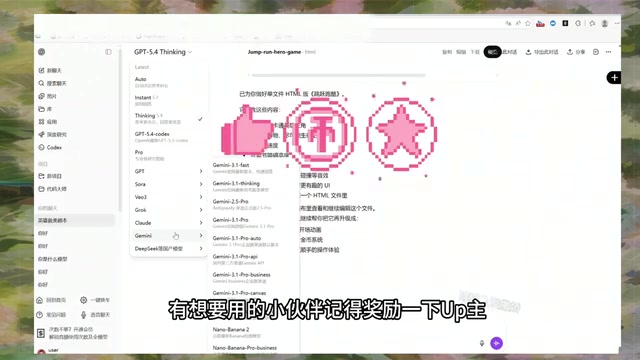
After selecting the Gemini entry point on the platform, users can jump directly to the Gemini official page and switch between different model versions, including the latest Pro series.
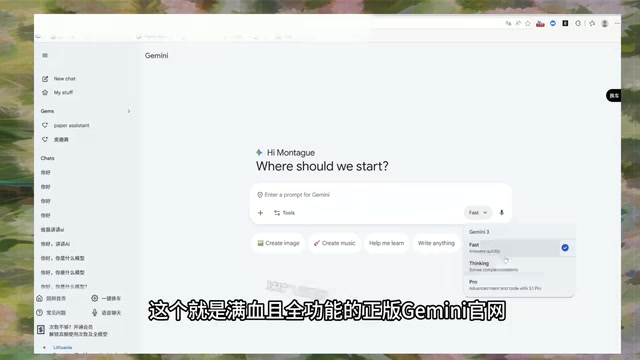
From the demonstration, users appear to get the full-featured official experience rather than a stripped-down or API-wrapper version.
GPT, Grok, and Other Model Sections
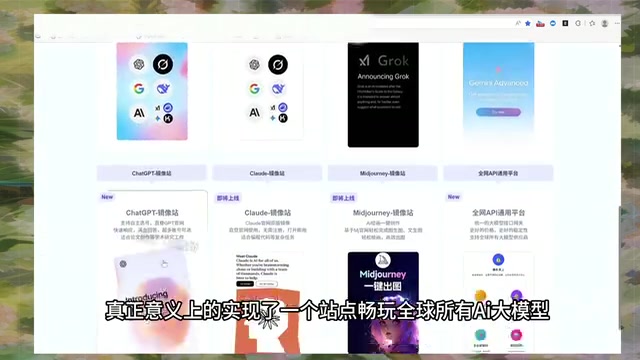
Besides Gemini, the platform's homepage features dedicated sections for GPT, Grok mirrors, and more. The creator also mentioned providing users with various bonus prompt instruction packs, covering optimized prompts for DeepSeek, Grok3, GPT-4, and other models.
Compliance and Security Risk Warnings
Platform's Official Statement
At the end of the video, a compliance statement was specifically included, emphasizing:
"All AI large language models used on this website are accessed and called through legal and compliant channels within China, strictly adhering to relevant national laws, regulations, and policy requirements. There is absolutely no use of VPNs or other irregular methods to access overseas services."
Risks Users Should Be Aware Of
Despite the platform's compliance statement, users should be mindful of the following when using such aggregation platforms:
-
Data security risks: When accessing AI models through third-party platforms, your input may be recorded by the intermediary platform. This risk is far more complex than it appears — if the platform uses the API forwarding model, all user inputs (prompts) and model outputs (responses) pass through the platform's servers, giving the platform full technical capability to record, store, and even analyze this data. Even if the platform promises not to log data, users have no way to verify this claim. A deeper risk is that some aggregation platforms may use shared API keys, meaning multiple users' conversations could exist under the same API account, creating the possibility of context leakage. Additionally, if the platform uses a reverse proxy approach, account credentials entered on the official interface could be intercepted by the middleman (i.e., a Man-in-the-Middle attack, MITM). Under China's Personal Information Protection Law and Data Security Law, users' conversation data constitutes personal information, and third-party platforms' collection and processing of such data requires clear legal basis and user authorization.
-
Service stability issues: The availability of aggregation platforms depends on their connection status with upstream services and could be interrupted at any time.
-
Questionable feature completeness: Although advertised as "full-featured versions," whether the actual experience is truly identical to the official version requires users' own verification.
-
Ambiguous compliance boundaries: Some overseas AI services themselves are not registered in China, and the specific "compliant channels" through which they are accessed deserve scrutiny.
Conclusion: How to Safely Use AI Aggregation Platforms
The emergence of these AI aggregation platforms reflects the strong demand among Chinese users for the world's top AI tools. For ordinary users, they genuinely lower the barrier to entry. However, from a security and long-term perspective, users are advised to:
- Never input sensitive personal information or trade secrets on such platforms
- Use official channels for important work
- Follow the development of domestic Chinese LLMs — models like DeepSeek and Kimi are already highly competitive
- Understand relevant laws and regulations, and use AI tools within compliant frameworks
It's worth noting that the competitiveness of domestic Chinese LLMs is rapidly increasing. After DeepSeek-R1 was released in early 2025, it generated enormous buzz in the global AI community with its performance rivaling GPT-4o on mathematical reasoning and programming tasks, combined with a fully open-source strategy. Its Mixture of Experts (MoE) architecture and innovative training methods brought training costs down to a fraction of comparable models. Beyond DeepSeek, China also has Baidu's ERNIE Bot, Alibaba's Tongyi Qianwen (Qwen series, also open-source with excellent performance), ByteDance's Doubao, iFlytek's Spark, and many other LLMs. The Qwen 2.5 series has performed impressively across multiple international benchmarks and has become one of the most popular Chinese LLMs in the global open-source community. These domestic models not only face no compliance barriers for use within China but often outperform overseas models in Chinese language understanding and localized scenario adaptation — in many use cases, users no longer need to rely on overseas services.
As China's AI ecosystem continues to mature, we can expect users to enjoy the conveniences of AI technology more easily and safely in the future.
Related articles

Cursor AI Programming in Practice: Build a Student Management System from Scratch in 30 Minutes
A Bilibili creator demonstrates Cursor AI programming: generating a student management system in 30 minutes with natural language. Details on Agent mode, Claude selection, prompt techniques, and thresholds.

Top 20 AI Coding Tools Ranking: From Rock-Solid to Lackluster, a Scored Matrix
Bilibili creator releases top 20 AI coding tools ranking, tiered T0–T4 from rock-solid to lackluster, with Claude Code and Codex tied at T0. This article details the scoring dimensions (capability, reliability, robustness, durability, cost, domestic availability) and tool performances to help developers choose the right AI coding assistant.

Vibe Coding Systematic Tutorial: Master AI-Assisted Programming from Zero
A three-month Vibe Coding tutorial from a Bilibili creator covering Codex, ClaudeCode, and Cursor, from core logic to commercial project practice for beginners.