Reviewing AI Agent Restart Requests During Training Jobs: A Practical Skyportal Guide

Before approving an AI agent's restart request, check checkpoint status and use the reject command with a clear reason.
This article uses the scenario of an AI agent proposing to restart a host that is actively running a training job, and walks through the proper human review workflow using the Skyportal CLI. The core process has three steps: use `skyportalai --json chat status` to view pending requests, assess the impact on running tasks and checkpoints, then reject inappropriate requests using the `reject` command with a `--reason` argument. A key boundary is emphasized: rejection only blocks actions not yet executed — it cannot stop or undo actions already approved. The overall approach embodies the human-in-the-loop design philosophy, where agents propose actions and humans gate the high-risk ones.
As automated operations become increasingly common, AI agents often proactively submit action requests — such as restarting a host. But when that host is running a training job that takes hours or even days to complete, a hasty approval can mean a significant waste of compute and time. Knowing how to properly review requests before approving them has become a critical skill when working with agent-based operations tools.
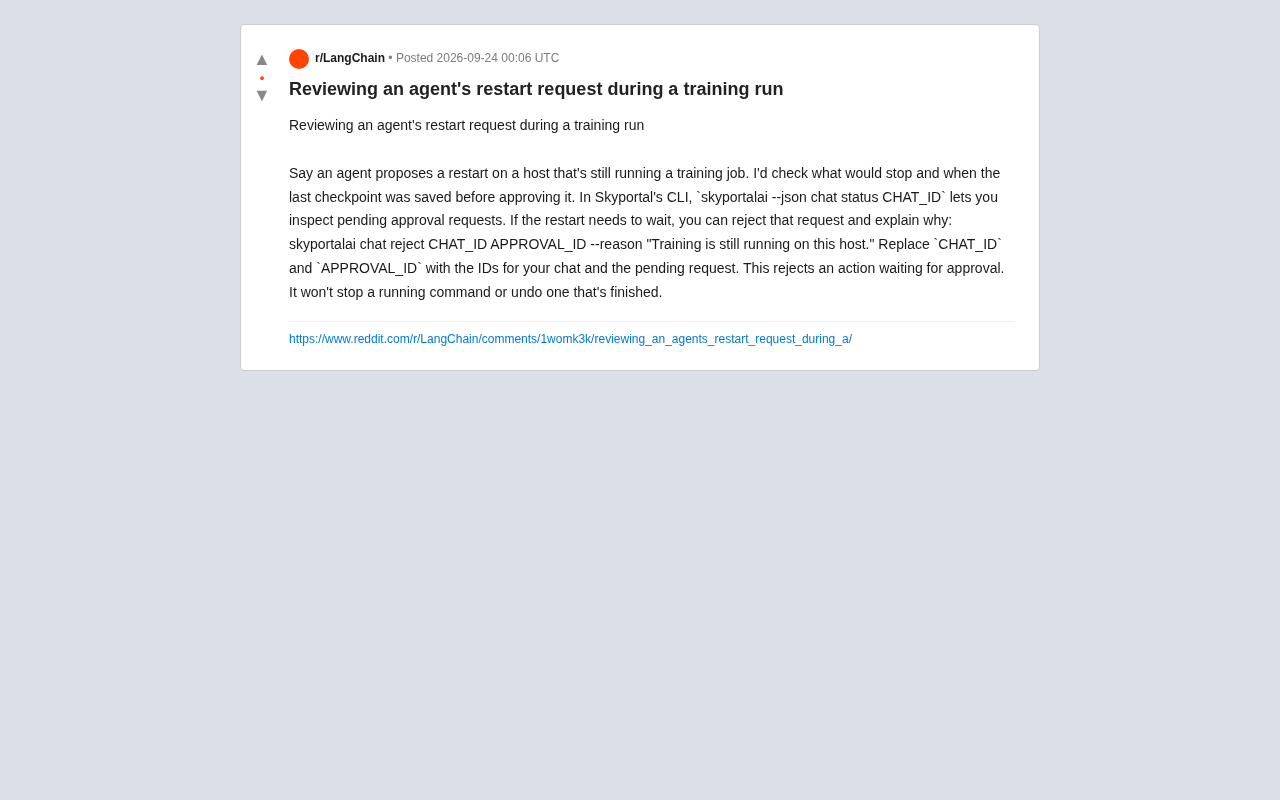
Scenario: An Agent Wants to Restart a Host That's Still Training
Consider this typical situation: an AI agent, as part of a maintenance workflow, proposes restarting a host — but that host is currently running a training job. Clicking "Approve" without a second thought is clearly unwise. The original author's guiding principle here is refreshingly practical: before approving, figure out two things:
- Which running tasks would this restart interrupt?
- When was the most recent checkpoint saved for those tasks?
These two questions directly determine the cost of the restart. If a checkpoint was just saved, the loss is manageable. If it's been a long time since the last save, a restart could wipe out hours of training progress. This mindset — "assess the impact first, then decide on the action" — is a discipline that's easy to overlook but critically important in human-AI collaborative operations.
A checkpoint is a fault-tolerance mechanism in deep learning training. The training framework periodically serializes the model weights, optimizer state, and current training step to disk. If training is interrupted, it can be resumed from the most recent checkpoint rather than starting from scratch. Frameworks like PyTorch and TensorFlow both support automatic checkpoint saving at configurable step or time intervals. The checkpoint save frequency is the core metric for assessing restart risk: if checkpoints are configured to save every hour and the job has been running for 50 minutes, a restart means losing nearly an hour of gradient updates. If a checkpoint was just completed, the cost of a restart is near zero. When deciding whether to approve a restart request, it's not enough to know whether checkpoints exist — you need to know how long ago the last one was saved, since that directly translates to unrecoverable compute loss.
Checking Pending Approval Requests with the Skyportal CLI
Skyportal provides a command-line tool for managing action requests submitted by agents. To view pending approval requests for a given session, use:
skyportalai --json chat status CHAT_ID
This command returns the pending approvals for the specified session (CHAT_ID) in JSON format. The --json flag produces structured output, making it easy to parse programmatically or to quickly locate key fields — such as the request type, target host, and the corresponding APPROVAL_ID.
In practice, this step gives you a "review window": the agent won't directly execute high-risk actions without confirmation, but instead hands the decision back to a human. This "requires human approval" design is fundamentally about striking a balance between automation efficiency and operational safety.
Rejecting a Request: How to Gracefully Say "No"
When you determine that a restart shouldn't proceed immediately, you can reject the request with an explicit reason:
skyportalai chat reject CHAT_ID APPROVAL_ID --reason "Training is still running on this host."
Replace CHAT_ID and APPROVAL_ID with the actual session and approval request IDs. The --reason parameter is worth highlighting: providing a reason doesn't just let the agent "know" why it was rejected — it also leaves a clear record for subsequent collaboration and auditing. In multi-turn human-agent interactions, an explicit rejection reason helps the agent adjust its future behavior and avoid repeatedly submitting similar requests that will be denied.
A Critical Boundary: Rejecting ≠ Stopping
The original post makes a point of clarifying something that's easy to misunderstand: rejecting a pending approval request only prevents that not-yet-executed action from being executed — it does not stop a command that is already running, and it cannot undo an action that has already completed.
In other words, the scope of reject is limited strictly to actions that are "queued and awaiting approval." It's a preventive gate, not an emergency stop button. If the target action has already been approved and is currently executing, or if it finished long ago, the reject command has no effect.
Understanding this boundary is essential. In operational practice, it means that review must happen before an action is approved — once that window is missed, you need other remediation measures (such as manually intervening to stop a process), not simply rejecting a request that is no longer in a "pending" state.
A Reflection on Human-AI Collaborative Operations
This seemingly mundane operational example actually reveals the core logic of current AI agent-based operations: the agent is responsible for proposing actions, while humans are responsible for gating high-risk ones. Tools like Skyportal combine automation efficiency with human judgment through a "pending approval queue + explicit rejection mechanism."
For teams managing training clusters, developing three habits — checking checkpoint status before approving, writing clear reasons when rejecting, and understanding the scope of the reject operation — can significantly reduce compute waste caused by operational errors. As more and more operational actions are initiated by agents, this kind of human-in-the-loop review discipline will become increasingly valuable.
Human-in-the-Loop (HITL) is a system design paradigm in which human review is mandated at critical decision points in an automated workflow, rather than allowing the system to operate fully autonomously. The concept originates from cybernetics and safety-critical systems design, and has seen renewed attention in the AI field — especially as AI agents are granted the ability to execute real-world actions. The core trade-off in HITL is this: full automation maximizes throughput, but introducing human checkpoints on high-risk, low-reversibility operations significantly reduces the probability of catastrophic errors. The pending approval queue is a concrete implementation of this paradigm: the agent continuously analyzes and proposes actions, while human reviewers only need to intervene "before an action executes" — without having to monitor every step of the agent's reasoning process. In environments of ever-increasing operational complexity, this division of responsibility provides a scalable safety net.
Related articles

GPT-Next Leak, Gemini 4 Argon Imminent: AI News Roundup
GPT-Next leak suggests extreme efficiency; OpenAI's 28-day shipping pledge boosts speed 50%; Gemini 4 Argon nears release; Anthropic subscription value report sparks debate.

GPT-Next Leaked, Gemini 4 Argon Speeds Up, Fable 5.5 May Launch Today
OpenAI's GPT-Next model leaks, expected to be extremely low-cost and possibly part of the 28-day release plan; Gemini 4 Argon internal testing accelerates, NanoBanana 2.1 is live; Semi Analysis tests show Claude Max's equivalent API value is about 5 times that of ChatGPT Pro; Fable 5.5 may launch today.

Gemini 4 Argon Launches Globally: Key Highlights from the AI Daily Brief
Google opens Gemini 4 Argon globally across Pro and Ultra subscriptions and the API, and demonstrates robot control. This article rounds up open-source models, Agent infrastructure, cost transparency, and safety governance updates.