Reviving Vintage Tape Drives with Claude: AI-Assisted Reverse Engineering in Practice

Using Claude to emulate a vintage QIC-117 tape drive reveals AI's real limits in hardware reverse engineering.
A developer used Anthropic's Claude to emulate a QIC-117 tape drive — a legacy backup device from the 1980s-90s that communicates via floppy disk controller interfaces. This niche retrocomputing project reveals how LLMs can accelerate documentation synthesis and scaffold emulator code, while exposing critical hallucination risks in low-resource, timing-sensitive hardware domains where human verification remains essential.
When AI Meets Retrocomputing
In software development, we're accustomed to using large language models to write modern web applications, debug Python scripts, or generate frontend components. But a more niche and challenging use case is quietly emerging — using AI to assist with reverse engineering in retrocomputing. A recent technical write-up on Hacker News, titled "Claude × retrocomputing: emulating a QIC-117 tape drive," is a prime example of this trend. The author attempted to use Anthropic's Claude model to emulate a QIC-117 tape drive from decades past.
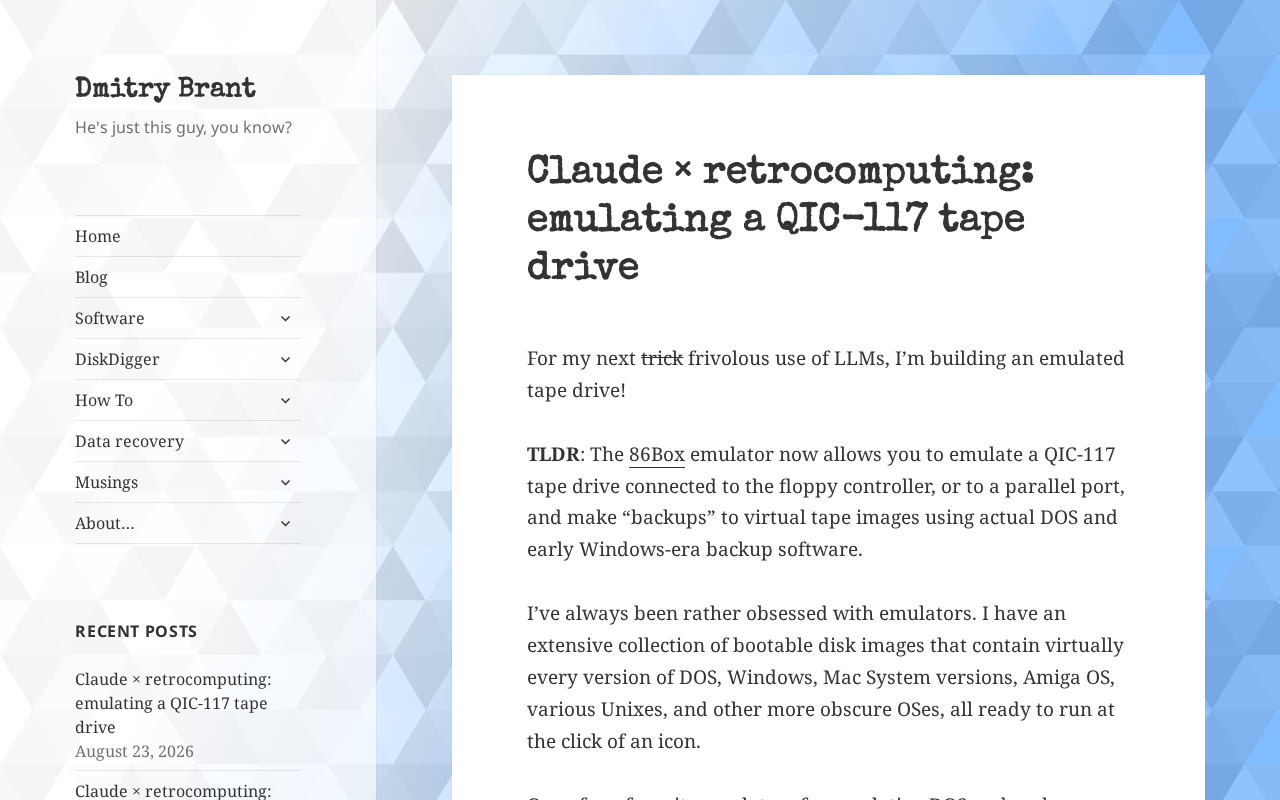
At first glance, this project seems incredibly niche, yet it reveals the true capability boundaries of AI coding assistants in a rarely explored domain: when faced with poorly documented, timing-dependent legacy hardware protocols with virtually no existing training data, how much can a large language model actually help?
What Is a QIC-117 Tape Drive?
To appreciate the difficulty of this project, you first need to understand what QIC-117 is. QIC (Quarter-Inch Cartridge) was a widely used backup storage standard from the 1980s through the 1990s. QIC-117 specifically defines the communication protocol between tape drives and host computers via the floppy disk controller (FDC) interface.
The QIC standard was originally proposed by 3M (now Imation) in 1972 and was subsequently maintained and evolved by the QIC Standards Committee. During the 1980s and 1990s, as personal computers became widespread, QIC tapes were one of the most popular backup media for small businesses and individual users, alongside Exabyte 8mm tapes and DLT (Digital Linear Tape) as the three major tape backup camps. The QIC standard spawned dozens of sub-specifications, from QIC-40 (40MB capacity) to QIC-3095 (25GB capacity), covering everything from capacity and physical dimensions to interface protocols. QIC-117 specifically defined how tape drives could piggyback on the motherboard's existing floppy disk controller interface to communicate with the host — an elegant design that dramatically reduced hardware costs. Users didn't need to buy expensive SCSI adapter cards; they simply connected the tape drive to the existing floppy cable. However, this "borrowed pathway" design also introduced enormous protocol-level complexity.
Why QIC-117 Is So Hard to Emulate
There are several core reasons why this type of device is so difficult to tackle:
-
Dependence on floppy disk controller (FDC) timing: QIC-117 tape drives typically connect through the standard floppy drive interface, meaning that emulating one requires precisely reproducing signal timing at the FDC level — not just a simple byte-stream protocol. The FDC chip (the most classic being the Intel 82077AA and its compatible counterpart, the NEC µPD765) was originally designed to drive floppy disk drives, translating the host CPU's read/write requests into precise head positioning, read/write pulses, and data encoding signals. The FDC operates at a very low-level hardware timing layer: it must manage stepper motor pulse intervals (typically on the order of milliseconds), head load/unload delays, data transfer rates (ranging from 250Kbps to 1Mbps), and MFM/FM encoding schemes. The QIC-117 protocol reuses the FDC's command set and DMA channels but redefines the original command semantics — for example, using the floppy "seek" command to encode tape drive control instructions. This means that emulating a QIC-117 device requires not only understanding the tape protocol itself but also precisely simulating the FDC chip's register behavior, interrupt timing, and DMA transfer flow. Any minor timing deviation can cause communication failure.
-
Scarce and outdated documentation: The original specifications for these standards were mostly paper documents or long-lost scanned copies. The information available online is fragmented and often contradictory.
-
Extremely sparse training data: Modern large models derive their knowledge primarily from publicly available code and documentation on the internet, and obscure legacy protocols like QIC-117 are virtually a blind spot in their training sets.
It's precisely this combination of "low resources, deep hardware dependencies, and weak documentation" that makes this an excellent litmus test for the real capabilities of AI-assisted programming.
What Role Does Claude Play in Reverse Engineering?
In projects like this, Claude doesn't replace the developer — it serves as a knowledgeable but supervised collaborator. Its value manifests in several key areas.
Accelerating Knowledge Assembly and Document Integration
When facing information scattered across multiple outdated documents, large language models excel at rapid synthesis and integration. Developers can feed Claude specification fragments, register definitions, and timing diagram descriptions they've gathered, letting it help organize the overall logical framework of the protocol. This dramatically reduces the time cost of "reading documentation."
Generating Emulator Scaffolding Code
Emulators typically involve large amounts of boilerplate code for state machines, register read/write operations, and command parsing. A hardware emulator is a program that fully reproduces the behavior of a hardware device in software. Unlike virtualization, an emulator doesn't rely on equivalent functionality in the host hardware; instead, it replicates the target device's internal state from the level of logic gates and registers upward. Classic emulator architectures typically include a CPU instruction interpreter (for full-system emulation), a memory management unit, I/O port mapping, and clock/timer subsystems. In the QIC-117 emulation scenario, the key challenge lies in the precise implementation of state machines — the switching logic between the tape drive's various operating modes (idle, seeking, reading, writing, erasing, rewinding, etc.) is extremely complex, and many state transitions depend on strict timing constraints. Well-known open-source emulator projects like QEMU, MAME, and DOSBox have all faced similar challenges; the MAME project alone has emulated over 7,000 different hardware systems.
Claude can quickly generate an initial code skeleton based on protocol descriptions, allowing developers to focus their energy on the truly tricky aspects of timing alignment and edge cases.
The Limitations and Hallucination Traps of AI Assistance
However, in these low-resource scenarios, AI's weaknesses are also fully exposed. Due to the lack of reliable training data, the model is prone to confidently fabricating (hallucinating) critical timing details — generating plausible-looking but incorrect register addresses or delay parameters.
Hallucination is one of the core challenges facing all current large language models. From a technical standpoint, the generation mechanism of LLMs is fundamentally based on probabilistic next-token prediction; the model has no built-in fact-checking mechanism. When the model encounters domains insufficiently covered in its training data, it tends to generate plausible-sounding content based on surface patterns rather than acknowledging the limits of its knowledge. Across multiple benchmarks, even the most advanced models can exhibit hallucination rates of 15%-30% in specialized technical domains. For an obscure protocol like QIC-117, the situation is even more severe: the model might misattribute details from other similar but different tape standards (such as QIC-80 or QIC-3010), or "infer" register bit definitions that don't actually exist based on general FDC knowledge. In hardware emulation scenarios, a single incorrect bitmask or a delay parameter off by a few microseconds can cause the entire protocol stack to collapse — the consequences are simply not comparable to a CSS styling discrepancy in web development.
Therefore, human engineers' verification of every low-level detail remains irreplaceable.
Industry Insights from This Niche Project
Although this write-up didn't generate massive buzz on Hacker News (9 upvotes, 5 comments), the industry trends it reflects are worth paying attention to.
AI Is Penetrating "Long-Tail" Technical Domains
In the past, when we discussed AI-powered programming, the focus was almost always on mainstream languages and popular frameworks. But retrocomputing, embedded reverse engineering, and legacy protocol restoration — these "long-tail" scenarios — are precisely the domains that most test a developer's patience and experience.
The term "long tail" in the technical world borrows from Chris Anderson's "Long Tail" theory proposed in 2004. In the technology landscape, while mainstream frameworks and languages capture the lion's share of attention and resources, thousands of niche protocols, legacy systems, and specialized hardware form an extremely long "tail" that remains critically important in specific industries and scenarios. For example, a vast number of core banking systems worldwide still run on COBOL; legacy flight control systems in the aerospace industry rely on Ada; and industrial control is rife with communication protocols designed decades ago, such as Modbus and PROFIBUS.
The involvement of AI tools gives individual hobbyists and small teams the opportunity to tackle these historical technical challenges with a lower barrier to entry. Solving long-tail problems used to require expensive expert consultants or months of documentation archaeology. Now, an independent developer armed with a general-purpose AI assistant like Claude or GPT-4 can rapidly build a foundational understanding even in unfamiliar domains, compressing what might have been weeks of preliminary research into days or even hours — making the preservation and restoration of digital heritage more feasible than ever.
Retrocomputing is not purely a nostalgic hobby; it's an important component of Digital Preservation, a serious academic and cultural endeavor. Globally, organizations like the Internet Archive and the Computer History Museum are systematically rescuing and preserving disappearing digital heritage. The challenges facing tape media are particularly urgent — the adhesive in magnetic coatings degrades over time (known as "sticky-shed syndrome"), and vast amounts of data stored on QIC tapes may become permanently unreadable within the next 10-20 years. Therefore, the ability to emulate a QIC-117 drive has not only technical research value but also direct practical significance for rescuing data from aging tape media.
The Right Approach to Human-AI Collaboration
This case once again confirms the core paradigm of AI-assisted development today: the model handles breadth; the human handles depth. Claude can deliver knowledge synthesis spanning dozens of documents in seconds, but whether a thirty-year-old tape drive ultimately "spins" correctly in an emulated environment still depends on the developer's understanding of hardware fundamentals and rigorous verification.
Practical Advice for Using AI to Tackle Niche Technologies
For developers looking to use AI assistants in niche technical domains, this project offers several practical tips:
- Proactively feed it information: Don't expect the model to "know" obscure protocols. Compile and provide all the raw materials you have on hand. Modern large models support increasingly large context windows (Claude supports up to 200K tokens), which is enough to accommodate an entire technical specification. Making full use of this capability can significantly reduce hallucinations.
- Verify in layers: For low-level outputs involving timing, addresses, and delays, cross-check each one individually — never accept them wholesale. Use real signal data captured by logic analyzers as a reference baseline to compare against model-generated parameters.
- Iterate collaboratively: Break big problems into small steps, let AI handle the boilerplate logic, and keep human hands on the critical decisions. This workflow aligns closely with the philosophy of Test-Driven Development (TDD) — define expected behavior first, have AI generate the implementation, then verify correctness through testing.
Conclusion
From a project as specific and niche as emulating a QIC-117 tape drive, we glimpse another facet of large language model capabilities: they are neither omnipotent magic nor entirely useless. In low-resource, highly specialized domains, AI is an assistant that can significantly boost efficiency, but the steering wheel remains firmly in human engineers' hands. As more and more hobbyists begin using tools like Claude to revive dusty old hardware, the boundaries of AI-assisted programming are being quietly expanded by these seemingly unassuming experiments.
Related articles

Free Unlimited Claude Code Solution: Agnes AI + CC Switch Setup Guide
No paid subscription needed — pair the free AI platform Agnes AI with the open-source tool CC Switch to provide a backend for Claude Code, enabling unlimited free calls to text, image, and video models. This guide covers the full setup, test results, and usage boundaries.

A Complete Zero-Cost Guide to Getting Started with Claude Code for Beginners in China
A beginner's guide to Claude Code for users in China: two installation methods (command line and IDE plugin), full configuration steps for replacing the official API with the free domestic LongCat model, and a hands-on demo of building a small tool with natural language, plus tips.

When the NSA Gets Involved: The AI Supply Chain Crisis Behind Open-Source CVEs and API Key Hijacking
Multiple open-source projects disclosed severe CVEs in one day, PHP flaws alarmed the FBI, and Railway and OpenCode were breached with API keys stolen. This article breaks down the vulnerability window, AI-accelerated exploitation, and the AI supply chain crisis behind the API key black market, with a developer defense checklist.