RIA: Let AI Agents Automatically Reverse Engineer Any Application

Open-source MCP Server RIA lets AI Agents reverse engineer native binaries, Electron, .NET, and Unity apps without source code.
RIA is an open-source project with over 347,000 stars on GitHub. Its core form is an MCP Server that can be integrated into AI coding tools like Claude Code, Codex, and Cursor with a single command, giving Agents reverse-engineering capabilities. Coverage includes native binaries (driving Hopper, Ghidra, or IDA to extract pseudocode, assembly, strings, and symbols), Electron apps, .NET assemblies, Go/Rust binaries, and Unity metadata. RIA emphasizes two key designs: all processing is done locally with no binaries uploaded to third parties; and every conclusion comes with traceable evidence to suppress AI hallucination. The article argues it lowers the barrier to reverse engineering, suitable for preliminary reconnaissance like competitor research and investigating closed-source dependencies, but complex obfuscated or packed samples still require professional reverse engineers, and native binary analysis quality depends on the local disassembler and the Agent's reasoning capabilities.
RIA: Let AI Agents Automatically Reverse Engineer Any Application
AI Agent capabilities are extending down to the binary level. An open-source project called RIA has already gathered over 347,000 stars on GitHub, enabling AI Agents to directly reverse engineer native binaries, Electron apps, .NET assemblies, and even Unity metadata — all without source code.
What RIA Is: An MCP Server That Unlocks Reverse Engineering
RIA's core positioning is an MCP (Model Context Protocol) server that integrates with mainstream AI coding tools like Claude Code, Codex, and Cursor, and can be configured with a single command.
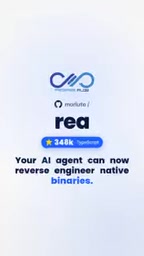
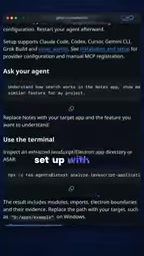
This means that if you're using any of the above AI coding assistants, simply adding RIA as an MCP service gives the Agent reverse-engineering capabilities. See a feature you like in an app? Just have the Agent investigate it — no source code required.
MCP, as a protocol layer connecting AI models with external tools, has rapidly gained traction in the developer community in recent years. RIA's choice to enter as an MCP Server offers the advantage of plug-and-play — users don't need to switch workflows and can invoke reverse-engineering capabilities right from their familiar editor.
MCP (Model Context Protocol) is an open protocol proposed by Anthropic in late 2024 to establish a standardized bidirectional connection between AI models (especially LLMs that support tool calling) and external data sources and tools. Its basic model is: an AI application acts as an MCP Client, communicating via the protocol with one or more MCP Servers, which expose structured tool lists, resources, and prompt templates to the Client. Compared to the past where each AI tool implemented its own plugin interface, MCP's value lies in decoupling — the same Server can be reused by different clients like Claude Code, Cursor, and Codex, so developers only need to maintain a single tool implementation. RIA leverages this characteristic by packaging reverse-engineering capabilities as a standard MCP Server, making it plug-and-play across editors.
Hopper, Ghidra, and IDA are three mainstream disassembly/decompilation tools in the reverse-engineering field. IDA (Interactive Disassembler) is commercial software known for its powerful interactive analysis and plugin ecosystem; Ghidra, open-sourced by the NSA, provides a decompiler and extensible scripting framework; Hopper is a commercial disassembler for macOS/Linux with a lightweight interface and quick onboarding. All three can convert machine code back into assembly instructions, and some support generating C-like pseudocode. RIA itself doesn't implement a disassembly engine but acts as an orchestration layer calling these local tools, so its analysis capabilities are closely tied to the versions of tools the user has installed.
Reverse-Engineering Coverage: From Native Binaries to Unity Metadata
RIA's reverse-engineering scope is quite broad, essentially covering the mainstream forms of application distribution today.
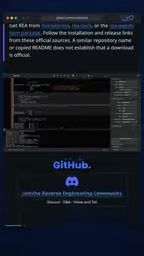
For native binaries, RIA drives the industry-standard reverse-engineering tools Hopper, Ghidra, or IDA to extract pseudocode, assembly instructions, strings, and symbol information. Note that native binary analysis depends on the user having one of these tools installed locally; RIA itself does not bundle these disassemblers.
Beyond native binaries, RIA can handle:
- Electron apps: Unpack and analyze frontend resources and Node-layer logic
- .NET assemblies: Parse IL and related metadata
- Go and Rust binaries: Analyze compiled artifacts from these two languages
- Unity metadata: Reconstruct resource and structural information of games or apps
This multi-format coverage means RIA isn't limited to a single tech stack but can handle reverse-engineering needs for most desktop applications.
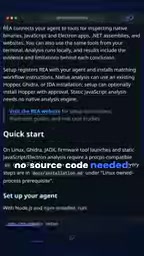
Electron apps are essentially desktop programs that bundle Chromium and the Node.js runtime, with business code typically distributed as asar archives (a tar-like packaging format) or compressed JavaScript bundles. "Unpacking" means extracting frontend HTML/CSS/JS resources from the asar, along with the main-process Node module code, and handing them to the Agent for reading and analysis. Since Electron apps often don't apply heavy obfuscation, this type of analysis is usually much easier than native binary analysis.
.NET assemblies compile to Intermediate Language (IL) rather than native machine code, accompanied by rich metadata tables recording types, methods, fields, references, and more. IL is closer to high-level languages than assembly, and with tools like dnSpy and ILSpy, it's relatively easy to reconstruct near-C# code, so the reverse-engineering barrier for .NET apps is comparatively low.
Unity games or apps typically store metadata in global-metadata.dat and assembly DLLs; the former records symbol information such as class names, method names, and string literals. By parsing this metadata, you can reconstruct the resource structure and script logic outlines without running the program — this is the technical basis for RIA's ability to handle Unity targets.
Local Execution and Evidence Chains: Key Design for Trustworthiness
RIA specifically emphasizes two points: all processing is done locally, and every conclusion comes with evidence.
Local execution means binary files are never uploaded to third-party servers, which is especially important when handling commercial software or sensitive samples. The design of "every conclusion backed by evidence" addresses the pain point of AI analysis being prone to hallucination — the Agent's reverse-engineering judgments need to be traceable to specific pseudocode, strings, or symbols, rather than pure speculation.
From an engineering perspective, these two design choices bring RIA closer to a practical analysis aid rather than a toy demo project.
When analyzing code or binaries, large language models are prone to generating plausible-sounding but nonexistent function names, addresses, or call relationships — a phenomenon known as "hallucination." In reverse-engineering scenarios, the cost of hallucination is especially high — a wrong address or fabricated symbol can lead to completely incorrect conclusions. Requiring evidence for every judgment (citing specific pseudocode snippets, strings, or symbol table entries) essentially introduces "verifiability" at the prompt and output-format level: analysts can check each of the Agent's citations against the disassembly output to filter out unreliable speculation. This is consistent with the "cite sources" approach in retrieval-augmented generation (RAG), except here the "knowledge base" is replaced by the real-time output of local disassembly tools.
Practical Implications for Developers
RIA opens up an imaginative workflow: when researching competitor implementations, investigating the behavior of closed-source dependencies, or studying an app's architecture, you can have an AI Agent handle preliminary reverse-engineering reconnaissance, then manually verify key conclusions.
However, limitations should be noted — the quality of native binary analysis depends heavily on the disassembler being driven and the Agent's own reasoning capabilities, and complex obfuscated or packed samples still require professional reverse engineers. RIA is more about lowering the barrier to reverse engineering by a notch rather than replacing professional toolchains.
If you're already using tools like Claude Code or Cursor, you can search for RIA on GitHub and try it out yourself — the setup cost is just one command.
One-line Summary
Open-source MCP Server RIA lets AI Agents reverse engineer native binaries, Electron, .NET, and Unity apps without source code.
Paragraph Summary
RIA is an open-source project with over 347,000 stars on GitHub. Its core form is an MCP Server that can be integrated into AI coding tools like Claude Code, Codex, and Cursor with a single command, giving Agents reverse-engineering capabilities. Its coverage includes native binaries (driving Hopper, Ghidra, or IDA to extract pseudocode, assembly, strings, and symbols), Electron apps, .NET assemblies, Go/Rust binaries, and Unity metadata. RIA emphasizes two key designs: all processing is done locally with no binaries uploaded to third parties; and every conclusion comes with traceable evidence to suppress AI hallucination. The article argues that it lowers the barrier to reverse engineering, making it suitable for preliminary reconnaissance scenarios like competitor research and investigating closed-source dependencies, but complex obfuscated or packed samples still require professional reverse engineers, and native binary analysis quality depends on the local disassembler and the Agent's reasoning capabilities.
Related articles

Codex for Absolute Beginners: Connect to Domestic LLMs + Four Hands-On Case Studies
A Codex beginner tutorial: three steps to install and connect to the DeepSeek domestic LLM, with CC Switch for provider switching, plus essential plugins, skills, and four hands-on cases.

Claude Detects Early Signs of Sepsis, Reddit User Says AI Saved Their Life
A Reddit user shared symptoms of sudden difficulty urinating and confusion late at night; Claude identified possible sepsis and urged immediate medical care, which doctors confirmed could have been fatal if delayed. Exploring AI's potential and limits in health early warning.

The Goose Programming Language: John Carmack and the Great Abstraction Debate
Starting from the Hacker News post "The Goose Programming Language," we explore the programming language design philosophy sparked by John Carmack and the trade-offs between performance and abstraction.