Ring Drone Confirmed to Have No Manual Controls, CBS Live Crash Exposes AI Shortcomings

After a live crash, Ring's drone still insists on pure AI control with no manual option, raising doubts about reliability in home security scenarios.
Ring's security camera drone crashed during a CBS News live demo, after which Ring confirmed the product offers no manual control and relies entirely on the AI Pilot system to execute preset routes and autonomously avoid obstacles. The article analyzes that this design may lower the barrier to use and position the product as an inspection camera rather than an aerial photography drone, but it puts all safety responsibility on the algorithm. The home environment is highly unstructured, and changes like moving furniture and floor clutter pose severe challenges to AI obstacle avoidance. Mainstream consumer drones generally retain manual mode as safety redundancy; Ring's opposite approach is radical, and the live crash exposes the risks of pure AI flight, potentially affecting user trust.
A Crash Demo Brings Ring Drone's Design Philosophy to the Surface
According to an RSS source, Ring's security camera drone (Ring Drone Cam) crashed during a live demonstration on CBS News. Ring subsequently confirmed that the product will not offer manual control options and relies entirely on an autonomous flight system called "AI Pilot" to execute preset routes and autonomously avoid obstacles.
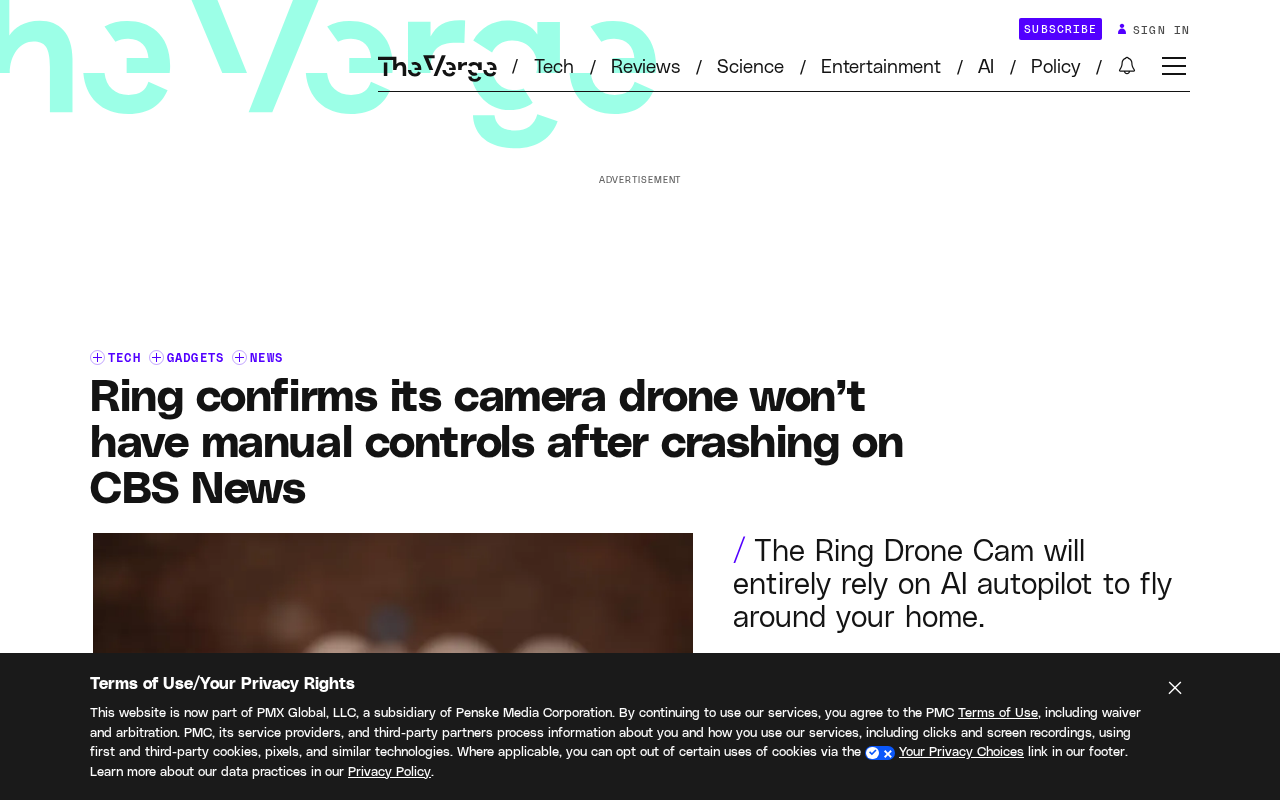
This accident happened in full public view—an embarrassing moment for any hardware product. But what's more noteworthy is Ring's stance after the crash: instead of adding a manual fallback due to the failed demo, the company stuck to its pure-AI operation product logic. This reveals a trade-off—Ring would rather let users be "passengers" than let them hold the remote.
AI Pilot: Technical Confidence or Risk Shifting?
According to the original report, the Ring Drone Cam's flight is fully taken over by the AI Pilot system, and users cannot intervene. This means that when the drone flies indoors, obstacle avoidance, route planning, and emergency handling are all left to algorithmic decisions.
The crash in the CBS demo shows that this system still has blind spots in real-world scenarios. Typically, consumer drone manufacturers offer manual mode as a safety net, letting users take over when the automatic system fails. Ring goes the opposite way, possibly for two reasons: first, to lower the barrier to use so that users without flight experience can operate it; second, because the product is positioned as a "security camera" rather than an "aerial photography drone," users only need inspection footage along fixed routes, not free flight.
But this design also puts all safety responsibility on the AI. Once the system makes a misjudgment in a complex home environment, users have neither the ability nor the permission to correct it.
Autonomous obstacle avoidance and path planning are two core technologies of autonomous drone flight. Obstacle avoidance relies on onboard sensors (such as vision cameras, ToF, ultrasonic, or LiDAR) to perceive obstacles in real time and calculate avoidance trajectories; path planning is divided into global planning (generating an approximate flight route based on a map before takeoff) and local planning (dynamically adjusting based on real-time perception during flight). Consumer products usually adopt a vision + IMU fusion solution, which is low-cost but sensitive to lighting, texture, and transparent/reflective objects—precisely why it tends to fail in indoor environments.
Manual mode as safety redundancy has a long tradition in aviation. Consumer drones generally retain manual or semi-automatic takeover because automatic systems suffer from "long-tail failures"—they perform well in the vast majority of scenarios but may completely falter in rare extreme situations. Letting humans take over at critical moments is essentially using human common-sense judgment to compensate for the algorithm's out-of-distribution blind spots.
How Much Fault Tolerance Does Home Security Require?
Ring's product context is home security. When the drone flies inside a home, it is surrounded by furniture, pets, and fragile items. Preset routes sound controllable, but the home environment is precisely the most unstructured space—today there's an extra toy on the floor, tomorrow the sofa has been moved. Can the AI respond correctly every time?
The CBS crash did not disclose the specific cause, but it at least shows that AI Pilot failed to work reliably in a demo environment. For a flying camera intended to enter users' homes, this uncertainty directly affects product credibility.
Unstructured environments refer to spaces lacking fixed rules, layouts, and frequently changing object positions—the home is a typical example. Unlike structured environments such as factories and warehouses, moving furniture, floor clutter, pets walking around, and lighting changes in a home quickly render pre-built maps outdated. This places high demands on drones that rely on SLAM (Simultaneous Localization and Mapping) and visual recognition: the system must not only recognize "there is something there" but also determine "what it is, whether it will move, and whether it can be avoided."
Fault tolerance in this context refers to the margin a system allows for errors without causing serious consequences. In home scenarios, a single misjudgment could shatter a vase, injure a pet, or frighten a child, so the recall rate for obstacle avoidance (not missing obstacles) must be far higher than in aerial photography scenarios. In aerial photography, hitting a tree costs at most one device, but the failure of an indoor flying camera directly affects personal and property safety—which is precisely why the "no manual fallback" design is most questioned.
Industry Perspective: Autonomous Flight Is the Trend, but "No Manual" Is a Radical Choice
The drone industry as a whole is evolving toward autonomy, with obstacle avoidance and path planning capabilities improving year by year. But mainstream manufacturers generally retain manual mode in consumer products, both as safety redundancy and as a feature selling point for advanced users.
Ring's choice to completely remove manual control is a radical experiment in the security camera subcategory. If the AI is reliable enough, users get a "zero-operation" experience; if not, users have no chance to remedy the situation. The crash in the CBS live broadcast happened to show the latter to everyone.
The product's market launch timing is already clear, but public feedback after the demo accident may affect users' acceptance of "pure AI flight." What Ring needs to prove is not just that AI can fly, but that AI is more reliable than humans on every flight—and that bar is not low.
Safety redundancy is a core principle of engineering system design: when the primary system fails, a backup system can take over to avoid catastrophic consequences. The multiple redundancies in aviation (multiple hydraulic systems, multiple engines, multiple pilots) are the exemplar of this principle. Consumer electronics, constrained by cost, often implement only partial redundancy, such as manual takeover for drones and physical collision buffers for robot vacuums. Ring's removal of manual control is equivalent to eliminating the last line of redundancy with a human in the loop, betting system reliability entirely on a single AI point.
At the regulatory level, airworthiness requirements for consumer drones in various countries usually assume that operators have some intervention capability. If purely autonomous flight enters indoor home spaces, it may also involve new issues of privacy and liability determination: when AI decisions cause damage or injury, whether responsibility lies with the manufacturer, the algorithm, or the user is not clearly defined in existing legal frameworks.
One-line Summary
After a live crash, Ring's drone still insists on pure AI control with no manual option, raising questions about reliability in home security scenarios.
Paragraph Summary
Ring's security camera drone crashed during a CBS News live demo, after which Ring confirmed the product offers no manual control and relies entirely on the AI Pilot system to execute preset routes and autonomously avoid obstacles. The article analyzes that this design may be intended to lower the barrier to use and position the product as an inspection camera rather than an aerial photography drone, but it also puts all safety responsibility on the algorithm. The home environment is highly unstructured, and changes such as moving furniture and floor clutter pose severe challenges to AI obstacle avoidance. Mainstream consumer drones generally retain manual mode as safety redundancy; Ring's opposite approach is a radical choice, and the live crash happens to expose the risks of pure AI flight, which may affect users' trust in the product.
Related articles

GPT-6.2 Astra vs. Sol Controversy: Behind the Polarized Reviews
OpenAI's Astra and Sol 6.2 face review controversy: early testers panned them, then OpenAI said the version had been updated. A hands-on look at computer use, video editing strengths, communication weaknesses, and the shifting cost and subscription quota landscape.
Anthropic IPO and GPT-6.2 Astra: Data Dependencies and Safety Concerns Behind the Model Competition
In-depth analysis of Anthropic's IPO and GPT-6.2 Astra: model performance depends on training data, not universal intelligence; chain-of-thought monitoring is failing as a safety pillar.
Atlassian Teamwork Graph: Giving AI Agents Better Context
Atlassian leverages Jira's contextual advantage to build Teamwork Graph, connecting people, projects, documents, and code so AI agents deliver better output with fewer tokens.