Rivian Spinoff Mind Robotics Hires Former Ford EV Chief Doug Field
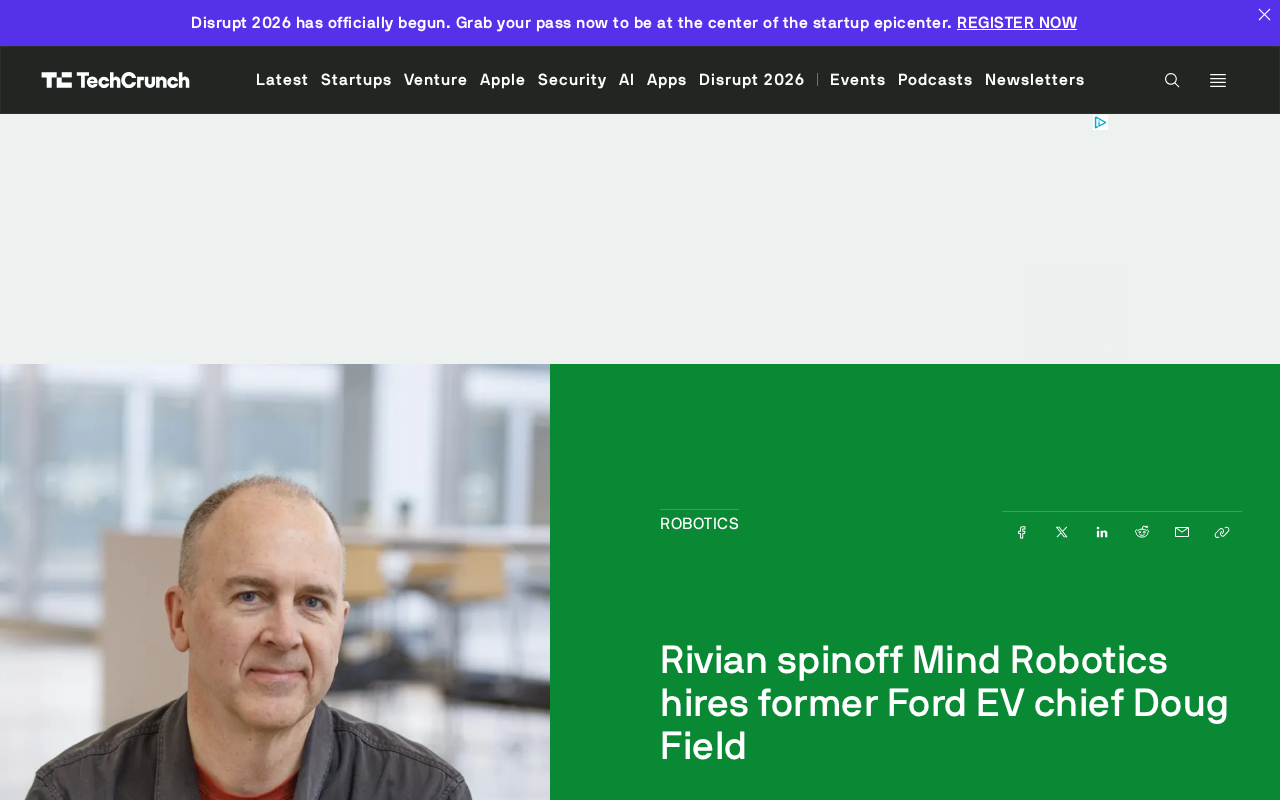
Rivian spinoff Mind Robotics hires former Ford EV chief Doug Field, reflecting auto talent's migration to robotics.
Mind Robotics, spun off from Rivian, has hired former Ford EV business chief Doug Field, who previously led Apple's Project Titan and oversaw Model 3 development at Tesla. The move highlights how the auto industry's expertise in autonomous driving, sensor fusion, and mass manufacturing overlaps with robotics, and suggests veterans are reassessing the robotics track's growth potential.
An Unusual Talent Move
According to RSS sources, Mind Robotics, the robotics company spun off from Rivian, has hired former Ford EV business chief Doug Field. The personnel move quickly drew industry attention—not only because Field's résumé spans three iconic companies in Tesla, Apple, and Ford, but also because of his chosen destination: a robotics startup spun off from an EV company.
Field's career trajectory is itself a condensed history of the intelligent mobility industry's evolution: he led Apple's secretive car project (Project Titan), spearheaded Model 3 development and production ramp at Tesla, and later joined Ford as head of its EV business. Now, moving from a traditional automaker executive role to the robotics track, his cross-industry choice carries signals worth examining closely.
What Doug Field's Résumé Means
Tesla Model 3: A Veteran of Production Hell
Field's most central contribution during his time at Tesla was overseeing the development of the Model 3. The significance of the Model 3 to Tesla needs no elaboration—it was the key product that took Tesla from a high-end niche player to the mass market, and its production process was dubbed "production hell" by Musk. The engineering management and supply chain coordination experience Field accumulated during this process holds direct value for any company trying to scale a hardware product.
"Production hell" was a phrase Musk repeatedly used between 2017 and 2018, referring specifically to the extreme difficulties Tesla faced during the Model 3 production ramp. At the time, Tesla had planned to produce 5,000 Model 3s per week, but actual output lingered at the hundreds for an extended period. The bottleneck centered on excessive automation of the battery module assembly line—Tesla had attempted to use robots for nearly every process, which instead caused frequent line stoppages. Musk later publicly admitted that over-automation was a mistake. In the end, Tesla barely hit its targets by mid-2018 by setting up a temporary tent production line and substantially introducing manual workstations. This experience not only drained a significant amount of Tesla's cash flow but also forced the entire industry to reconsider the "automation-first" manufacturing philosophy. As the engineering lead at the time, Field accumulated hands-on experience in production emergency management under precisely this kind of high-pressure environment.
Apple's Car Project: Forged in a Culture of Secrecy
After leaving Tesla, Field joined Apple's Project Titan. Although Apple's car plans ultimately never materialized into a production vehicle, the experience gave Field deep exposure to Apple's engineering methodology in systems integration and hardware-software synergy. For a robotics company, this ability to integrate complex hardware with precision software is precisely the dividing line between a product that can move from prototype to commercialization.
Project Titan was Apple's car project launched around 2014, long shrouded in extreme secrecy, with outside understanding of its progress coming mostly from scattered leaks and patent filings. The project's direction shifted several times: the initial goal was to build a complete autonomous electric vehicle, then it was一度 narrowed to focus on autonomous driving systems, and it was finally officially terminated around 2024. Employees involved in the project often could not mention their work externally, and cross-department collaboration was constrained by strict information silos. This "black box" R&D model exposed Field to a methodology of deep vertical hardware-software integration, but also revealed the inherent challenges of advancing large-scale hardware projects within a highly secretive culture.
The Ford Period: Electrification Transformation at a Traditional Automaker
At Ford, Field was responsible for driving the century-old automaker's electrification strategy. The resistance to transformation at traditional automakers, organizational inertia, and supply chain restructuring gave him experience in driving change from within a large organization. For a startup born from a spinoff, this experience may mean Field understands how to build systems with limited resources.
Why Mind Robotics Is Worth Watching
Mind Robotics emerged from Rivian—an American EV manufacturer known for electric pickups and SUVs. Rivian's decision to spin off its robotics business as an independent operation itself demonstrates its strategic emphasis on the direction. Spinning off a robotics business typically means the company believes it needs a different financing cadence, talent structure, and business model from the core automotive business.
Doug Field brings to Mind Robotics not just individual capability but an industry network spanning automotive, consumer electronics, and robotics. The supplier relationships, engineering team connections, and industry credibility he built at three top-tier companies could help this startup rapidly fill in critical resources in its early stages.
Spinning off a business from a parent company is usually driven by several considerations: first, the business's valuation logic differs too greatly from the parent's core business, making it easier to secure targeted financing as an independent entity; second, it allows granting core team members independent equity incentives, avoiding conflicts with the parent company's compensation system; third, it facilitates cooperation with the parent company's competitors without being constrained by the parent's business relationships. There are precedents—for example, Alphabet operates Waymo as an independent subsidiary. For Rivian, spinning off the robotics business means Mind Robotics can raise capital at the pace of the robotics industry, rather than being dragged down by the heavy capital expenditures of the EV business.
The Robotics Track Is Absorbing the Auto Industry's Talent Dividend
Field's job change is not an isolated event. In recent years, as the competitive landscape in the EV industry has stabilized, some seasoned talent has begun migrating to emerging fields such as robotics and AI hardware. The capabilities the automotive industry has accumulated in autonomous driving, sensor fusion, and large-scale manufacturing overlap significantly with the core technologies robotics companies need.
Mind Robotics hiring Field can be seen as another footnote to this trend. For robotics startups, bringing in executives with mass production experience from the automotive industry helps avoid the common trap of "stunning prototype, disappointing production." And Field's personal choice also suggests that, in his eyes, the growth potential of the robotics track may already rival that of electric vehicles.
Variables Worth Watching Next
Field's specific role and scope of responsibilities at Mind Robotics have not yet been publicly detailed. Whether he will lead product direction, take charge of building the engineering system, or focus on commercialization and partner development will determine the actual impact of this appointment.
Another dimension worth watching is the synergistic relationship between Rivian and Mind Robotics. How the spun-off robotics company will interact with its parent—whether sharing technology stacks and supply chains or developing independently—will shape the boundaries of the resources Field can mobilize.
Regardless, the fact that an executive who has held key roles at Tesla, Apple, and Ford has chosen to place his next stop in robotics is itself a vote for the track's prospects.
One-line Summary
Mind Robotics, spun off from Rivian, hires former Ford EV chief Doug Field, reflecting the trend of automotive talent migrating to the robotics track.
Paragraph Summary
Mind Robotics, a robotics company spun off from Rivian, has hired former Ford EV business chief Doug Field. Field previously led Apple's Project Titan car initiative and oversaw Model 3 development and production ramp at Tesla, with a résumé spanning consumer electronics, electric vehicles, and traditional automakers. The personnel move has drawn attention not only for his background but also because he chose to move from a traditional automaker executive role to a robotics startup track. The article argues that the automotive industry's capabilities in autonomous driving, sensor fusion, and large-scale manufacturing overlap significantly with those needed by robotics companies. Field's industry network and mass production experience could help Mind Robotics rapidly fill in critical resources, and his choice itself suggests the robotics track's growth potential is being reassessed by seasoned industry veterans.
Related articles

Apple HomeView Hands-On Review: Is the $300 Smart Home Hub Worth It?
Apple HomeView hands-on: a $300 smart home hub with facial recognition for quick account switching, but no App Store or voice recognition. Is the wall-mounted version worth it? Should you buy the first generation?

Meta Muse Wonder Launch: What It Means for Meta's Return to the Frontier AI Race
Meta releases Muse Wonder and WonderFull, benchmarks reach the frontier, community feedback is polarized. An in-depth look at Meta's return to the frontier AI race, its personal agent strategy, and Zuckerberg's different path.

Apple Home Smart Home Lineup Leaked: LG and Schneider Team Up, UWB Door Lock on Board
Apple Home ecosystem gains new LG and Schneider devices: UWB smart lock with proximity unlock, 2.5K dual-camera doorbell, privacy indoor camera, and AirPods-like seamless pairing.